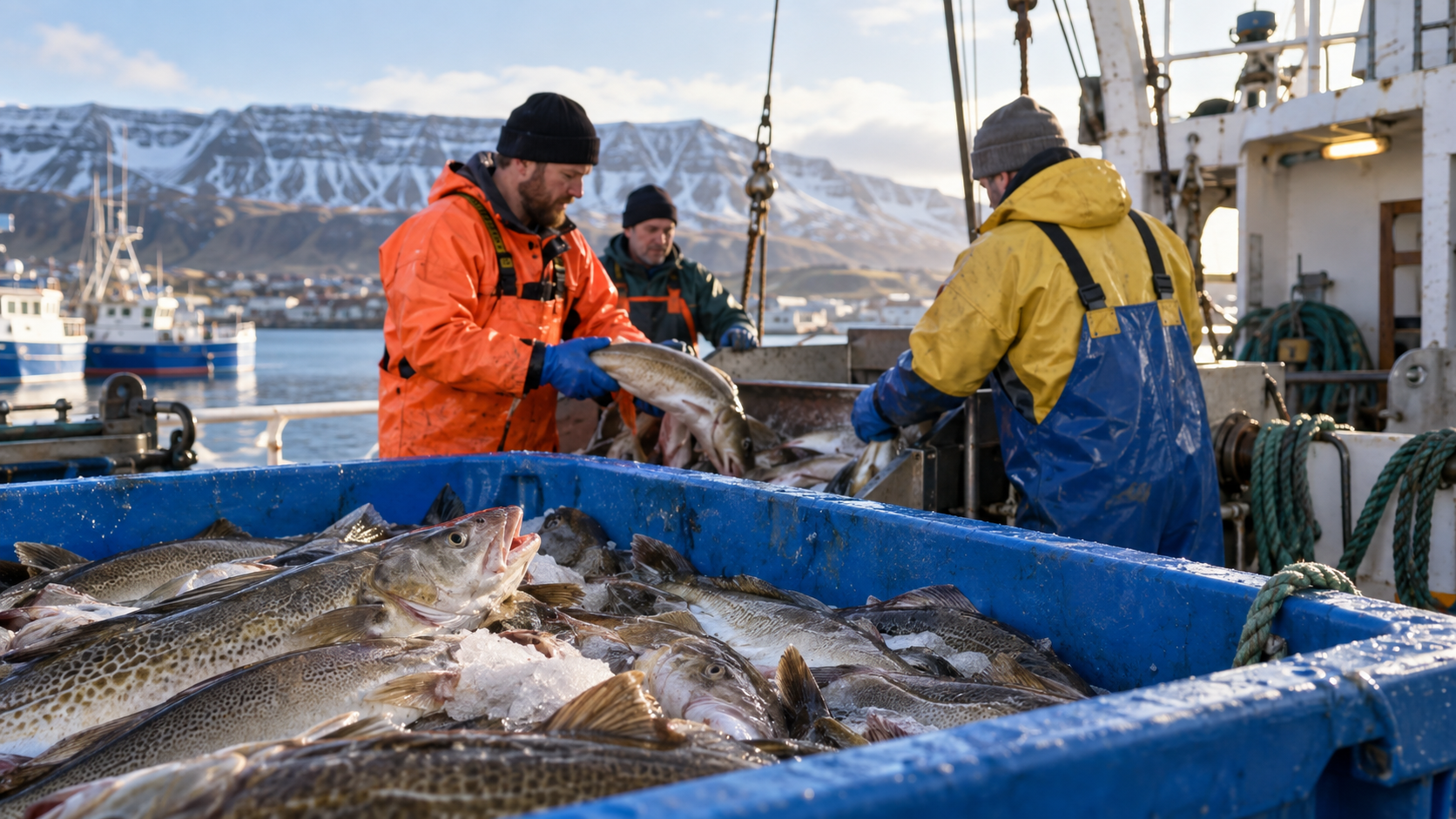
In a country where the sea writes the rules, Iceland’s fishing industry is both its crown jewel and its battleground. For over 700 years, cod has been Iceland’s lifeblood fueling wars, shaping politics, and minting fortunes. Today, it powers nearly half of Iceland’s exports, yet remains a lightning rod for controversy. This is the story of how a small island nation turned ocean wealth into national sovereignty and then into private hands.
The Cod Wars: How Iceland Fought for Its Waters
After World War II, Iceland was one of Europe’s poorest nations but it sat on a gold mine: some of the richest cod fisheries in the world. The UK had fished these waters for generations, hauling in millions of tons annually. Iceland wanted control. In a series of confrontations known as the “Cod Wars,” Iceland expanded its territorial waters from 4 to 12 nautical miles in 1958, then pushed further to 50 nm in 1972, and finally to 200 nm by 1975. Each move sparked violent clashes with British trawlers and Royal Navy escorts. But Iceland held firm. By 1976, the UK conceded. The victory reshaped the global order: the 200-nm Exclusive Economic Zone became international law under UNCLOS in 1982. Overnight, Iceland transformed from a dependent backwater into a maritime power with exclusive rights to its fish.
The Quota System: Turning Fish Into Capital
Securing the waters was only the first battle. Managing them was the next. By the 1980s, overfishing threatened stocks. Iceland responded with a radical solution: privatize the commons. It introduced Individual Transferable Quotas (ITQs), giving fishermen shares of the annual Total Allowable Catch (TAC) based on historical catch data. Those who fished more in the 1980s got bigger slices. Quotas could be bought, sold, or leased creating a market for fish.
The result? A new aristocracy emerged: the “cod kings” (kvótakóngar). A handful of companies amassed 75% of all quotas. Some didn’t even fish they rented their rights to smaller operators, collecting rent without casting a net. Efficiency soared. Waste dropped. Profit margins hit 25%. But equity plummeted. Small boats were squeezed out. Coastal towns emptied. Fishing, once a birthright, became an asset class.
Global Model, Local Storm
Iceland’s ITQ system is now a benchmark praised for sustainability, condemned for inequality. Unlike the EU’s state-managed Common Fisheries Policy or Norway’s community-focused approach, Iceland fully embraced market logic. The outcome: healthier stocks, fewer enforcement costs, and a high-tech, high-profit fleet.
But the model isn’t exportable. European nations reject full privatization, fearing social unrest. The U.S. adopted “catch shares” cautiously, with restrictions to protect small-scale fishers. Canada, after the 1992 cod collapse, moved slowly prioritizing indigenous rights and local access. Iceland stands alone: a free-market experiment in marine capitalism.
Political Firestorm: Who Owns the Ocean?
Fisheries dominate Icelandic politics like few issues elsewhere. The quota system is legally bulletproof upheld by courts after fierce challenges but politically explosive. Leftists call it feudalism. Populists decry rent-seeking barons. Even mainstream parties tweak fees and carve out “community quotas” to soothe anger.
A 2009 reform attempt backed by public fury after the financial crash sought to reclaim and re-auction quotas. It failed amid fierce opposition from industry and conservatives. Today, the debate rages: Is fishing a public trust or a private asset? Should Iceland tax windfall profits? Can the system evolve without collapsing?
Foreign Hands Off Our Fish
No foreigner can own an Icelandic fishing company. Law bars non-citizens from holding quotas, capping foreign ownership at 25%. The rationale? National sovereignty. After fighting off the UK, Iceland refuses to let outsiders profit from its seas. Even EEA investors face limits.
This wall has cracks. Companies have tried loopholes using proxies, splitting ownership. Regulators squash them fast. When Samherji, Iceland’s largest fishing firm, faced scandal in Namibia, the backlash wasn’t just about bribes it was about image. Iceland prides itself on clean governance. The episode forced a reckoning: if our companies act like oligarchs abroad, what does that say about us?
Scandal in Africa: The Fall of Samherji
Samherji’s downfall began in Namibia. In the 2010s, it secured lucrative horse mackerel quotas through murky deals. Leaked documents revealed $6.9 million in alleged bribes to Namibian officials. Whistleblowers surfaced. Samherji’s CEO stepped down. The company denied wrongdoing, blaming a rogue manager but the damage was done.
Worse still, Samherji retaliated against journalists. Private investigators, smear videos, intimidation tactics all aimed at silencing critics. Public outrage exploded. Trust in the industry cratered. Calls grew to revoke Samherji’s quotas at home. Though no action followed, the scandal exposed a darker side of Iceland’s fishing elite: powerful, insulated, and willing to bend rules.
Climate Change: The Next Frontline
The sea is shifting. Warming waters are pushing cod northward. Mackerel, once rare, floods in. Capelin collapses. Iceland’s quota system, built on stable ecosystems, must adapt. Scientists track species migration. Negotiations loom with neighbors over new stock splits.
Meanwhile, aquaculture booms. Salmon farming, once unthinkable, now rivals wild catch in value. Iceland balances growth with caution strict regulations, experiments with land-based farms. But tensions rise between wild and farmed sectors. Traditional fishermen fear disease, pollution, and competition for space.
Tech Takes the Helm
Iceland’s fleet leads the tech race. AI predicts fish hotspots. Robots gut, fillet, and pack. Vessels optimize fuel use via real-time sonar. Traceability systems track each fish from net to plate – building premium brand equity.
Full utilization drives innovation: fish skin becomes leather, enzymes feed cosmetics, peptides become supplements. Iceland aims for 100% fish use extracting maximum value from every kilogram caught. Aquaculture follows suit, with geothermal-powered salmon farms and experimental cod tanks. The future is digital, automated, and hyper-efficient.
Conclusion: Will Iceland Hold Its Edge?
Iceland’s fishing empire faces a paradox: success breeds fragility. Its market-driven model thrives on efficiency but strains social cohesion. Climate change demands flexibility. Technology offers solutions but disrupts tradition. And scandals like Fishrot remind that unchecked power corrodes trust.
The stakes? Nothing less than Iceland’s identity. Fishing built this nation. Can it sustain it fairly, wisely, and without repeating the mistakes of the past? The answer will define not just an industry, but a country.
Read our full Report Disclaimer.
Report Disclaimer
This report is provided for informational purposes only and does not constitute financial, legal, or investment advice. The views expressed are those of Bretalon Ltd and are based on information believed to be reliable at the time of publication. Past performance is not indicative of future results. Recipients should conduct their own due diligence before making any decisions based on this material. For full terms, see our Report Disclaimer.