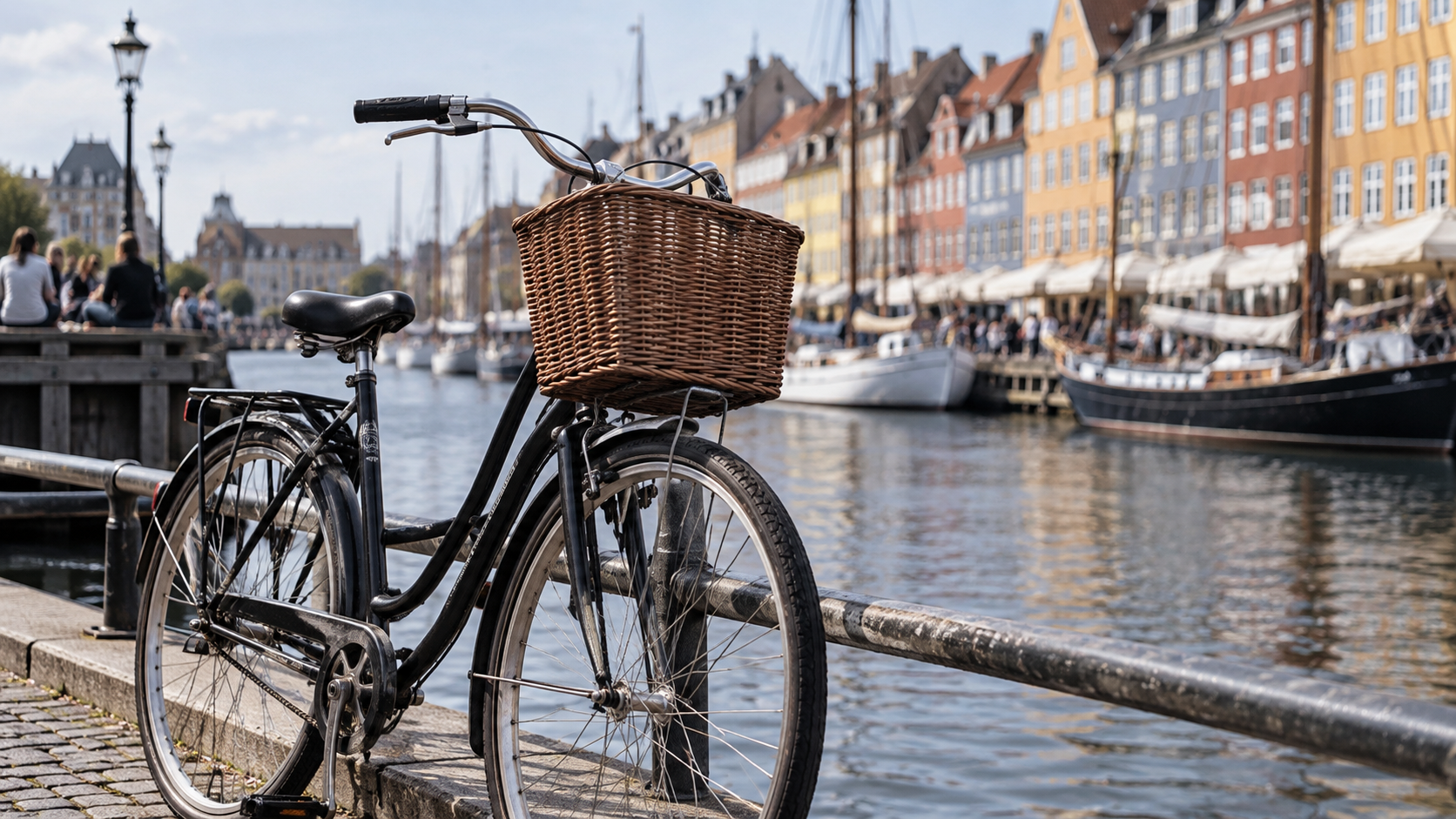
COPENHAGEN – At first blush, the Kingdom of Denmark presents a curious economic paradox. Imagine a nation that decided to build a world-beating luxury car, but with a small engine, a sky-high price tag, and a design that prioritizes fuel efficiency and safety over raw speed. It shouldn’t work. Yet, Denmark has built one of the world’s most prosperous societies on a similar premise: punishingly high taxes, a modest industrial footprint, and a workforce that values leisure as much as labour.
This is a country with no mountains of iron ore, no Silicon Valley, and a 25% sales tax that makes every purchase a serious consideration. Nearly half of its economic output is vacuumed up by the state. Still, its companies are global titans, its citizens are wealthy and content, and its economy hums with a quiet, stubborn resilience.¹ While other developed nations wrestle with the specter of debt and social division, the Danes just keep cycling to the bank. How did this little Nordic kingdom turn fiscal water into wine?
The answer is a kind of modern alchemy, a formula that transmutes high taxes not into leaden bureaucracy, but into societal gold. It’s a story of radical trust, clever design, and a cultural bedrock that sees the state not as an adversary, but as a co-op.
From Poorhouse to Powerhouse
It’s easy to forget that for much of its history, Denmark was the poor cousin of Scandinavia. An agrarian society of farmers and fishermen, it watched from the sidelines as Germany and Britain fired the forges of the Industrial Revolution. But the ashes of World War II, which left Denmark’s infrastructure mercifully intact, provided a pivotal moment. The choice was stark: remain a quaint but unproductive agricultural backwater, or engineer a new kind of modern economy.
Denmark chose the latter, but with a twist. Instead of simply mimicking the industrial giants, it embraced what is now known as the Nordic model – a potent cocktail of free-market capitalism and an all-encompassing welfare state. The secret, however, isn’t just the ingredients, but the recipe.
At the heart of this recipe is a unique concept known as “flexicurity.” It’s a portmanteau that sounds like a corporate buzzword but is, in reality, a grand social bargain. To understand it, consider a hypothetical Dane named Lars, a skilled technician at a manufacturing firm. When a market shift makes his role redundant, his company can let him go with minimal fuss or cost – that’s the “flexibility” that keeps businesses nimble and competitive.
But Lars doesn’t spiral into ruin. The “security” part kicks in immediately. He receives up to 90% of his previous salary for two years, not as a handout, but as a bridge. This isn’t just unemployment benefit; it’s an active reinvestment. Lars is enrolled in state-funded retraining programs, sharpening his skills for the industries of tomorrow. This system keeps unemployment incredibly low (under 5%) and encourages a dynamic labour market where changing jobs is seen as normal, not catastrophic.
The Smart-Tax Illusion
The fuel for this engine, of course, is taxes. The Danish approach, however, is more scalpel than sledgehammer. While personal income and consumption taxes are dizzyingly high, the government is surprisingly gentle on the creators of wealth. Corporate taxes are a competitive 22%, lower than in many other developed economies. This encourages companies not just to stay, but to reinvest their profits back into the economy.
This creates a high-trust loop. Citizens pay their taxes without revolt because they see, feel, and use the returns every day: free universities that continuously upskill the population, universal healthcare that is viewed as an economic asset (healthy workers are productive workers), and famously, a cycling infrastructure that saves billions in healthcare costs and lost productivity. This communal ethos has a name: samfundssind, a sense of civic duty and shared responsibility that was a national rallying cry long before the recent pandemic.² It’s the cultural software that runs the economic hardware.
Giants from a Small Kingdom
This carefully cultivated ecosystem has produced corporate giants that punch absurdly above their weight. Think of Maersk, the shipping behemoth whose vessels move a staggering 14% of global trade, its blue-and-white stars a symbol of Danish dominance on the high seas.³ Or consider Vestas, a company that began by making farm equipment and, thanks to an early an audacious bet on renewable energy, became a world leader in wind turbine technology.⁴ Today, wind power, once a fringe idea, generates half of Denmark’s electricity.
And then there is the titan, Novo Nordisk. Born from a love story and a quest to bring life-saving insulin to Denmark a century ago, it now controls a third of the global diabetes market and, with its new generation of weight-loss drugs, has become the most valuable company in Europe. Its market capitalization now frequently eclipses Denmark’s own GDP – a sign of how a small nation can dominate a global industry through focused, long-term investment in research and people.
Can the Miracle Last?
No paradise is without its serpents. Denmark faces the same demographic winter as much of Europe, with a graying population putting pressure on its generous pension and healthcare systems. The very success of its welfare state also creates a magnetic pull for immigrants, and tensions exist around integrating lower-skilled newcomers into a high-skilled economy. As an export-driven nation, it is also perpetually exposed to the chilling winds of global trade disputes.
Yet, Denmark’s greatest strength may be its ability to adapt. The retirement age is rising, public services are being relentlessly digitized, and the country is investing heavily in automation and AI.
Could another country simply copy the Danish blueprint? Unlikely. Denmark’s success is a product of its unique size, its homogenous and high-trust society, and decades of patient, consensus-driven reform. But the lessons it offers are universal: invest in your people, tax consumption more than creation, and build a system that balances corporate dynamism with human dignity.
Denmark proves that a society can choose to be both wealthy and well, competitive and compassionate. It’s a quiet, ongoing miracle built not on dogma, but on design.
Read our full Report Disclaimer.
Report Disclaimer
This report is provided for informational purposes only and does not constitute financial, legal, or investment advice. The views expressed are those of Bretalon Ltd and are based on information believed to be reliable at the time of publication. Past performance is not indicative of future results. Recipients should conduct their own due diligence before making any decisions based on this material. For full terms, see our Report Disclaimer.