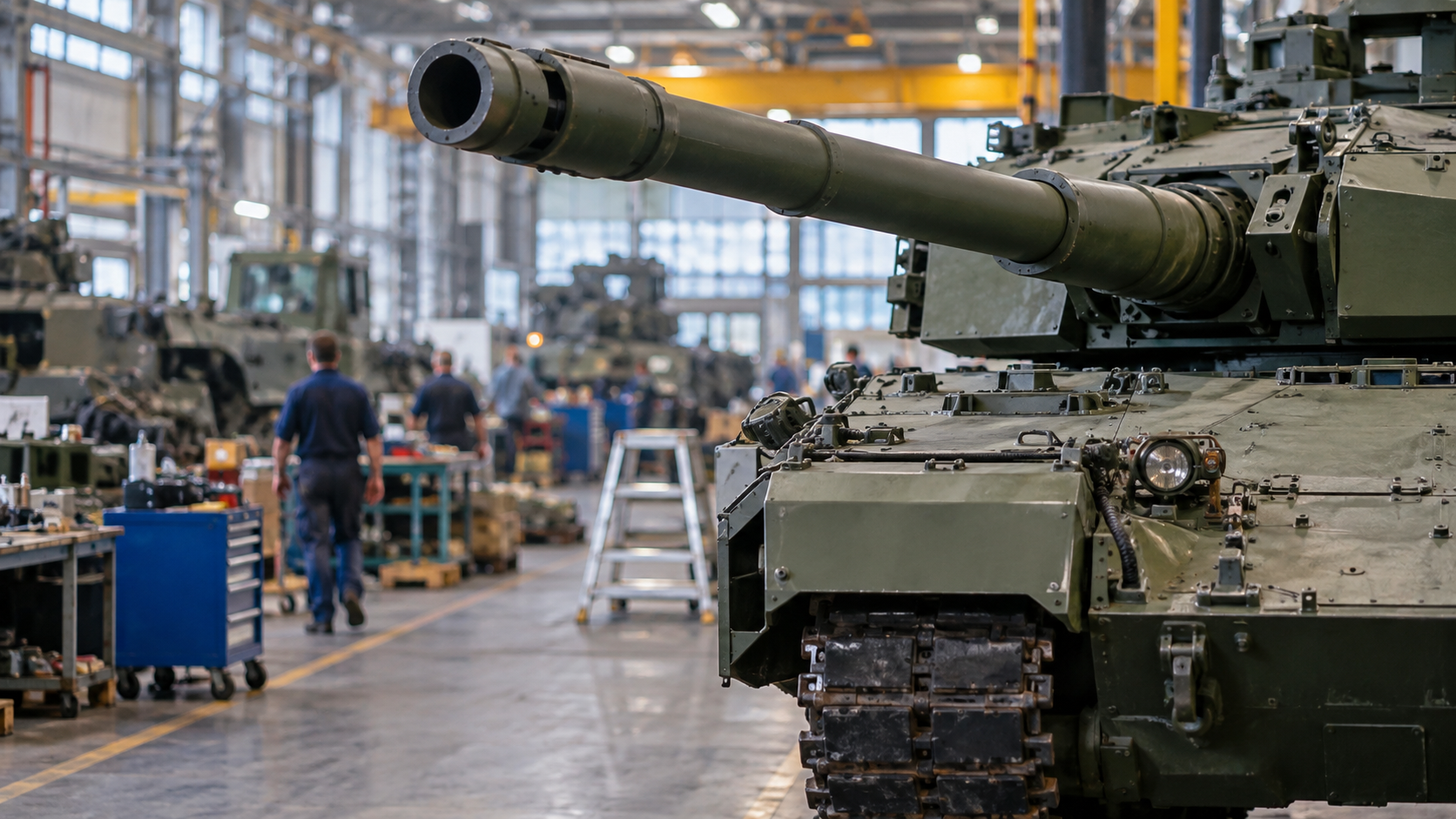
If you listened closely to the wind blowing through The Hague this morning, you could hear the distinct sound of a door slamming shut. It wasn’t just the heavy oak doors of the World Forum where the “Readiness 2030” initiative was ratified; it was the door closing on the post-1945 European social contract.
For eighty years, Europe has existed in a state of suspended reality – a geopolitical “Goldilocks zone” where the American security umbrella allowed nations to spend minimal amounts on defense and maximum amounts on the good life. We built the world’s most generous welfare states, funded by a “peace dividend” we assumed was permanent.
As of this morning, with the ink drying on a mandate forcing EU members to hit a defense spending floor of 3.5% to 4.0% of GDP, that dividend has been cancelled. In its place, we have a bill for €400 billion. And the only way to pay it is to dismantle the very society we are trying to defend.
The Arithmetic of Austerity
To understand why this is a demolition event rather than a strategic pivot, you have to look at the math. It is brutal, unyielding, and terrifyingly simple.
In 2024, European NATO members spent roughly 2% of their combined GDP on defense. Jumping to 3.5% or 4.0% by 2030 isn’t just a budget adjustment; it requires finding an additional €350 to €400 billion every single year.
In a robust economy, you might fund this through growth. But the Eurozone of late 2025 is stagnant, projecting a meager 1.1% growth. You might try to borrow it, but the era of free money is over; inflation remains sticky, and interest rates are punishing.
This leaves only one option: Cannibalization. To buy the “Guns” (artillery, drone swarms, missile shields), Europe must liquidate the “Butter” (pensions, green subsidies, healthcare).
Germany: Burning the Future to Secure the Present
Nowhere is this tragedy more Shakespearean than in Germany. For years, Berlin has touted its Klimatransformationsfonds (KTF), a massive fund dedicated to the green energy transition, as the engine of its future economy.
Under the pressure of “Readiness 2030,” that engine is being stripped for parts.
With the constitutional “debt brake” (Schuldenbremse) still limiting new borrowing, the coalition government has essentially been forced to raid the KTF to fund the Bundeswehr. Revenues from carbon pricing, originally destined for battery gigafactories and heat pump subsidies, are being diverted to a “Dual-Use Infrastructure Fund.”
The irony is palpable. Germany is de-industrializing its civilian future to secure its military present. The Mittelstand, the small and medium enterprises that form the backbone of the German economy, are being left exposed to high energy prices, their subsidies vanished, all to pay for tank battalions that won’t be operational for another three years.
France: The End of the “Sovereign Put”
If Germany is facing an industrial crisis, France is facing a solvency crisis. The French social model is the most expensive in the Eurozone, with public spending historically topping 57% of GDP.
You cannot add a massive military surge to that structure without something breaking. That “something” is the bond market.
For a decade, the European Central Bank (ECB) acted as a fire suppressant, buying up sovereign debt to keep borrowing costs low. But with inflation still hovering above 2.5%, the ECB’s hands are tied. They cannot print money to fund French deficits without violating their mandate.
The market knows this. The “Bond Vigilantes”, traders who punish fiscally irresponsible governments, have returned from their long slumber. They are shorting French bonds (OATs), driving up the borrowing costs relative to Germany. The spread (the difference in yield) has widened to dangerous levels.
To stop the bleeding, Paris is floating the unthinkable: a “Social Solidarity Freeze.” This bureaucratic euphemism means de-indexing pensions from inflation and capping healthcare reimbursements. In a country where the retirement age is a blood sport, this is political suicide. But the alternative is a sovereign debt crisis that makes the 2011 Greek meltdown look like a rounding error.
The Street Level: Farmers vs. Drones
This is not just a story of high finance; it is a story of imminent social violence. The “Readiness 2030” plan is a wealth transfer mechanism. It takes money from the civilian population and hands it to the defense industry.
The first casualties are already visible. To scrape together €1 billion for immediate ammunition procurement, governments are accelerating the phase-out of agricultural diesel subsidies.
We are seeing the return of the “Tractor Sieges” in Paris and Berlin. But unlike the protests of 2024, the governments cannot back down. The money is legally ring-fenced for defense. This sets up a zero-sum conflict: every euro spent on a drone is a euro taken from a farmer’s fuel tank or a grandmother’s heating bill.
The populist right, the AfD in Germany, the Rassemblement National in France, is already weaponizing this. Their new narrative is lethal in its simplicity: “Globalist War-Mongering paid for by your pension.” It reframes the 2027 elections not as a culture war, but as a referendum on NATO membership itself.
The Winter of Discontent
The “Readiness 2030” initiative is being hailed by the mainstream press as a “Hamiltonian Moment,” a bold step toward European sovereignty. This is a dangerous delusion.
Sovereignty requires economic strength, and this plan hollows out the European economy. We are entering a period of “stagflationary militarism” – high inflation driven by defense spending, combined with low growth caused by the gutting of civilian investment.
The bond markets are already pricing in the hard landing. S&P and Moody’s are sharpening their knives for credit downgrades. The Eurozone is fracturing, not uniting, as each nation scrambles to protect its own industrial base while starving its neighbors of capital.
November 23, 2025, will be remembered as the day the bill finally came due. We wanted to be a moral superpower. We wanted to be a lifestyle superpower. But we outsourced our security to Washington and our energy to Moscow, assuming the bill would never arrive.
Now, with the American retreat and the Russian threat, we are forced to become a military superpower overnight. But looking at the crumbling budgets and the angry streets, one has to wonder: By the time we have built the fortress, will there be anything left inside worth defending?
Read our full Report Disclaimer.
Report Disclaimer
This report is provided for informational purposes only and does not constitute financial, legal, or investment advice. The views expressed are those of Bretalon Ltd and are based on information believed to be reliable at the time of publication. Past performance is not indicative of future results. Recipients should conduct their own due diligence before making any decisions based on this material. For full terms, see our Report Disclaimer.