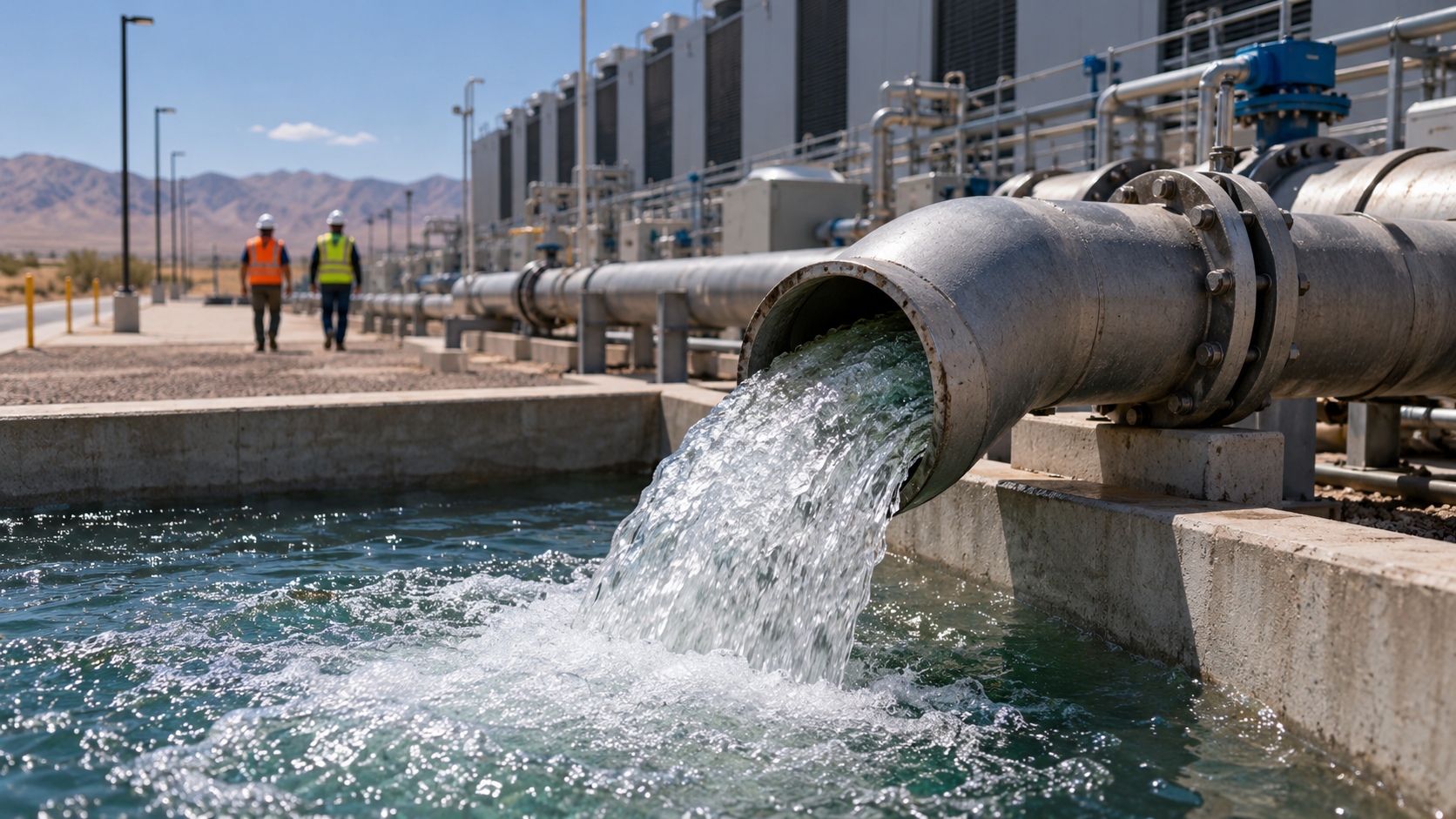
For the past decade, the global technology sector operated under a convenient delusion: that “The Cloud” was an ethereal, infinite resource decoupled from physical limits. As the sun sets on 2025, that illusion has evaporated.
The artificial intelligence infrastructure sector has slammed into a hard operational ceiling known as the “Thermodynamic Wall.” From the parched deserts of the American Southwest to the river basins of Southern England and the plateaus of Inner Mongolia, the story is the same: the convergence of blistering heat generated by next-generation silicon and a catastrophic shortage of water to cool it. The era of infinite, cheap compute has ended, replaced by a crisis of plumbing and physics that knows no borders.
The Death of Air Cooling
The catalyst for this global shift was the mass deployment of NVIDIA’s Blackwell architecture throughout 2025. For years, data centers from Frankfurt to Ashburn relied on high-velocity air, giant fans blowing over hot metal, to maintain thermal stability. That methodology is now physically obsolete.
The new B200 chips generate heat flux densities exceeding 100kW per rack. Cooling these densities with air is physically comparable to attempting to extinguish a house fire with a hair dryer; it requires wind velocities so high they create acoustic vibrations capable of destroying hard drives.
Consequently, the industry has bifurcated. New specifications effectively penalize air-cooled facilities, creating a performance delta where air-cooled chips are throttled by 11-15%. This has triggered a “CapEx Crisis” for legacy infrastructure operators worldwide. Older facilities, designed with raised floors for airflow, cannot support the crushing weight of liquid immersion tanks or the complex plumbing required for Direct-to-Chip cooling. The result is a growing inventory of “Zombie Data Centers”, electrically connected but thermally useless for modern AI workloads.
The Hidden Cost of “Thinking”
While the thermal heat is an engineering challenge, the water required to remove it has triggered a societal backlash. In 2025, the “Water Usage Effectiveness” (WUE) crisis eclipsed carbon emissions as the primary environmental constraint.
The driver is the proliferation of “Reasoning Models” (such as OpenAI’s o3 and DeepSeek-R1). Unlike their predecessors, these models do not only retrieve answers; they “think,” running internal chains of logic before responding. This extended compute time carries a terrifying hydrological cost.
Consider the math of the modern query:
- Standard Query (GPT-4o): ~5–15 mL of water. A sip.
- Reasoning Query (DeepSeek-R1): >200 mL of water. A full cup.
When scaled to 700 million daily queries, the aggregate water demand rivals the drinking needs of 1.2 million humans. This “Hydrological Shock” is draining municipal aquifers indiscriminately, rendering the “Water Positive” pledges of major technology firms effectively void as withdrawal rates spike in water-stressed regions globally.
The “Blue Bans”: A Transatlantic Revolt
The physical reality has birthed a political one. Municipalities across the Western hemisphere are no longer willing to trade potable water for property tax revenue, leading to the rise of “Blue Bans” – moratoriums on data center water withdrawals.
- Loudoun County, Virginia (USA): The traditional epicenter of the global internet effectively froze development in March 2025. New zoning amendments eliminated “by-right” development, stranding 40 projects. The local aquifers simply could not sustain the projected 63% surge in consumption.
- The Thames Valley (UK): West of London, a similar crisis has unfolded. Following the driest spring in a century, Thames Water’s financial and physical exhaustion led to strict “hosepipe bans” and a bottleneck on new connections. In Slough, a major European data hub, new facilities face a permit freeze, forcing operators to rely on logistically complex water trucking.
- Tucson, Arizona (USA): In a landmark rejection, the Tucson City Council unanimously denied “Project Blue,” a massive hyperscale facility. The decision signaled a definitive shift: in arid environments, water for citizens now takes political precedence over water for servers.
Geopolitical Divergence: State Strategy vs. Market Constraints
While Western markets deal with regulatory gridlock and “NIMBY” (Not In My Backyard) resistance, China has executed a massive state-directed infrastructure realignment. The “Eastern Data, Western Computing” initiative has successfully relocated the bulk of China’s new AI training capacity to the country’s interior provinces, such as Guizhou and Inner Mongolia.
This represents a strategic geography arbitrage. By constructing facilities in cool, mountainous regions near massive hydroelectric dams, Chinese operators utilize free-air cooling and subsidized renewable power (approx. $0.08/kWh).
A stark divergence has emerged: While Western operators build in demand-heavy but resource-poor hubs, battling for water rights, Chinese infrastructure is being optimized by state fiat to lower the “Total Cost of Compute.” This infrastructure efficiency is rapidly becoming a counterweight to US export controls on silicon, allowing Chinese labs to maintain competitiveness through sheer thermodynamic efficiency.
The New Financial Reality
Financial markets are ruthlessly repricing the sector based on this new paradigm. The metric for valuation has decoupled from square footage and re-anchored to secured water rights.
A “Brown Discount” is now applied to legacy Real Estate Investment Trusts (REITs) holding air-cooled assets in drought-prone zones. Conversely, entities holding senior water rights in basins like the Colorado River are seeing asset appreciation, with rights trading at record highs ($52,000 per acre-foot). The market winners of the next decade will not necessarily be the firms with the most advanced algorithms, but those with the most robust plumbing and secure resource access.
Conclusion
The “Thermodynamic Wall of 2025” has reshaped the digital landscape. The industry has moved from a land-grab to a resource-siege. As 2026 approaches, the sector faces a forced migration – a shift away from parched traditional hubs toward water-rich regions like the Canadian border, the US Midwest, and the Nordics.
The cloud is no longer floating above the world. It is grounded, heavy, and incredibly thirsty. And irrespective of the country, it now has to wait in line for a drink.
Read our full Report Disclaimer.
Report Disclaimer
This report is provided for informational purposes only and does not constitute financial, legal, or investment advice. The views expressed are those of Bretalon Ltd and are based on information believed to be reliable at the time of publication. Past performance is not indicative of future results. Recipients should conduct their own due diligence before making any decisions based on this material. For full terms, see our Report Disclaimer.