
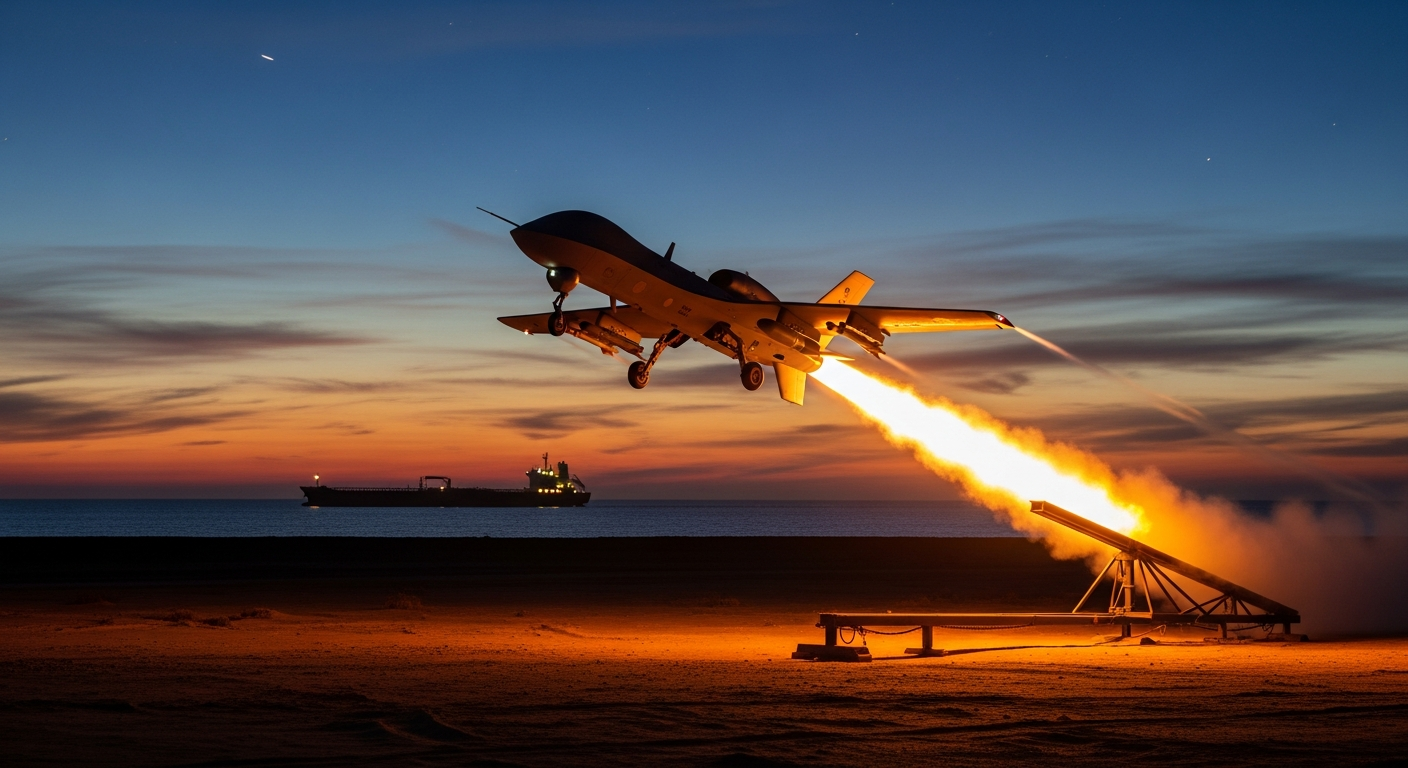
In the first seventy-two hours of Operation Epic Fury, Gulf states spent an estimated $3 to $5 billion intercepting Iranian missiles and drones. The UAE alone burned through $1.3 to $2.6 billion in interceptor missiles defending against 152 ballistic missiles and 506 drones. Iran’s total expenditure on the entire strike package — 388 ballistic missiles and 689 Shaheds — was somewhere between $194 and $391 million. One analyst described the calculus as “using Ferraris to intercept e-bikes.” Every $35,000 Shahed that Gulf air defences engaged with a $4 million Patriot PAC-3 MSE round represented a 114-to-one cost disadvantage that is, by any rational strategic assessment, unsustainable. The solution to this asymmetry is not being developed in American defence laboratories or European think tanks. It is being forged, under fire, in Ukraine.
The Mathematics of Bankruptcy
The Patriot PAC-3 MSE — the Western world’s primary counter to ballistic missile and drone threats — costs $5.17 million per round at domestic procurement prices. For Gulf export customers, that figure climbs to approximately $12 million per missile, as demonstrated by the $9 billion Saudi Arabian acquisition of 730 rounds approved in February 2026. Standard engagement doctrine requires two interceptors per incoming ballistic missile, doubling the effective cost per engagement. Lockheed Martin delivered a record 620 PAC-3 MSEs in 2025 and has signed a landmark framework agreement to ramp production to 2,000 units per year by 2030 — but at current rates, rebuilding 800 expended interceptors would take over fifteen months.
The stockpile crisis is immediate. The Heritage Foundation assessed in January 2026 that high-end interceptors — SM-3, SM-6, PAC-3 MSE, THAAD — “would likely be exhausted within days of sustained combat.” The U.S. inventory of THAAD missiles stood at 434; SM-3 stocks at approximately 414. Gulf state inventories were critically thin: the UAE held fewer than 1,000 interceptors total, Kuwait approximately 500, Bahrain fewer than 100. Fabian Hoffmann of the University of Oslo warned that Gulf stocks “could run out very soon. No more than another week, probably a couple of days at most.” The Trump administration has been reportedly stonewalling Gulf requests to replenish supplies, while analysts in Beijing note with interest that American missile stocks are draining over Iran at the very moment Pacific deterrence requires them most.
The tactical trigger point came on February 28, 2026, when an Iranian Shahed drone struck the U.S. Navy Fifth Fleet headquarters in Manama, Bahrain, destroying two AN/GSC-52B satellite communication terminals — roughly $20 million worth of equipment per radome — with a weapon that cost $35,000 to produce. Satellite imagery published by the New York Times showed half of a warehouse complex destroyed. Bahrain’s defences had intercepted 9 drones and 45 missiles that night, but some penetrated. The Shahed’s ocean-skimming flight profile, its honeycomb radar-absorbing structure, and the sheer volume of Iran’s concurrent salvoes overwhelmed conventional detection and engagement sequences. The attack on the Fifth Fleet’s nerve centre demonstrated that the existing air defence paradigm — high-end interceptors against mass-produced threats — is not merely expensive. It is failing.
Ukraine’s Counter-Drone Arsenal
The world’s only operational, combat-proven counter-drone ecosystem was not designed in a procurement boardroom. It was improvised under nightly bombardment by a nation that absorbed 54,500 Shahed-type drones in the 2025 calendar year alone — some nights 400 to 500 in a single wave. Ukraine’s response has been to build, from scratch, a layered drone-on-drone interception capability that now accounts for one in every three Russian aerial targets destroyed, with interceptor drones handling over 70% of Shahed kills in the Kyiv defensive zone during February 2026. Commander-in-Chief Oleksandr Syrskyi reported 6,300 interceptor sorties in February, destroying more than 1,500 Russian UAVs of various types. Colonel Yuriy Cherevashenko, the Ukrainian Air Force’s deputy commander, stated plainly: “We are the first in the world to have a system of destroying drones with drones.”
A dozen Ukrainian companies now produce kinetic interceptors at costs ranging from $2,100 to $15,000 per unit — a fraction of even the cheapest guided missile. The most prolific is the Merops system, also known as Project Eagle, developed by Swift Beat with funding from former Google CEO Eric Schmidt. Its Surveyor interceptor flies at 282 km/h, destroys targets via direct collision or proximity detonation, and costs approximately $15,000 per round. As of November 2025, Merops had downed over 1,900 Shaheds and accounted for roughly 40% of all confirmed Shahed kills, according to U.S. Army Brigadier General Curtis King. A crew of four can be trained in two weeks. Poland and Romania have already received Merops systems, with NATO training underway at a military centre in Poland and Denmark seeking acquisition.
At the lower end of the cost spectrum, Wild Hornets’ Sting interceptor achieves 343 km/h in a 3D-printed, bullet-shaped airframe equipped with Kurbas thermal imaging cameras and AI-based target guidance. It costs $2,100. By October 2025, Sting drones had destroyed over 1,000 enemy UAVs, and on November 30, 2025, achieved a historic first: downing a jet-powered Geran-3 — Russia’s next-generation Shahed variant that cruises at 550 km/h. General Cherry, also known as General Chereshnya, unveiled its Bullet interceptor at the UMEX 2026 exhibition in Abu Dhabi, reaching 310 km/h in burst mode with a tactical range of 17 to 20 kilometres and a price tag of $2,100. Delegations from India, the UAE, and Egypt expressed specific interest. Alongside them at UMEX were SEEDIS (320 km/h, fully autonomous targeting without GPS or radio dependency), Piranha Tech’s Riki (340 km/h, torpedo-shaped, altitude ceiling of 6,000 metres), and the Bagnet system — a Ukrainian-French partnership between Tenebris and Alta Ares that operates entirely autonomously using optical sensors and onboard machine vision in contested electronic warfare environments, with French production localisation planned for Q1 2026.
The most sophisticated platform in this ecosystem is the Magura V7 naval drone, now being integrated with Red Cat Holdings’ Bullfrog autonomous turret — an AI-driven weapons platform supporting M240, M2, and M134 machine guns with an effective range of 800 metres. The Magura V7 itself has an 800-nautical-mile range, can carry paired surface-to-air missile launchers (AIM-9 Sidewinders have been used operationally), and holds the distinction of being the first naval unmanned system to destroy two Mi-8 helicopters and two Su-30 fighter aircraft. It represents the convergence of autonomous naval defence and anti-drone warfare in a single platform.
The Gulf Pivot
The diplomatic manoeuvring has been swift. On March 2, 2026, Ukrainian President Volodymyr Zelenskyy spoke directly with UAE President Mohamed bin Zayed and Qatar’s Sheikh Tamim bin Hamad Al Thani, as well as the leaders of Jordan and Bahrain. His proposal was characteristically blunt: “Let’s speak about weapons that we’re short of: PAC-3 missiles — if they give them to us, we will give them interceptors. This is a fair exchange.” The logic is elegant. Gulf states receive battle-tested counter-drone systems at a fraction of the cost of conventional interceptors. Ukraine receives high-end missiles it desperately needs against Russian ballistic and cruise missile threats. The global PAC-3 stockpile is preserved for the scenarios where it is actually needed — advanced ballistic targets that a $2,100 interceptor drone cannot reach.
The Financial Times reported that the Pentagon and at least one Persian Gulf government are in active negotiations to purchase Ukrainian interceptor drones. Separately, the Pentagon’s $1.1 billion “Drone Dominance” programme has invited two Ukrainian manufacturers to participate, while a five-year framework deal for millions of Ukrainian drones is in advanced talks. The United Kingdom signed a licence agreement in November 2025 for mass production of Octopus-100 interceptors — the first serial production of a Ukrainian combat drone within a NATO country, with a target of 2,000 units per month. Ukrainian officials estimate that 2026 defence exports could reach “several billion dollars,” with weapons export centres planned across ten European countries and drone production facilities opening in Germany.
At the Munich Security Conference, Zelenskyy framed the proposition in terms that resonated far beyond the Gulf: “Our wall of drones is your wall of drones.” Danish Prime Minister Mette Frederiksen was equally direct: “The only expert right now in the world when it comes to anti-drone capacities is Ukraine.” The endorsements are not diplomatic courtesy. They reflect a practical reality that no amount of Western defence procurement can replicate — three years of continuous, high-intensity counter-drone combat experience against the most sustained aerial bombardment campaign since the Second World War.
The Evolving Threat
The challenge is not static. Russia has introduced the Geran-3, a jet-powered evolution of the Shahed platform that cruises at 550 to 600 km/h — roughly double the speed of the fastest current interceptors — with attack dive speeds reaching 700 km/h and an operational range of 2,500 kilometres. More concerning still is the Geran-5, first deployed in combat in January 2026, based on the Iranian Karrar airframe with extensive Russian localisation. At 850 kilograms with a 90-kilogram warhead and cruising at 450 to 600 km/h, it represents what analysts describe as “a comprehensive solution engineered to overcome the most advanced air defence and electronic warfare systems.” It is being adapted for air launch from crewed aircraft, which would extend its effective range and dramatically increase attack unpredictability. Russian production targets for 2025 stood at approximately 79,000 Shahed-type UAVs.
Ukrainian interceptor developers are responding. The Sting’s November 2025 kill of a Geran-3 proved the intercept is physically possible, even at a significant speed deficit. Autonomous guidance systems — computer vision, thermal imaging, machine learning-based target recognition — are narrowing the engagement window requirements. SEEDIS and Bagnet operate without GPS or radio links, making them resistant to the electronic warfare countermeasures that Russia has deployed against earlier-generation interceptors. The race is between the drone swarm’s speed and volume and the interceptor ecosystem’s autonomy and affordability.
Strategic Implications
The broader strategic logic is inescapable. The March 2, 2026, friendly fire incident — in which a Kuwaiti F/A-18 Hornet shot down three American F-15E Strike Eagles during anti-drone operations, with all six aircrew ejecting safely — illustrated the lethal complexity of manned-aircraft counter-drone patrols. The battlespace becomes too fast, too saturated, and too ambiguous for human-piloted platforms performing air policing against swarm-scale threats. Autonomous drone-on-drone interception is not merely cheaper. It removes the human pilot from the most dangerous and cognitively overwhelming engagement envelope.
For NATO, the implications are structural. The Hedgehog 2025 exercise saw ten Ukrainian drone operators effectively eliminate two NATO battalions in half a day, mock-destroying 17 armoured vehicles and striking 30 additional targets. NATO’s UNITE-Brave joint initiative with Ukraine has committed an initial 10 million euros, scalable to 50 million in 2026, for counter-drone technology integration. The UK’s Octopus production deal, Poland’s Merops deployment, and the Pentagon’s framework negotiations collectively signal that Ukrainian counter-drone technology is transitioning from a wartime improvisation into the foundation of Western low-tier air defence doctrine.
Ukraine produced 100,000 interceptor drones in 2025 — an eightfold increase over the prior year — and was delivering 1,500 per day by the turn of the year. This is not a nascent industry. It is an operational ecosystem refined under the most demanding conditions in modern warfare, producing systems that cost less than a single artillery shell while destroying platforms that cost less than a single interceptor missile. The Gulf states, staring at depleted stockpiles and an adversary that can produce Shaheds faster than Lockheed Martin can produce PAC-3s, have no rational alternative but to integrate this technology. The question is no longer whether Ukrainian drone interceptors will reshape global air defence. It is how quickly the procurement bureaucracies of the West can get out of the way.
Read our full Report Disclaimer.
Report Disclaimer
This report is provided for informational purposes only and does not constitute financial, legal, or investment advice. The views expressed are those of Bretalon Ltd and are based on information believed to be reliable at the time of publication. Past performance is not indicative of future results. Recipients should conduct their own due diligence before making any decisions based on this material. For full terms, see our Report Disclaimer.