
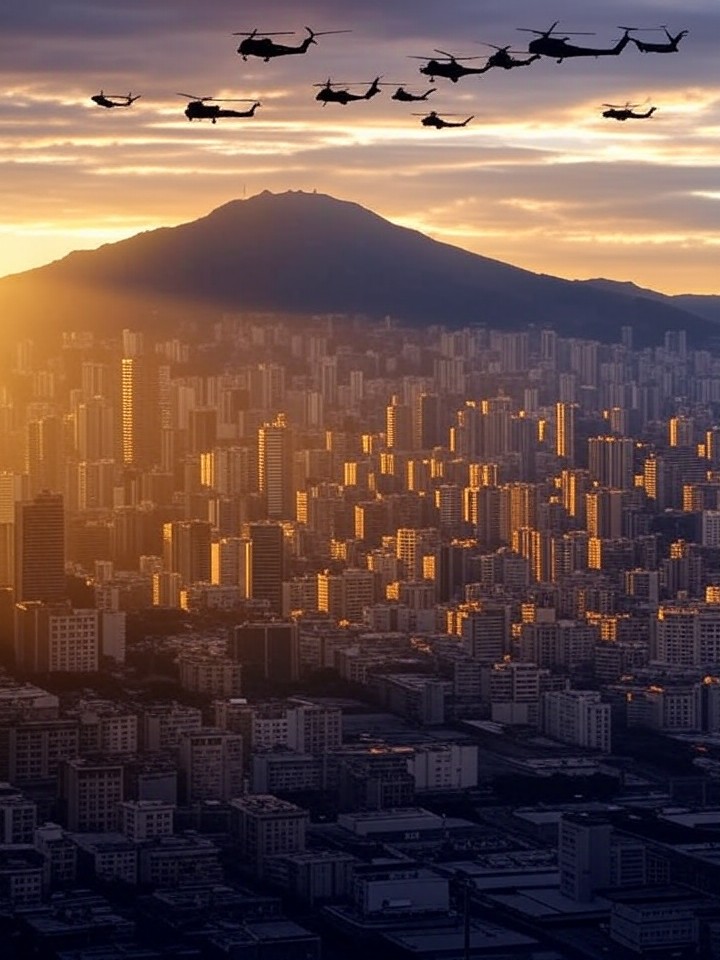
The early hours of January 3, 2026, will likely be recorded by historians as the precise moment the geopolitical tectonic plates of the Western Hemisphere shifted violently, then settled into a new, stark alignment.
For a decade, Venezuela had been a bleeding wound in the Americas – a narco-state exporting instability, refugees, and terrorism while importing the influence of America’s adversaries. That era ended in under thirty minutes.
Operation Absolute Resolve was not merely a military strike; it was a statement of intent. The capture of Nicolás Maduro and his wife, Cilia Flores, executed with surgical, almost clinical precision by U.S. special operations forces, has decapitated the “Cartel of the Suns.” But as the dust settles on the raid, a far more complex operation begins: the resurrection of a failed state into a market-oriented powerhouse.
The Thirty-Minute War
To understand the magnitude of this shift, one must appreciate the tactical perfection of the extraction. This wasn’t a bludgeoning; it was a scalpel. U.S. forces, utilizing a “full-spectrum” deployment of over 150 aircraft including F-22s and specialized stealth helicopters, neutralized Venezuelan air defenses before the regime could reach for the phone.
The details are cinematic. U.S. forces had reportedly built a full-scale replica of Maduro’s fortified residence for rehearsals, allowing teams to navigate the compound in the dark after cutting the power grid. The result? Zero U.S. fatalities and zero damage to the country’s critical oil infrastructure. By the time the sun rose, the dictator was en route to the Southern District of New York, and the “fortress” of the revolution had fallen to what ground troops called a “bum rush.”
The “Donroe Doctrine”: A New Era of Assertiveness
The justification for this intervention goes beyond law enforcement. It represents the crystallization of a new foreign policy framework: the “Donroe Doctrine.”
A modern, aggressive evolution of the Monroe Doctrine, this policy asserts that American dominance in the hemisphere is non-negotiable. The “Trump Corollary” to this doctrine identifies external adversaries, specifically the “axis” of China, Russia, and Iran, as existential threats when they gain footholds in the Americas.
By removing Maduro, Washington has effectively evicted these powers from their primary regional hub. The reaction from the neighborhood has been telling. While there were murmurs of concern regarding unilateralism, the silence was drowned out by applause from key allies. Argentina’s Javier Milei and Ecuador’s Daniel Noboa have hailed the move as a victory for stability. The message to Havana and Managua is clear: the era of permissive authoritarianism is over.
A Trillion-Dollar Phoenix: The Economic Renaissance
With the regime gone, the conversation shifts immediately to the engine of Venezuela’s future: Oil.
Venezuela sits atop 303 billion barrels of proven reserves – the largest in the world. Yet, under the mismanagement of Chavismo, production had withered to a paltry 900,000 barrels per day. The Trump administration’s plan is pragmatic and bold: get the oil flowing to pay for the rebuild.
The “oil-for-reconstruction” model posits that U.S. taxpayers will not foot the bill. Instead, U.S. energy firms will partner with a revitalized sector to repair the infrastructure. The synergy is undeniable; Venezuela’s heavy crude is chemically perfect for U.S. Gulf Coast refineries.
The Production Roadmap:
- Immediate (2026): Stabilize at 1.2–1.5 million barrels per day (bpd).
- Intermediate (2027-28): Deploy U.S. tech to hit 2 million+ bpd.
- Long-Term (2030+): Restore world-class status with 3 million+ bpd.
This is what the opposition calls a “trillion-dollar opportunity.” Wall Street agrees. Sovereign bonds, once treated as toxic waste, have surged in value, with investors betting on a “popular capitalism” that respects property rights and welcomes foreign investment.
Healing the Human Catastrophe
However, barrels of oil do not eat, and they do not heal. The true measure of this intervention’s success will be its humanitarian impact.
The humanitarian crisis under Maduro sparked the largest exodus in the region’s history, with nearly 8 million Venezuelans fleeing hunger and repression. The transition government, backed by $606 million in immediate U.S. aid, is launching a “Land of Grace” plan. The priorities are stark: food security for 5.4 million people and the revitalization of a healthcare system that had been “hollowed out” by corruption.
The strategic goal is the return of the diaspora. As security stabilizes and the economy triples, a realistic target of $400 billion GDP by 2040, the hope is that the millions of engineers, doctors, and teachers who fled will return to rebuild their homeland.
The Path to Democracy: “Justice, Not Revenge”
Politically, Venezuela is entering a delicate transition. The “dual leadership” of Nobel Peace Prize laureate María Corina Machado and President-elect Edmundo González Urrutia offers a credible path forward. Machado, providing the moral core, and González, the diplomatic bridge, are tasked with dismantling the “socialist machine” without sparking a civil war.
The U.S. has signaled it will “run” the transition temporarily to ensure stability – a controversial but perhaps necessary stance to purge the deep-rooted corruption of the Cartel of the Suns. The objective is to professionalize the military and restore the rule of law, creating an environment where a new, independent National Electoral Council (CNE) can oversee true elections in 2027.
Conclusion: The Hour of Freedom
The removal of Nicolás Maduro is a watershed moment, comparable to the most significant geopolitical shifts of the post-Cold War era. It is a high-stakes gamble that bets on the resilience of the Venezuelan people and the efficiency of American “popular capitalism.”
If successful, this intervention does more than liberate a nation; it secures the Western Hemisphere, lowers global energy costs, and proves that the slide toward authoritarianism is reversible. The road ahead is paved with challenges, from debt restructuring to social reconciliation. But for the first time in a generation, when Venezuelans look to the horizon, they see not the twilight of democracy, but the sunrise of a recovered nation.
Read our full Report Disclaimer.
Report Disclaimer
This report is provided for informational purposes only and does not constitute financial, legal, or investment advice. The views expressed are those of Bretalon Ltd and are based on information believed to be reliable at the time of publication. Past performance is not indicative of future results. Recipients should conduct their own due diligence before making any decisions based on this material. For full terms, see our Report Disclaimer.