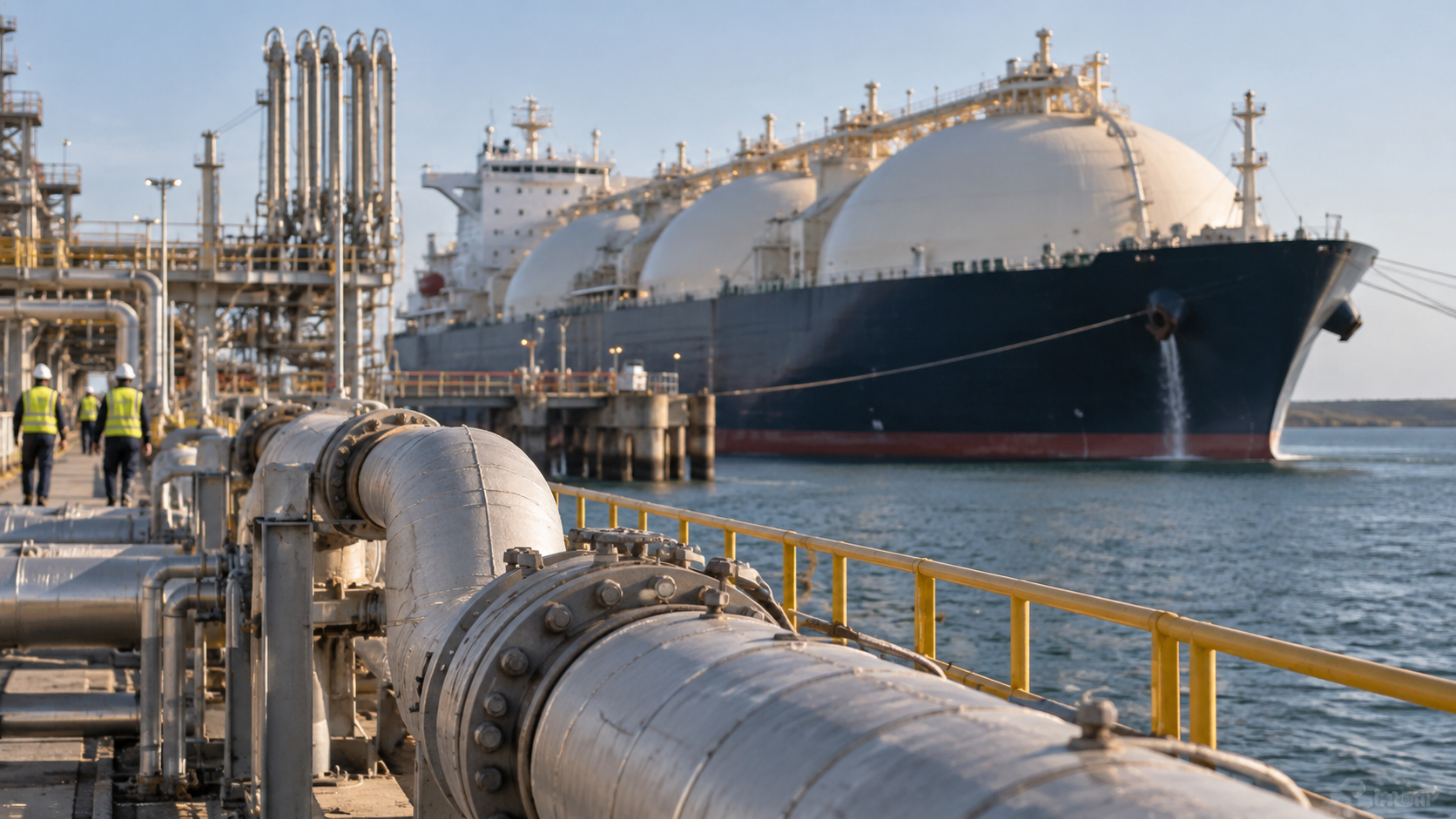
On 22 April 2026, the first cargo of liquefied natural gas sailed out of the Golden Pass terminal at Sabine Pass, Texas. It was the ninth American LNG export facility to commission a commercial vessel, the third to enter service inside twelve months, and the first to ship under the joint ownership of QatarEnergy, holding 70 percent of the equity, and ExxonMobil with the remaining 30 percent. The poetry of the configuration is difficult to ignore. Doha, the world’s incumbent LNG superpower, is now the largest single shareholder in American supercooler capacity, just as American supercoolers are about to become the marginal price-setter against Doha’s own. The structural change has been visible in the trade press for two years. The marker that landed in Sabine Pass that morning made it operational.
Approximately 225 million tonnes per annum of LNG liquefaction capacity is under construction globally, with the Institute for Energy Economics and Financial Analysis modelling 57 Mtpa of incremental supply hitting the market in 2026 alone, the largest single year ever recorded, followed by a further 44 Mtpa in 2027 and 43 Mtpa in 2028. Global nameplate capacity will reach roughly 666 Mtpa by the end of 2028, against 2025 baseline output near 410 Mtpa. The International Energy Agency’s first-quarter 2026 Gas Market Report describes the supply growth as the fastest since 2019, with European LNG imports expected to set a new all-time high. The wave is not contested. The relevant questions concern timing, distribution and the political economy of who pays for it.
The Doha Detour. The narrative ran into an inconvenient March. At 02:30 local time on 19 March 2026, Iranian ballistic missiles struck Train 7 and one further train at the Ras Laffan complex, alongside one of two gas-to-liquids units. Approximately 12.8 Mtpa of Qatari LNG capacity, roughly 17 percent of Doha’s nameplate output, was sidelined for an estimated three to five years. QatarEnergy filed force majeure notices on long-term contracts to Italy, Belgium, Korea and China within the week. Saad al-Kaabi, the company’s chief executive, briefed publicly that oversupply through 2030 would now be replaced by a “shortage” beyond, driven by artificial intelligence and data-centre baseload. Morgan Stanley quietly recalibrated its 2026 oversupply call to near zero. The Ras Laffan strike has not cancelled the wave. It has deferred it by twelve to eighteen months, and it has materially shifted the leverage between Qatar and the American Gulf Coast, in favour of the latter.
Houston Picks Up the Slack. The American build-out is now operating at industrial cadence. Venture Global’s Plaquemines LNG entered full service on Phase 1 in the fourth quarter of 2026 and is bringing Phase 2 forward to mid-2027. Cheniere’s Corpus Christi Stage III shipped its first cargo in March 2025 and reached more than 87 percent construction completion by early 2026, with Trains 5 to 7 expected to substantially complete during the year, lifting Cheniere’s Corpus capacity above 25 Mtpa. NextDecade’s Rio Grande LNG, with 30 Mtpa under construction across Phases 1 and 2, has commissioning starting in late 2026 and first LNG from Train 1 in the first half of 2027. Sempra and ConocoPhillips’s Port Arthur LNG Phase 1, 13 Mtpa across two trains, is on track for Train 1 in 2027 and Train 2 in 2028. Shell’s LNG Canada Phase 1 shipped its first cargo on 30 June 2025 and brought Train 2 into service in November 2025, the first North American export terminal with direct Pacific access. The American share of European LNG imports has reached approximately 56 percent. Cheniere alone supplies 11 percent of global LNG.
The Asian Demand That Wasn’t. The other half of the glut equation is the demand that did not arrive on the assumed trajectory. China’s full-year 2025 LNG imports fell 10.6 percent, with first-half imports down approximately 20 percent year-on-year. Domestic gas inventories in Beijing’s storage system reached 90 percent in February 2025. The Power of Siberia 1 pipeline reached its 38 billion cubic metres per year nameplate, displacing marginal LNG demand at the coast. Kpler now projects 2026 Chinese LNG demand at 73.9 Mt, slightly below prior estimates. Japan, the founding LNG buyer of the modern market, has continued the trajectory the Japan Oil, Gas and Metals National Corporation has been signalling since 2018: 40 percent of LNG handled by Japanese firms in fiscal year 2024 was resold offshore, against 16 percent six years earlier, and the country’s 7th Strategic Energy Plan envisions domestic demand falling to 53 Mt by 2040. South Korea is structurally flat. The growth that the project sponsors of the 2020-22 FID wave assumed has not materialised.
Brussels Buys the World. The European policy frame is the binding asymmetry. Regulation EU 2026/261, adopted on 26 January 2026, banned new short-term Russian LNG contracts from 25 April 2026, banned long-term Russian LNG contracts from 1 January 2027, and ordered a full Russian pipeline phase-out by 30 September 2027. Ukraine transit ended on 1 January 2025. EU storage stood at approximately 28 percent on 1 April 2026, well below the levels of the previous three years. The Title Transfer Facility, the European benchmark, traded at €44.86 to €45.17 per megawatt hour at the end of April 2026; the spread between TTF and Henry Hub compressed from approximately $12 per million British thermal units at the start of 2025 to roughly $4 to $5 by late 2025, and is expected to narrow further in 2026. The bloc that two winters ago was rationing pipeline gas has now legislated itself dependent on a new commodity flow. The relevant question is whether Brussels has priced the political content of the substitution. The cargoes will arrive. They arrive on terms that put Houston, Doha and Lake Charles in a position of leverage Moscow only briefly enjoyed, and which the European Commission has not yet built a counterweight to.
The Mercenary Margins. Two further sources of capacity sit at the edge of the legitimate market. Mozambique LNG, a TotalEnergies-led $20.5 billion project on the northern coast that suspended construction during the 2021 jihadist insurgency, lifted its force majeure on 7 November 2025 and announced full restart in January 2026. The project is roughly 40 percent complete, with first LNG now scheduled for 2029. Russia’s Arctic LNG 2, a sanctioned 19.8 Mtpa project led by Novatek, ran briefly in August 2024, mothballed in October, and resumed loading in June 2025; the United States Treasury confirmed in September 2025 that doing business with the project carries “significant sanctions risk,” a phrase the trade has read as latitude rather than prohibition. Roughly 38 billion cubic metres of Russian gas continues to reach China by pipeline, 25 to Türkiye, and 15 to Europe through TurkStream. The notional cleanness of the Western LNG market is a useful editorial fiction. The marginal cargo, in 2026 and 2027, will increasingly be priced at the boundary between sanctioned, semi-sanctioned and freely traded supply, and the discounts will reflect that.
The Buyer’s Verdict. The structural conclusion holds, even as Ras Laffan has deferred its 2026 expression. By the end of 2028, global LNG nameplate will exceed 660 Mtpa against demand growth that is nowhere near matching it, the European bloc will have legally ejected Russian supply, and the marginal cargo will be set in the United States Gulf Coast. Patrick Pouyanne of TotalEnergies has stated, on the record, that the industry is “building too much” and that oversupply could persist “for some years.” Wael Sawan at Shell has framed the same fact as an opportunity to “create new pockets of demand.” Both are correct. The fifteen-year LNG cycle that began with the post-Fukushima FID wave of 2012 has reached its supply-side culmination. The Iran exchange of 2026 has bought Doha a window. It has not closed the cycle. Europe will pay a premium that is geopolitical rather than commodity in nature, and Brussels has not yet built the institutional architecture to recognise the difference. The cargoes are arriving. The pricing layer that matters is the political one.
Read our full Report Disclaimer.
Report Disclaimer
This report is provided for informational purposes only and does not constitute financial, legal, or investment advice. The views expressed are those of Bretalon Ltd and are based on information believed to be reliable at the time of publication. Past performance is not indicative of future results. Recipients should conduct their own due diligence before making any decisions based on this material. For full terms, see our Report Disclaimer.