
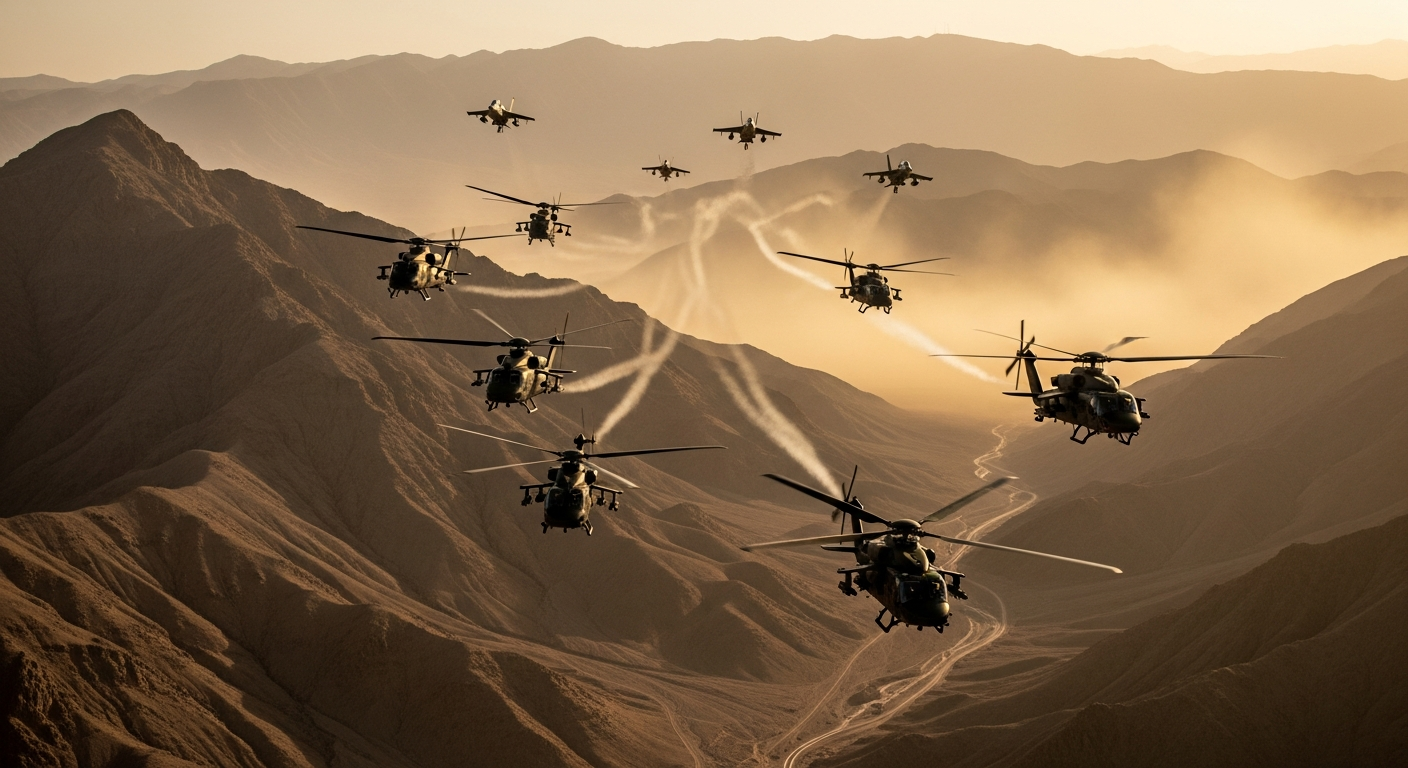
On the morning of 5 April 2026, a United States Air Force Weapons Systems Officer who had spent more than thirty hours evading Iranian Revolutionary Guard Corps search parties in the mountains of Kohgiluyeh and Boyer-Ahmad province was pulled from hostile territory by American special operations forces. Hundreds of operators, dozens of aircraft, and a CIA deception campaign had been marshalled for a single objective: bring one man home. The operation, which President Trump described as “one of the most daring Search and Rescue Operations in U.S. History,” succeeded without a single American fatality. It was not luck. It was the product of an institutional machinery that no other nation on earth can replicate at scale, and a broader Western alliance that, when operating in concert, represents the most lethal military force ever assembled.
The American Enterprise: More Than Better Operators
The rescue of the F-15E crew members in Iran was not merely a tactical triumph. It was a demonstration of what military doctrine calls “enterprise superiority,” the capacity to integrate intelligence, surveillance, and reconnaissance with long-range strike, aerial refuelling, combat search and rescue helicopters, and special operations ground forces into a single coordinated action across thousands of miles of contested airspace. The United States Special Operations Command maintains a force structure that no ally or adversary can match: Air Force Special Operations Command for fixed-wing insertion and refuelling, Naval Special Warfare Command for maritime operations, Marine Forces Special Operations Command, and the Army’s special operations units, all coordinated through Joint Personnel Recovery Centres and Personnel Recovery Coordination Cells embedded at every level of command.
This architecture is what separates American capability from everyone else. The HC-130J Combat King tankers that refuelled rescue helicopters deep inside Iranian airspace, the A-10C Warthogs flying the traditional “Sandy” close air support mission to escort extraction teams, the MQ-9 Reapers providing persistent overwatch and striking threats approaching the downed airman; none of these represent a single brilliant unit. They represent a system designed to function as an integrated whole, one that treats personnel recovery not as an afterthought but as a core warfighting requirement. When the WSO ejected wounded into hostile mountains with an Iranian bounty on his head, the machinery was already spinning.
Britain’s Silent Professionals
The United Kingdom’s Special Air Service operates under a policy of deliberate opacity that makes public assessment difficult by design. The Ministry of Defence neither confirms nor denies SAS deployments. What is known, through decades of public record, parliamentary scrutiny, and documented operations, is that the SAS remains among the handful of units globally that operate at the same tactical tier as American Tier 1 forces. The 1980 Iranian Embassy siege in London remains the defining public benchmark of British special operations capability: six terrorists, seventeen minutes, live on television. It established a template for hostage rescue that militaries worldwide still study.
In the current conflict, the operational connection between UK and US forces is structural, not ceremonial. The downed F-15E belonged to the 48th Fighter Wing, based at RAF Lakenheath in Suffolk. British bases have been formally authorised for American strike operations against Iran since Prime Minister Starmer’s decision in March. SAS forward operating positions in Iraq have themselves been targeted by Iranian drone strikes during this campaign. Whether British special forces played a direct role in the Iran rescue is, per standing policy, unknowable from open sources. What is knowable is that the UK’s special operations ecosystem, its intelligence sharing through Five Eyes, its basing infrastructure, and its institutional interoperability with USSOCOM, makes it the single most valuable coalition partner the United States has in this theatre.
Israel’s Compressed Battlefield
Israeli special operations forces bring a different but complementary set of advantages. Sayeret Matkal, the IDF’s premier strategic reconnaissance unit, is tasked with deep penetration behind enemy lines, counter-terrorism, and hostage rescue beyond Israel’s borders. Shayetet 13, the naval commando unit, operates across sea, land, and air with an explicit mandate for strategic maritime effects and intelligence gathering. Unit 669, the IAF’s dedicated tactical rescue unit, was originally formed to recover downed pilots and has expanded its mandate to encompass aerial rescue of soldiers and civilians regardless of location or conditions. The 1976 Entebbe raid remains the gold standard of long-range hostage rescue under political and operational constraints that would have paralysed lesser militaries.
In the Iran rescue, an Israeli military officer confirmed that Israel provided intelligence support for the search and rescue effort while remaining explicitly uninvolved in ground operations. This division of labour is itself revealing. Israel’s strength in personnel recovery and adjacent missions lies in regional basing knowledge, human terrain understanding, signals intelligence density, and a mobilisation speed that reflects the compressed geography of its operating environment. What Israel lacks relative to the United States is not tactical quality but global enabling architecture: the long-range aviation, the worldwide logistics chain, the dedicated combat search and rescue fleet. This is precisely why the alliance functions as a force multiplier rather than a redundancy.
The Force Multiplier Effect
The concept of a US-UK-Israel special operations trifecta is not rhetorical. It is doctrinal. NATO personnel recovery doctrine explicitly requires an overarching framework to facilitate unity of effort among nations with differing policies and capabilities. The UK has participated in US-led joint personnel recovery exercises, including Red Flag Rescue, explicitly designed to build interoperability between British pararescue teams and American CSAR assets. US-Israel interoperability exercises, including Juniper Oak, are designed to deepen integration across the full spectrum of military operations, including the kind of contested recovery demonstrated this week in Iran.
The force multiplier arithmetic is straightforward. The United States contributes scale, long-range mobility, and integrated joint command and control. The United Kingdom contributes Five Eyes intelligence fusion, forward basing in critical theatres, and special operations units whose tactical proficiency is near-peer with American Tier 1 forces. Israel contributes regional intelligence depth, rapid mobilisation, and niche capabilities in strategic reconnaissance and maritime commando operations that are optimised for the Middle Eastern theatre. Together, the three nations can execute operations that none could sustain alone: persistent ISR coverage fused across multiple national collection platforms, deconflicted airspace management across sovereign boundaries, and ground force insertion options that span rotary-wing, fixed-wing, and maritime approaches.
What the Rescue Proves
The recovery of both F-15E crew members from inside Iranian territory, the first such deep personnel recovery in a generation, is significant beyond the operational facts. It validates a strategic commitment that the Western alliance has maintained since the Vietnam-era promise crystallised in doctrine: no one gets left behind. That commitment is not sentimental. It is calculated. A military that retrieves its people from the worst circumstances generates a willingness to accept risk among its operators that no amount of equipment or training alone can produce. The IRGC offered a bounty. The CIA ran deception operations. A-10s flew Sandy missions for the first time in a real-world combat rescue since the doctrine was written. And a wounded airman walked out of the mountains alive.
The iron trifecta of American, British, and Israeli special operations capability is not a diplomatic talking point. It is the sharpest edge of Western military power, proven this week in the most demanding operational context imaginable. The question for adversaries is not whether these forces can reach you. It is whether you have accurately calculated the cost of making them try.
Read our full Report Disclaimer.
Report Disclaimer
This report is provided for informational purposes only and does not constitute financial, legal, or investment advice. The views expressed are those of Bretalon Ltd and are based on information believed to be reliable at the time of publication. Past performance is not indicative of future results. Recipients should conduct their own due diligence before making any decisions based on this material. For full terms, see our Report Disclaimer.