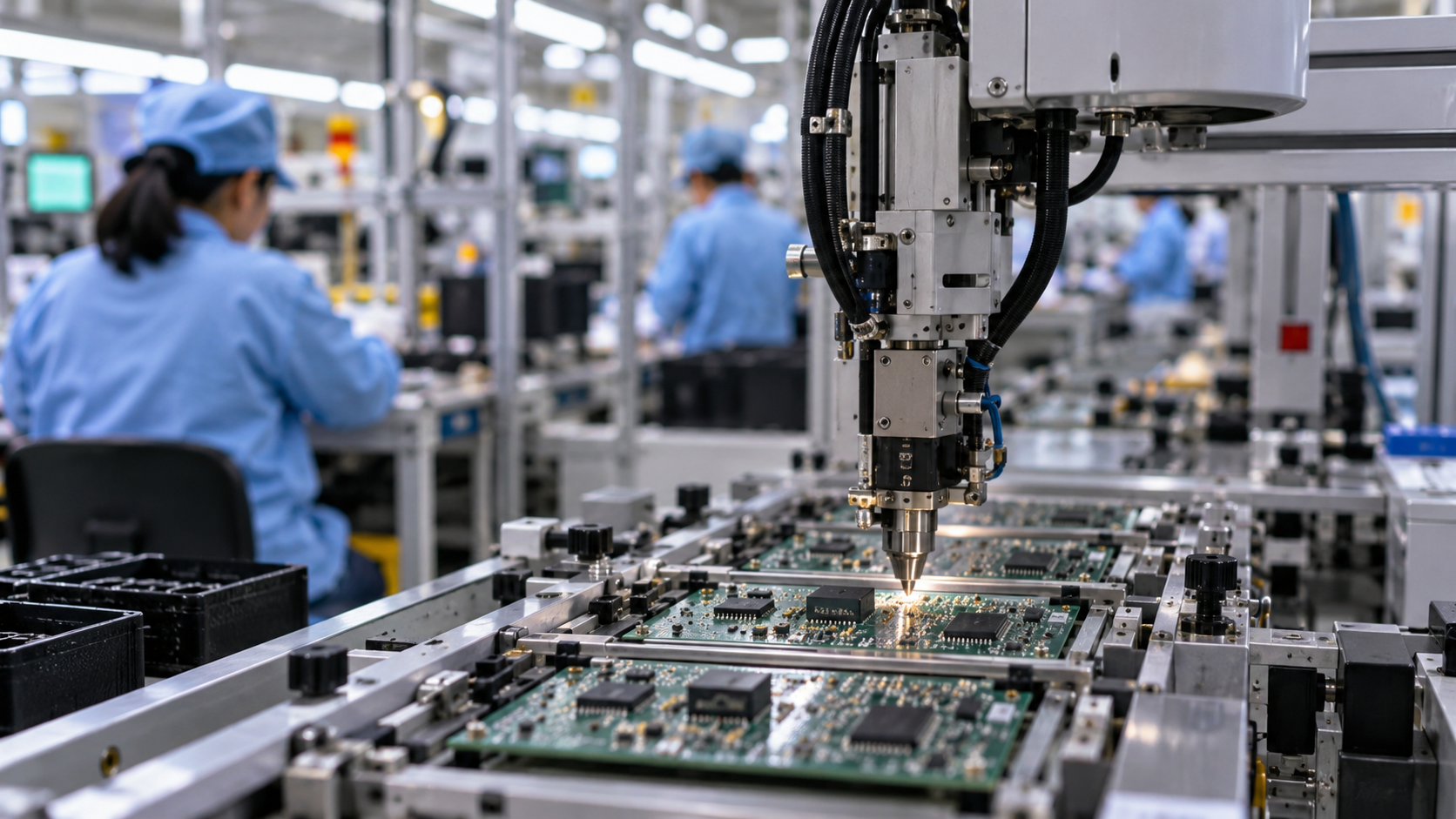
The most consequential economic fact of the modern era is not that some poor countries got rich, but that so few of them did. Escaping absolute poverty turns out to be the easy part: move a farmer from a subsistence plot to a factory floor, and output per worker jumps. The hard part comes later, at the point where a country has exhausted the gains from cheap labour but has not yet built the institutions, the firms, or the technological depth to compete with the wealthy. The World Bank, in its flagship World Development Report on the subject, put a number on the difficulty. Of the roughly 108 economies sitting in the middle-income band, only about three dozen have crossed into the high-income tier since the early 1990s, and more than a third of those owe their success to European Union accession or to newly discovered oil. The rest are stuck. Understanding why is less a question of policy fashion than of mechanics, and the mechanics are unforgiving.
The Squeeze in the Middle
The trap has a precise shape. A poor country competes on one variable above all: the price of its labour. Garments, footwear, basic electronics assembly, low-end components; these flow to whoever can supply them most cheaply, and a nation with abundant underemployed workers can undercut almost anyone. Growth follows. But growth raises wages, and rising wages are the very thing that erodes the original advantage. Somewhere around a tenth of US output per person, an income of roughly $8,000 a head in today’s terms, the country finds it can no longer beat Bangladesh or Vietnam on cost, yet it cannot beat Germany or Japan on sophistication. It is too expensive to be cheap and too unsophisticated to be expensive.
This is the squeeze. The arithmetic is punishing because the two transitions, from cheap to capable, do not happen automatically or even sympathetically. The conditions that make a country a low-cost producer (a compliant labour force, an undervalued currency, foreign-owned assembly plants) are not the conditions that produce domestic engineering talent, proprietary technology, or globally competitive firms. The first phase does not seed the second. A country can run the cheap-labour playbook to its natural conclusion and arrive at the threshold with nothing in hand for the next game.
The World Bank frames the required shift as a movement from investment, to the absorption of foreign technology, to genuine innovation at the frontier. Most middle-income economies master the first, partially manage the second, and never reach the third. The frontier is where high incomes are made, and the frontier is crowded, defended, and expensive to approach.
Premature Deindustrialisation
The classic escape route ran through manufacturing. Factories absorb workers, raise productivity, generate exports, and, force a learning process: making complex goods teaches a workforce and a supplier base things that cannot be acquired any other way. The danger for today’s middle-income countries is that the manufacturing share of their economies peaks earlier and lower than it did for the nations that industrialised before them. Economists call this premature deindustrialisation. Workers move out of factories and into low-productivity services (informal retail, security work, domestic labour) long before the country has captured the technological depth that manufacturing was supposed to deposit.
South Africa is the textbook case. It entered the post-apartheid era as a middle-income economy with real industrial assets, then watched its manufacturing base hollow out under the weight of cheap imports, chronic electricity shortages, and policy drift. Its share of value added in manufacturing fell while its workforce shifted into services that added little to productivity. The capacity to climb the technological ladder shrank precisely when it was needed most, and the country fell further behind the frontier rather than closing on it.
The deeper point is that participation in global supply chains is not the same as capturing value within them. A country can assemble a great many phones and keep very little of the margin, because the design, the chips, and the brand belong to someone else. Volume without value is a treadmill, not a ladder.
Who Stayed Stuck
Brazil is the most sobering example because its stagnation is so durable. At the start of the 1980s its income per working-age person stood at roughly a third of the United States level. Four decades later, after democratisation, commodity booms, financial crises, and stabilisation programmes, that ratio had not risen; by most measures it had drifted lower, toward a fifth. An entire generation of activity, measured against the frontier, produced no convergence at all and arguably some retreat. Brazil expanded its universities (tertiary enrolment now reaches well above half the relevant age cohort) and built a substantial industrial sector, yet remained tethered to commodities and a protected, inefficient domestic market that never forced its firms to compete globally.
Malaysia is the instructive near miss. It ran the export-manufacturing playbook with discipline for half a century and arrived at the doorstep of high income, with gross national income per person in the region of $11,000, only some way short of the World Bank’s high-income line of roughly $14,000. But much of its electronics sector is foreign-owned, and the domestic innovation base remained thin. Malaysia has lingered just below the threshold for years, illustrating that the final stretch is the steepest: the gap between assembling advanced goods and inventing them is wider than the income figures suggest.
The common thread among the stuck is not laziness or bad luck. It is that each captured the easy productivity gains and then failed to build the institutional and technological machinery for the hard ones. Resource dependence, foreign ownership of the high-value layers, protected and unaccountable domestic firms, and education systems that expand access without raising the ceiling all point the same way: enough to grow, not enough to converge.
Who Escaped, and How
The escapees are few, and the East Asian cases are the clearest. South Korea is the headline. Its income per person in 1960 was around $155, comparable to the poorest economies on earth; it now exceeds $35,000. The state did not simply subsidise its industrial conglomerates, the chaebol such as Samsung and Hyundai; it disciplined them. Support was tied to export performance, a metric that cannot be faked because it is set by foreign buyers in competitive markets. Firms that hit world-market targets kept their cheap credit and protection; those that did not lost them. That feedback loop, support conditioned on globally tested results, is the institutional innovation that distinguishes Korea from countries that handed out the same subsidies and got captured cronies instead of champions. Korea now spends more than 5 percent of its output on research and development, among the highest rates of any large economy in the world.
Taiwan reached the same destination by a different road. Rather than betting on national champions, the state built public research capacity and then spun the results out into private firms. The Industrial Technology Research Institute identified a niche in the semiconductor supply chain and, in 1980 and again in 1987, hived off the companies that became United Microelectronics and Taiwan Semiconductor Manufacturing Company. TSMC’s pure-play foundry model, manufacturing chips that other firms design, let Taiwan own a defensible, high-value layer of the most strategic industry on earth. Its income per person now sits in the same high-thirties-of-thousands range as Korea’s, the two having converged at the front of the pack. In both cases the state was active, but its activism was tethered to external discipline (export markets, global technological competition) rather than to domestic political convenience.
What the Leap Actually Requires
Strip away the national particulars and a pattern emerges. Escape requires three things in sequence and in combination. First, a deliberate move up the value chain into goods and services where the country, not a foreign multinational, captures the margin. Second, sustained investment in the unglamorous foundations (engineering education, applied research, the supplier ecosystems that turn an idea into a manufacturable product) at levels that look extravagant until they pay off a decade later. Third, and most elusive, institutions that subject the country’s own firms to genuine competitive discipline, whether through export markets or domestic competition policy, so that capital flows to the productive rather than the politically connected.
The third condition is where most candidates fail, because it is the one that powerful incumbents resist hardest. Cheap labour and foreign capital can be bought; technological depth can, with patience, be built; but a state willing to let its own champions fail when they underperform is rare, and rarer still in places where the firms are also the financiers of the political class.
The strategic implication is that convergence is not a default outcome of growth but a narrow and contingent achievement, demanding a coherence of state, capital, and education that few societies sustain for the requisite decades. For investors and policymakers alike, the lesson is to distrust the extrapolation of early growth. The first leg of the journey, from poor to middling, says almost nothing about whether the second leg, from middling to rich, will ever be made. Most of the world’s people live in countries that have completed the first and stalled on the second, and the historical record suggests the majority will remain there. The miracle is not that East Asia grew fast; many places grew fast. The miracle is that a handful kept climbing after the cheap-labour ladder ran out, and built a new one before the ground gave way.
Read our full Report Disclaimer.
Report Disclaimer
This report is provided for informational purposes only and does not constitute financial, legal, or investment advice. The views expressed are those of Bretalon Ltd and are based on information believed to be reliable at the time of publication. Past performance is not indicative of future results. Recipients should conduct their own due diligence before making any decisions based on this material. For full terms, see our Report Disclaimer.