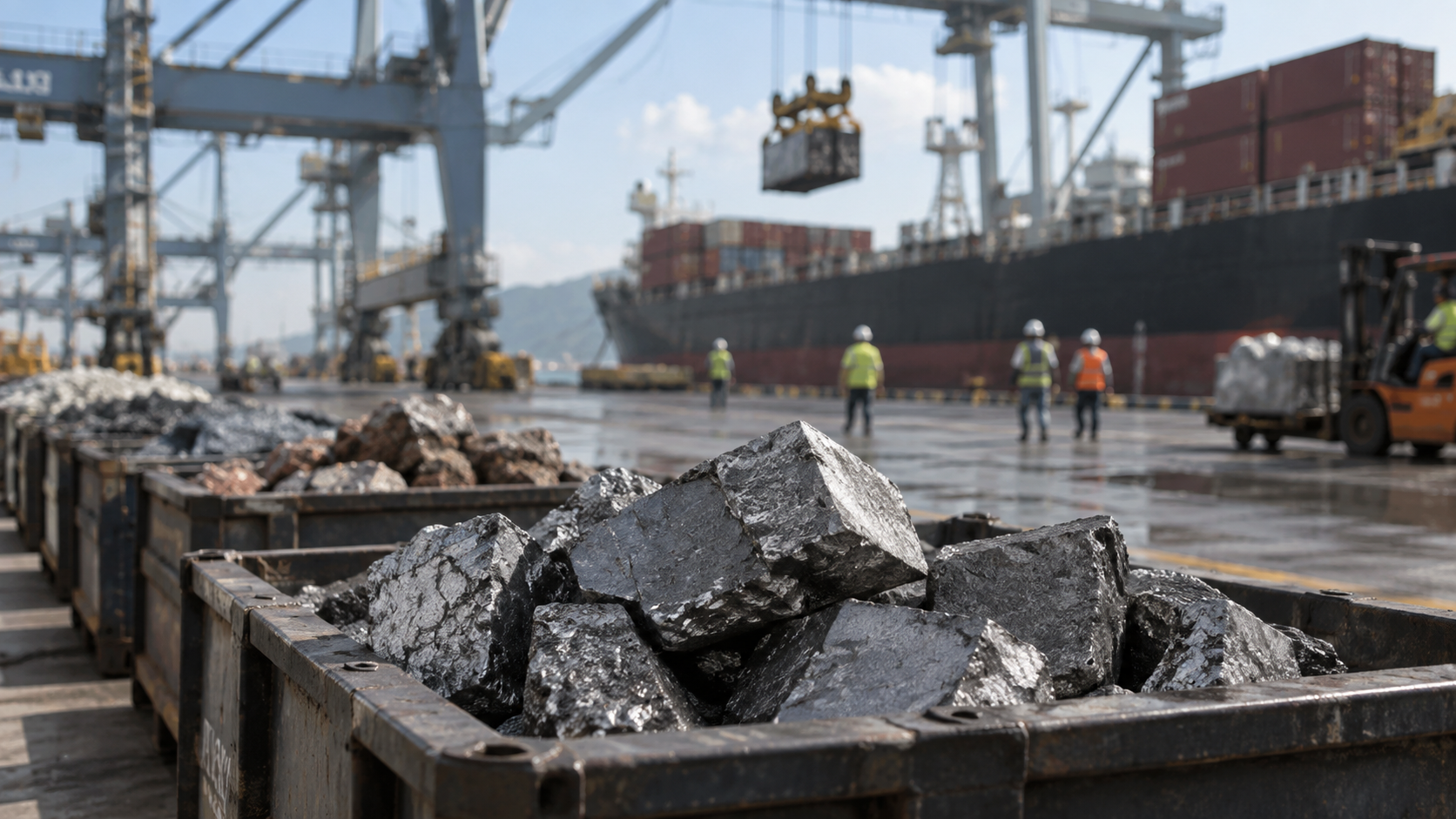
On 9 November 2025, China’s Ministry of Commerce issued Announcement No. 72, suspending Article 2 of its 2024 dual-use controls until 27 November 2026. The number to hold onto is the one the International Energy Agency attaches to the underlying regime: roughly 6.5 trillion dollars of annual economic activity outside China rests on uninterrupted access to Chinese gallium, germanium, antimony and rare-earth inputs. Beijing did not lift that exposure. It paused it, on a clock it sets. The strategic lesson Beijing absorbed between 2023 and 2025 is the thesis of this piece: an outright embargo invites the West to escape, while a discretionary export licence keeps it dependent and hopeful. The licence is the more durable weapon precisely because it never forces a clean break.
The Failed Embargo. In July 2023, MOFCOM placed gallium and germanium under licensing, and in December 2024 it converted that into an outright ban on shipments to the United States. The market reaction was instructive in the wrong direction for Beijing. Low-purity gallium spot prices in Rotterdam jumped more than 40 percent within a month as buyers scrambled, and a two-tier market emerged in which material sold outside China commanded nearly double the domestic price. But the panic did not translate into lasting denial. Chinese suppliers secured licences through other channels, third-country re-export routes opened, and by the end of 2024 US gallium imports had roughly recovered to pre-control levels. Germanium found its way out through Belgium, whose imports from China rose around 224 percent against a 2022 baseline even as direct shipments to the United States fell to zero. The ban taught Western buyers to stockpile, to recycle, and to fund substitution. USGS modelling put the cost of a full one-year cutoff of both metals at only about 3.4 billion dollars of US GDP, a figure small enough to galvanise diversification rather than enforce surrender. The embargo generated exactly the behaviour a supplier wanting permanent leverage should fear: it proved the dependence was survivable, and a survivable threat is no threat at all.
The Licence Instead. The architecture Beijing built after April 2025 inverts that logic. MOFCOM Announcement No. 18, issued on 4 April 2025, placed seven heavy rare-earth elements, samarium, gadolinium, terbium, dysprosium, lutetium, scandium and yttrium, plus their alloys and permanent magnets, under case-by-case licensing rather than prohibition. The shipments do not stop; they slow, queue and clear at Beijing’s discretion. A buyer cannot justify writing off a supplier who is still, formally, supplying. The October 2025 escalation added an extraterritorial layer: foreign-made magnets containing as little as 0.1 percent Chinese-origin rare-earth content, or made with Chinese processing technology, would themselves require an export licence. That threshold is not a wall but a dial. By adjusting domestic Chinese prices, Beijing can widen or narrow the share of the world’s magnets that fall inside its jurisdiction without issuing a single new rule.
The Suspension Trick. What followed the late-2025 truce is the cleverest part of the design. Announcement No. 70 on 7 November 2025 suspended six October directives, and No. 72 two days later paused the broader 2024 controls. Crucially, none of this was repealed. A suspension leaves the rule legally intact; it can be reactivated by letting a date pass, with no fresh rulemaking, no consultation, no political theatre. The October 2025 rare-earth controls lapse on 10 November 2026, and the gallium-germanium-antimony pause on 27 November 2026. The instruments remain fully drafted, fully published and fully enforceable on the day after expiry. A repeal would have required Beijing to legislate the leverage back into existence under scrutiny. The suspension lets it simply decline to renew.
The Hostage Math. The reason this works is the gradient of dependence the licence preserves. China accounts for roughly 90 percent of rare-earth separation and processing and around 93 percent of permanent-magnet manufacturing, a position built through decades of state-directed industrial policy rather than any transient cost advantage. An embargo at that level of dominance would be self-defeating: it would hand every automaker, defence prime and wind-turbine builder in the world an unanswerable case for emergency diversification budgets. A licence does the opposite. It keeps each shipment conditional on good behaviour while keeping the underlying relationship alive, so the capital required to build a parallel supply chain, which the IEA estimates at around 60 billion dollars over a decade for magnet rare earths alone, never quite clears the boardroom hurdle. Hope is the cheapest form of capture.
The April Tell. The clearest evidence that the licence bites harder than the ban is what the April 2025 controls did while diplomacy proceeded. Those controls were never suspended, and they kept working through the May 2026 Beijing summit. CSIS data show US yttrium imports falling from over 333 metric tons in the eight months before the April restrictions to just 17 metric tons in the eight months after, a collapse engineered entirely through licence approvals rather than any announced cutoff. The summit’s own optics confirmed the asymmetry: the White House fact sheet recorded that China would “address” concerns over yttrium, scandium, neodymium and indium, while Beijing’s MOFCOM readout did not mention rare earths at all. One side negotiated; the other administered. The curbs that still bit were precisely the ones dressed as ordinary paperwork rather than as confrontation.
The Western Gap. The response from the United States and its allies remains structurally unequal to a discretionary instrument. The core problem is what might be called mines without markets: new deposits in Australia, Canada and the United States can be dug, but separation and magnet-making capacity outside China is thin, and any Western producer that does come online faces Chinese pricing power capable of flooding the market the moment a competitor approaches break-even. Without a guaranteed price floor or offtake commitment, private capital will not fund the separation and refining stage that actually matters, the stage that decades of Chinese subsidy locked up first. New mining headlines flatter the diversification story while the bottleneck stays exactly where Beijing wants it. Worse, there is no allied stockpile-coordination body, no critical-minerals equivalent of the IEA’s strategic petroleum mechanism, able to absorb a synchronised licence-denial shock across the G7 at once. Each renewal window arrives with the West holding national stockpiles measured in months and no shared release protocol.
The Recurring Dial. This is the feature that distinguishes the licence from any embargo: it renews. A ban is a single event that the target absorbs once and then engineers around. A suspension with an expiry date is a pressure mechanism that resets on a calendar Beijing controls, converting every renewal into a negotiation lever. The November 2026 dates are not deadlines after which the matter is settled; they are the first turns of a dial that can be advanced or held at each cycle, indefinitely, in response to tariff threats, chip controls or Taiwan posture. The instrument’s value lies in its repeatability. Each window lets Beijing extract a concession for non-renewal without ever surrendering the underlying rule.
The Verdict. The West has been reading the wrong threat. The embargo, loud and total, is the instrument that frees its target, because denial creates the political cover for the capital that ends dependence. The licence, quiet and conditional, is the instrument that holds, because partial supply keeps the substitution case perpetually just below the threshold of action. Beijing’s November 2026 expiry dates should therefore be treated not as a thaw to be welcomed but as a scheduled extraction event to be neutralised in advance. The only adequate answer is to make the dial irrelevant before it next turns: fund Western separation and magnet capacity with guaranteed offtake and a price floor, and stand up an allied stockpile-coordination body capable of absorbing a coordinated licence denial. Until the West can shrug off a single non-renewal, every expiry date on Beijing’s calendar is a lever it has chosen to leave in Beijing’s hand.
Read our full Report Disclaimer.
Important Notice
Bretalon Ltd is not a registered investment adviser or broker-dealer. This report is published free of charge as impersonal, general commentary in a publication of regular circulation. It is not investment, financial, legal, or tax advice, and not an offer or recommendation to buy, sell, or hold any security; no report recommends, rates, or values any specific security. Do not rely on it for investment or business decisions; always consult a qualified professional. It speaks only as of its publication date, and its views on companies, securities, and markets are analytical opinion, not fact. As of 22 October 2026, neither Bretalon Ltd nor those involved in its reports have ever been paid by any company a report discusses (unless expressly disclosed in the report). Those involved hold no direct positions in individual securities and hold any securities only through mutual funds and similar pooled or collective investment funds. Bretalon Ltd provides strategic advisory services to publicly listed and privately held companies under separate written agreements. This report was drafted with AI from public sources, its illustration is AI-generated, and it was approved for publication by a person acting for Bretalon Ltd. Provided "as is" without any duty of care to readers. Read our full Report Disclaimer.