
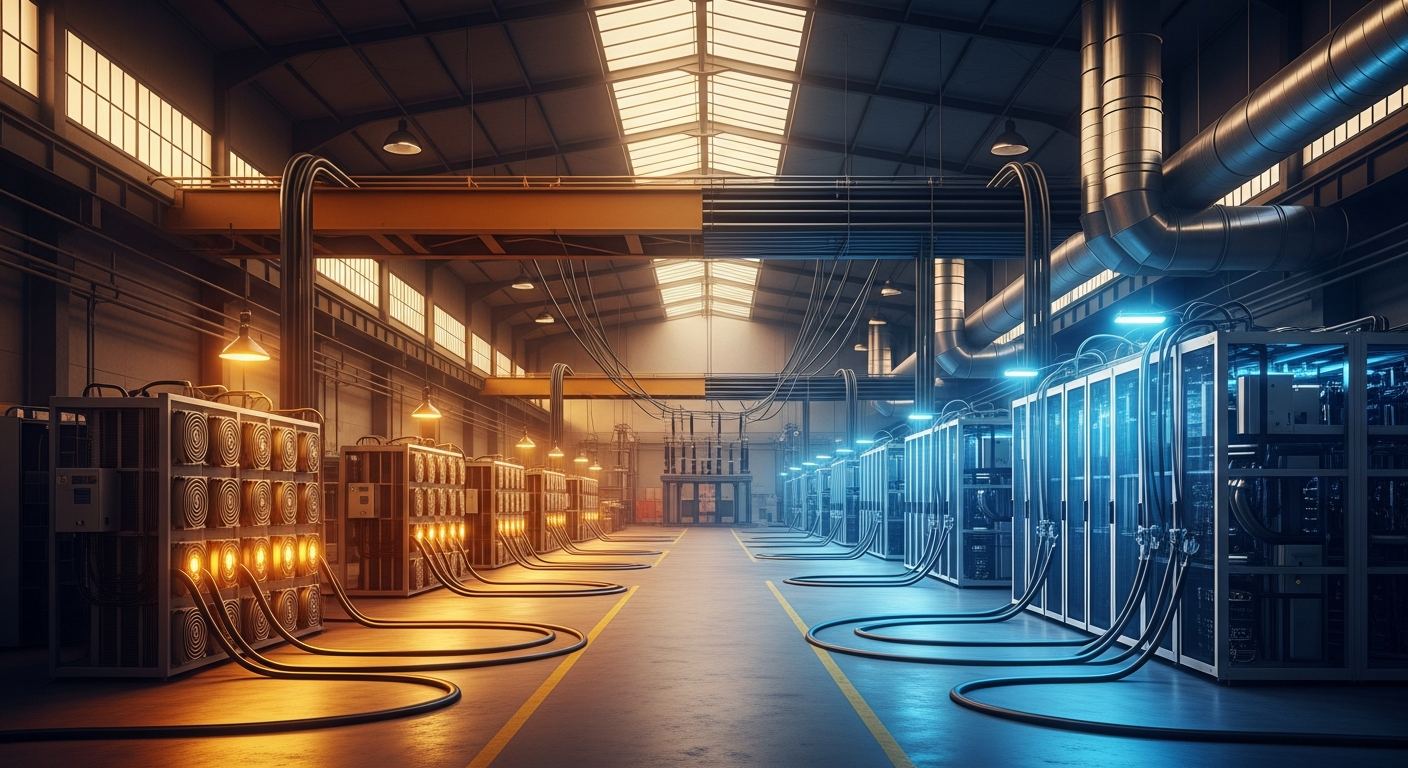
There’s a peculiar irony unfolding in the sprawling industrial corridors of rural America. Inside cavernous warehouses once devoted entirely to minting digital gold, engineers are ripping out racks of Bitcoin mining machines and replacing them with something far more demanding: the supercomputers training the next generation of artificial intelligence. It’s a transformation that tells you everything you need to know about where power — both electrical and political — is heading in the digital age.
For years, the AI and cryptocurrency industries circled each other like rival predators claiming the same territory. Venture capitalists who once couldn’t write checks fast enough for blockchain startups pivoted hard toward generative AI after ChatGPT electrified the public imagination. Talent followed the money. By late 2024, the crypto sector was enduring a brutal winter of regulatory crackdowns and market consolidation, while AI basked in an endless summer of hype and capital.
But here’s what nobody anticipated: the two industries didn’t just need the same investors. They needed the same electricity. And that shared physical dependency has forced what can only be described as a marriage of convenience — one that is quietly restructuring the backbone of the internet itself.
The story begins with a simple, almost embarrassing problem. By 2025, the largest technology companies on the planet — Microsoft, Google, Amazon — had more money than they knew what to do with, but they couldn’t plug in their machines fast enough. Training a frontier AI model demands staggering amounts of power, and the United States electrical grid wasn’t built for this kind of appetite. New grid connections and substation expansions carried wait times of three to five years. For companies racing to dominate the AI landscape, that timeline might as well have been a century.
Enter the Bitcoin miners.
After the 2024 halving event — a programmed reduction in mining rewards that effectively cut revenues in half — many crypto mining operations found themselves staring down razor-thin margins. Yet they possessed something Silicon Valley desperately wanted: live, energized industrial sites with existing grid connections. In the currency of the AI boom, immediate access to megawatts of power became more valuable than the Bitcoin those sites had been producing.
The economics were irresistible. Bitcoin mining is a relentless race to find the cheapest electricity possible, typically requiring rates below four cents per kilowatt-hour to remain viable. AI companies, by contrast, will pay premium rates for guaranteed uptime and rapid deployment. The arbitrage opportunity was enormous, and miners seized it.
But converting a Bitcoin mine into an AI data center is far more complex than swapping out hardware. The engineering gap between the two is a chasm. Picture a typical mining operation: an open-air warehouse, perhaps a converted shipping container complex, where specialized chips churn through cryptographic calculations around the clock. If one machine overheats and dies, the operator loses a trickle of revenue. The network doesn’t even notice.
Now imagine an AI training run — a single, coordinated computation spread across thousands of processors that might take weeks or months to complete. A power blip lasting seconds can corrupt the entire run, wasting millions of dollars. AI tenants demand what the industry calls “five nines” reliability: 99.999 percent uptime. They need precise temperature and humidity control, sophisticated dust filtration, and redundant power supplies that would make a hospital jealous. You’re essentially upgrading from a glorified garage to a surgical suite.
This is the unglamorous reality beneath the headlines. The companies making this pivot aren’t just changing their business model; they’re rebuilding their physical infrastructure from the ground up. It’s expensive, technically demanding, and not every miner will survive the transition. Those who can’t meet the stringent requirements of AI workloads will find themselves stranded — too unprofitable for mining, too unreliable for artificial intelligence.
What makes this moment genuinely fascinating, though, isn’t just the physical infrastructure story. It’s the philosophical collision happening underneath it.
The AI industry, as currently constructed, is profoundly centralized. A handful of companies control the most powerful models, the largest data centers, and the safety protocols governing how these systems behave. The cryptocurrency world was born from the opposite impulse — a cypherpunk vision of decentralized systems that no single entity controls.
These two philosophies are now being forced to coexist, and the friction is generating ideas that neither community would have arrived at alone. As AI systems grow more autonomous — booking services, executing transactions, negotiating with other software agents — they need financial infrastructure that works without human intervention. Traditional banking systems, with their business hours and compliance bottlenecks, simply weren’t designed for machines that operate at millisecond speed around the clock.
Cryptocurrency rails, for all their volatility and controversy, offer something uniquely suited to this emerging “agentic economy”: programmable money that moves without gatekeepers. When an AI agent needs to pay another AI agent for a service, blockchain-based payments offer a mechanism that doesn’t require a bank to open on Monday morning.
Similarly, as deepfakes and AI-generated content erode trust in digital identity, the crypto ecosystem’s work on verifiable credentials and decentralized identity systems suddenly looks less like ideological hobbyism and more like critical infrastructure.
The real story of 2026 isn’t whether AI will beat crypto or vice versa. That framing was always too simple. The real question is far more consequential: as these technologies merge into the plumbing of the next internet, who decides how they’re governed?
The centralized AI stack wants safety, alignment, and control. The decentralized crypto stack wants openness, resistance to censorship, and individual sovereignty. Neither vision is complete on its own. An AI ecosystem without trustless verification risks becoming an instrument of surveillance. A crypto ecosystem without intelligent automation risks remaining a solution in search of a problem.
What we’re witnessing isn’t a feud reaching its conclusion. It’s a negotiation just beginning — one that will determine whether the digital economy of the next decade serves the interests of a few platform giants or distributes its benefits more broadly. The warehouses being retrofitted across America aren’t just changing what they compute. They’re quietly reshaping who gets to decide what the future looks like.
And that, in the end, is worth paying attention to.
Disclaimer: Important Legal and Regulatory Information
This report is for informational purposes only and should not be construed as financial, investment, legal, tax, or professional advice. The views expressed are purely analytical in nature and do not constitute financial guidance, investment recommendations, or a solicitation to buy, sell, or hold any financial instrument, including but not limited to commodities, securities, derivatives, or cryptocurrencies. No part of this publication should be relied upon for financial or investment decisions, and readers should consult a qualified financial advisor or regulated professional before making any decisions. Bretalon LTD is not authorized or regulated by the UK Financial Conduct Authority (FCA) or any other regulatory body and does not conduct activities requiring authorization under the Financial Services and Markets Act 2000 (FSMA), the FCA Handbook, or any equivalent legislation. We do not provide financial intermediation, investment services or portfolio management services. Any references to market conditions, asset performance, or financial trends are purely informational and nothing in this report should be interpreted as an offer, inducement, invitation, or recommendation to engage in any investment activity or transaction. Bretalon LTD and its affiliates accept no liability for any direct, indirect, incidental, consequential, or punitive damages arising from the use of, reliance on, or inability to use this report. No fiduciary duty, client-advisor relationship, or obligation is formed by accessing this publication, and the information herein is subject to change at any time without notice. External links and references included are for informational purposes only, and Bretalon LTD is not responsible for the content, accuracy, or availability of third-party sources. This report is the intellectual property of Bretalon LTD, and unauthorized reproduction, distribution, modification, resale, or commercial use is strictly prohibited. Limited personal, non-commercial use is permitted, but any unauthorized modifications or attributions are expressly forbidden. By accessing this report, you acknowledge and agree to these terms-if you do not accept them, you should disregard this publication in its entirety.
Report Disclaimer
This report is provided for informational purposes only and does not constitute financial, legal, or investment advice. The views expressed are those of Bretalon Ltd and are based on information believed to be reliable at the time of publication. Past performance is not indicative of future results. Recipients should conduct their own due diligence before making any decisions based on this material. For full terms, see our Report Disclaimer.