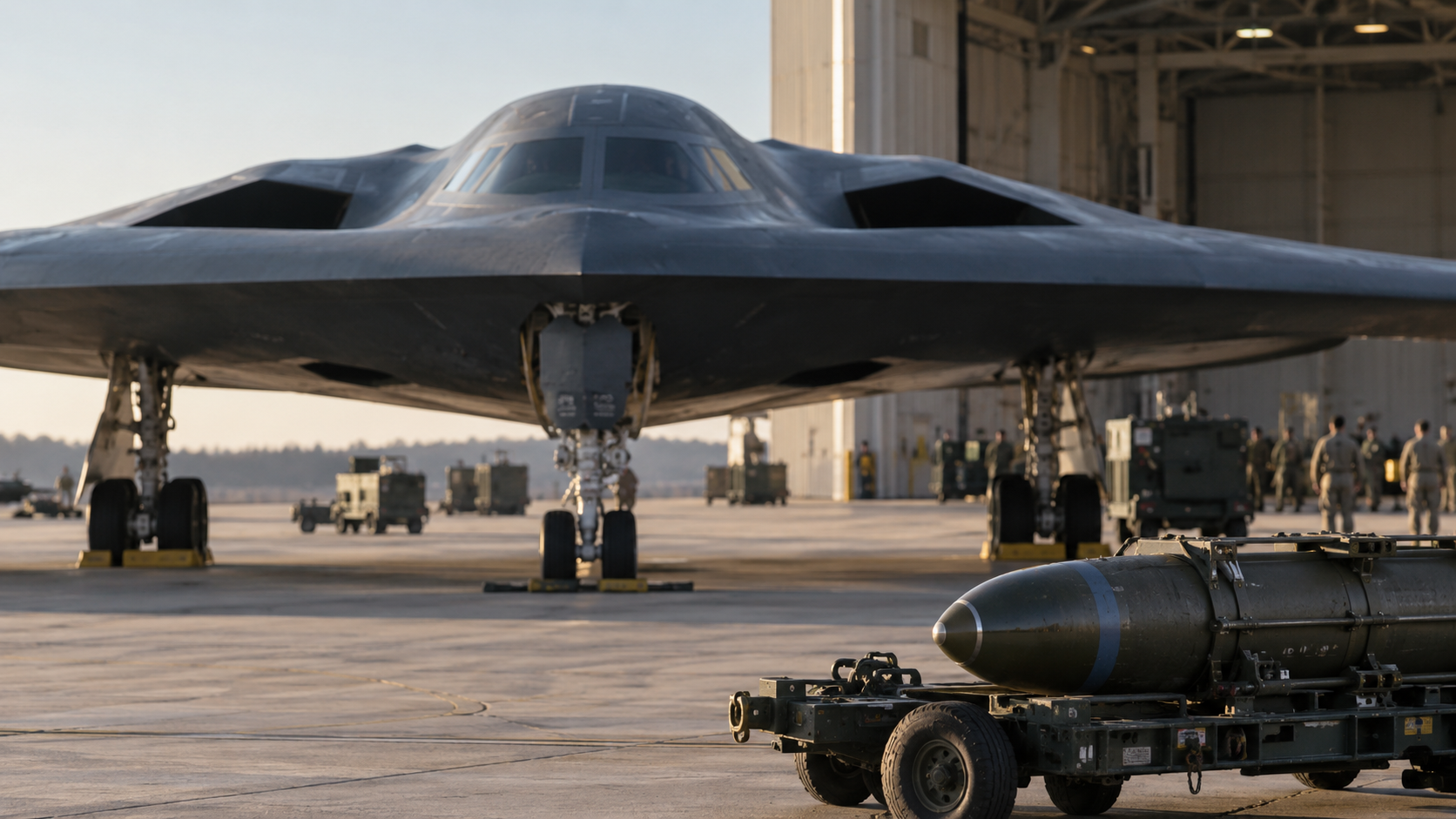
The combat operations of 2025–2026 have not only validated American military superiority: they have demonstrated it with a clarity that renders the term “near-peer competitor” functionally obsolete. In less than fourteen months, the United States conducted three major operations across two hemispheres (Operation Midnight Hammer against Iran’s nuclear infrastructure, Operation Absolute Resolve to extract Venezuela’s head of state, and the ongoing Operation Epic Fury to dismantle Iran’s conventional military) suffering minimal casualties while achieving objectives that no other nation on earth could contemplate, let alone execute. The strategic implication is not a modest lead. It is a structural chasm across every domain of modern warfare: air, sea, land, space, cyber, and the integration of all five simultaneously.
Midnight Hammer: The Thirty-Minute War That Changed Everything
On June 22, 2025, seven B-2 Spirit stealth bombers of the 509th Bomb Wing departed Whiteman Air Force Base in Missouri. They flew eastward for eighteen continuous hours, refueling three times mid-air, maintaining near-total communications silence. As a deception measure, six additional B-2s had been deployed westward toward Guam the previous day: a feint designed to confuse any intelligence tip-offs following President Trump’s social media commentary earlier that week. At approximately 2:10 AM Iran Standard Time, six of the seven aircraft began dropping GBU-57A/B Massive Ordnance Penetrators on the Fordow enrichment facility, while the seventh struck Natanz. A total of fourteen MOPs were delivered across Fordow, Natanz, and the Isfahan Nuclear Technology Center. Not a single one was intercepted.
This was the first combat use of the GBU-57 in history: a weapon so heavy that only the B-2, which only the United States possesses, can deliver it. But the strike’s significance extends beyond the ordnance. Preceding the bombers into Iranian airspace were F-35s and F-22s, tasked with drawing any defensive fire. None came. U.S. Cyber Command had executed what officials described as “some of the most sophisticated action Cyber Command has taken against Iran in its nearly 16-year history,” targeting mapped nodes in military networks connected to the nuclear sites and preventing Iran from launching surface-to-air missiles at the incoming aircraft. General Dan Caine, Chairman of the Joint Chiefs, confirmed that all three sites were struck within a thirty-minute window. Lieutenant General William Hartman, acting chief of Cyber Command and the NSA, put it plainly: “We’ve really graduated to the point where we’re treating a cyber capability just like we would a kinetic capability.”
The operation, part of the broader Twelve-Day War between Israel and Iran, was the sole American offensive action in that conflict. Its economy of force was itself a statement: one mission, eighteen hours of flight, thirty minutes of combat, zero casualties, and the functional destruction of a nuclear weapons programme that had consumed two decades of international diplomacy.
Absolute Resolve: Extracting a Head of State from a Defended Capital
Six months later, on January 3, 2026, the United States demonstrated a different kind of dominance. At approximately 2:00 AM local time, more than 200 special operations forces surged through Caracas, supported by over 150 aircraft and drones launched from more than twenty locations across the Western Hemisphere. F-22 Raptors, F-35 Lightning IIs, F/A-18 Super Hornets, EA-18G Growlers, and B-1B Lancers provided the air umbrella. The objective was the capture of Venezuelan President Nicolás Maduro and his wife Cilia Flores.
The operation’s success was not a product of brute force but of intelligence preparation that dwarfed the kinetic phase by a ratio of roughly 1,200 to one. The CIA had maintained a clandestine ground team in Venezuela since August 2025: five months of patient intelligence collection, including a cultivated source inside the highest echelons of the Venezuelan government who provided extraordinary insight into Maduro’s pattern of life: where he slept, how he moved, what his security looked like, and his fallback options. RQ-170 surveillance assets mapped air defences, communications networks, and movement patterns. When the strike came, EA-18G Growlers provided an electronic warfare blanket that blinded Venezuelan radar and disrupted communications. Cyber Command layered additional effects: widespread power outages were reported across Caracas during the raid. Venezuela’s air defences, including S-300VM systems, Buk-M2 medium-range SAMs, and MANPADS, were neutralised without a shot being fired at American aircraft.
Maduro and his wife surrendered. Zero American personnel or vehicles were lost. One helicopter sustained damage from enemy fire but remained operational. By January 5, Maduro appeared at Manhattan Federal Court, pleading not guilty to drug trafficking charges. Defence Secretary Hegseth was explicit about the deterrent message: if the United States could extract a sitting head of state from a defended capital with no casualties, what does that signal to every other adversary on earth?
Epic Fury: The Dismantlement of Iran’s Conventional Forces
Operation Epic Fury, launched at 1:15 AM on February 28, 2026, escalated the scale dramatically. More than 50,000 U.S. troops, 200-plus fighter aircraft, two aircraft carriers, and strategic bombers struck over 1,000 Iranian targets in the first twenty-four hours and more than 1,700 within seventy-two. Israel’s parallel component, Operation Roaring Lion, added over 1,600 strike sorties and approximately 4,000 munitions in the first eighty hours: the largest air combat operation in Israeli history.
The results were categorical. Within forty-eight hours, seventeen Iranian warships and one submarine had been destroyed or critically damaged; by day five, the count exceeded twenty naval vessels sunk. Iran’s key naval base on the Strait of Hormuz was set ablaze. Over 200 air defence systems (including S-300, Khordad-3, and RAAD-1 batteries) were dismantled within the opening phase, with the total exceeding 300 by day five. Roughly half of Iran’s missile launchers were eliminated early. Within the first eight hours, Israeli and American forces had neutralised Iran’s entire defence network, which relied on a mix of Russian-made S-300 systems and domestic platforms. Not a single successful intercept was recorded by Iranian air defences: a fact that reportedly alarmed Russian military officials, given that the S-300 and its export variants form the backbone of Russian arms sales worldwide.
The speed of this dominance enabled something remarkable: the transition from stealth-dependent stand-off strikes to the open deployment of non-stealth platforms in Iranian airspace. B-1B Lancers flew direct from Ellsworth Air Force Base to conduct deep strikes on ballistic missile facilities and command infrastructure. B-52 Stratofortresses (eight-engine, non-stealth aircraft with enormous radar cross-sections) operated openly. MQ-9 Reapers, carrying Hellfire missiles and guided bombs, conducted persistent surveillance and targeting missions. A-10 attack aircraft were employed. The very presence of these platforms in a theoretically contested battlespace is itself conclusive evidence of total air supremacy. None of them could survive thirty seconds in a defended environment.
The Generational Technology Gap
The operational evidence is underpinned by a hardware asymmetry that continues to widen. The United States now fields approximately 835 to 850 F-35 Lightning IIs across all services, with 191 delivered in 2025 alone: a record year that pushed total global programme deliveries past 1,300 aircraft across nineteen nations. The B-21 Raider, the next-generation stealth bomber, has two working prototypes in testing with two more expected in 2026, first delivery to Ellsworth scheduled for 2027, and production accelerated by 25% via a $4.5 billion deal announced in February 2026. The Air Force plans to acquire at least 100 B-21s, and the programme is described as “more or less on budget and on schedule”: a near-unprecedented achievement in defence procurement.
The hypersonic gap, long cited as a Chinese and Russian advantage, is closing rapidly. The Army’s Dark Eagle boost-glide system (Mach 5-plus while manoeuvring unpredictably, with a range of approximately 1,725 miles) deployed its first battery to Australia for Exercise Talisman Sabre in July 2025, with a second battery scheduled for late 2026. In space, the Space Development Agency has placed 126 Link-16 satellites in orbit for intercommunication, with $3.5 billion awarded in December 2025 for 72 additional missile-tracking satellites. This mesh network passes tracking data via laser crosslinks directly to missile defence systems and weapons platforms in near-real-time. No other nation has anything comparable.
All of this is sustained by a defence budget that has, for the first time, exceeded $1 trillion: $1.01 trillion for FY2026, a 13% increase. For perspective, China’s official 2025 defence budget is $246 billion; Russia’s approximately $186 billion. Even generous purchasing-power parity adjustments do not close this gap. The United States maintains 750 to 877 military installations in more than 80 countries, with over 190,000 troops stationed overseas. China has one overseas base, in Djibouti. Russia has a handful.
The Myth of the Near-Peer
Russia’s performance in Ukraine has shattered any remaining credibility as a peer military power. Casualty estimates from the UK Ministry of Defence, former CIA Director William Burns, and the Estonian Foreign Intelligence Service converge at approximately 1 to 1.2 million killed and wounded. By February 2026, Russia was losing more soldiers monthly (roughly 40,000) than it could recruit. Equipment losses documented by Oryx through visual confirmation alone exceed 4,000 main battle tanks, 8,800 armoured fighting vehicles, and over 23,000 total vehicles and heavy equipment: the largest armoured losses since the Second World War, exceeding all armoured vehicle losses in all conflicts from 1946 to 2022 combined. Russia has lost at least 335 air defence systems, including 18 S-400 launchers and over 60 Tor systems.
Most damning is what Russia has failed to achieve against a nation with no stealth aircraft, no fifth-generation fighters, and initially no Western-supplied advanced surface-to-air missile systems. After more than three years, Russia has not established air superiority over Ukraine. The contrast with Epic Fury could not be starker: the United States and Israel seized air supremacy over Iran, a country with a more sophisticated air defence network than Ukraine possessed in February 2022, in less than four days. The systemic causes of Russia’s failure are structural: decades of corruption that damaged both force quality and resource allocation, a command structure that subordinated air units to ground command, and defence spending now consuming approximately 10% of GDP, five times NATO’s 2% target, while hollowing out the broader economy.
China presents a different but equally revealing picture. The People’s Liberation Army has not fought a major conflict since the 1979 Sino-Vietnamese War, in which the Vietnamese “more than held their own” against a numerically superior Chinese force, and will soon have zero personnel with firsthand combat experience. Xi Jinping himself has diagnosed what he terms the “Five Incapables”: officers who cannot judge situations, understand higher authorities’ intentions, make operational decisions, deploy troops, or deal with unexpected situations. The PLA’s official newspaper acknowledges “peace disease”: the strategic, institutional, and psychological weaknesses that develop in a military that has not experienced real combat for over four decades.
The corruption that Xi’s purges have exposed is staggering. Since 2022, at least 101 potential and confirmed purges of senior officers have been documented. Of 47 PLA leaders who were generals in 2022 or promoted afterward, 87% have been purged or have disappeared. The Rocket Force, China’s nuclear and strategic missile arm, saw two consecutive commanders removed after Bloomberg reported, citing U.S. officials, that corruption was so pervasive that some missile silos had been fitted with faulty lids and some missiles filled with water instead of propellant. Only two official Central Military Commission members remain: Xi Jinping and General Zhang Shengmin. Meanwhile, the J-20 fighter’s radar cross-section is estimated at 0.01 to 0.1 square metres: ten to a thousand times larger than the F-22’s estimated 0.0001 square metres. Specialists who examined the J-20 up close noted “exposed rivets and shoddy workmanship” and panels that “do not match up precisely, which can compromise the low-observable surface.” A former U.S. Air Force Chief of Staff compared it to the F-117: a first-generation stealth design from the 1980s.
The Dependency That Defines the Order
American primacy is further reinforced by the dependency of even its most capable allies. NATO assessments identify critical European gaps in ISR (including space-based capabilities), integrated air and missile defence, long-range precision strike, strategic airlift, and air-to-air refuelling. The United States operates 246 military satellites; all European NATO members combined operate 49. When the U.S. halted intelligence sharing with Ukraine in March 2025, it immediately exposed Europe’s inability to independently sustain situational awareness. Analysts estimate Europe will need five to ten years to achieve sufficient capacity to stop relying on American space data, if it ever does.
Even Israel, arguably the most capable U.S. ally, cannot sustain high-intensity operations without continuous American resupply. During Operation Epic Fury, Israel expended 2,500 pieces of ammunition in eighty hours. The U.S. fired approximately 150 THAAD interceptors during the June 2025 Twelve-Day War, depleting roughly 25% of total American THAAD stocks. The Pentagon had only 25% of the Patriot interceptors it would need for its own future military plans, many having already been sent to Ukraine. Replenishing THAAD shortages alone will take at least eighteen months at current production capacity.
Yet the United States conducted Operation Absolute Resolve in Venezuela, launched Epic Fury against Iran, continued supporting Ukraine’s defence, and maintained its Pacific deterrence posture against China, simultaneously. Retired General David Deptula noted that despite multi-theatre operations, the U.S. “retains a broad, flexible, and scalable set of capabilities.” Cyber Command conducted sophisticated operations against both Venezuela and Iran within the span of two months, demonstrating global reach in the domain that matters most in twenty-first-century warfare. No other nation has demonstrated this level of cyber-kinetic integration in combat, and no other nation can sustain simultaneous major combat operations across multiple theatres. This is not a lead that can be closed by procurement schedules or budget increases. It is a structural reality, and it defines the geopolitical order of our time.
Read our full Report Disclaimer.
Report Disclaimer
This report is provided for informational purposes only and does not constitute financial, legal, or investment advice. The views expressed are those of Bretalon Ltd and are based on information believed to be reliable at the time of publication. Past performance is not indicative of future results. Recipients should conduct their own due diligence before making any decisions based on this material. For full terms, see our Report Disclaimer.