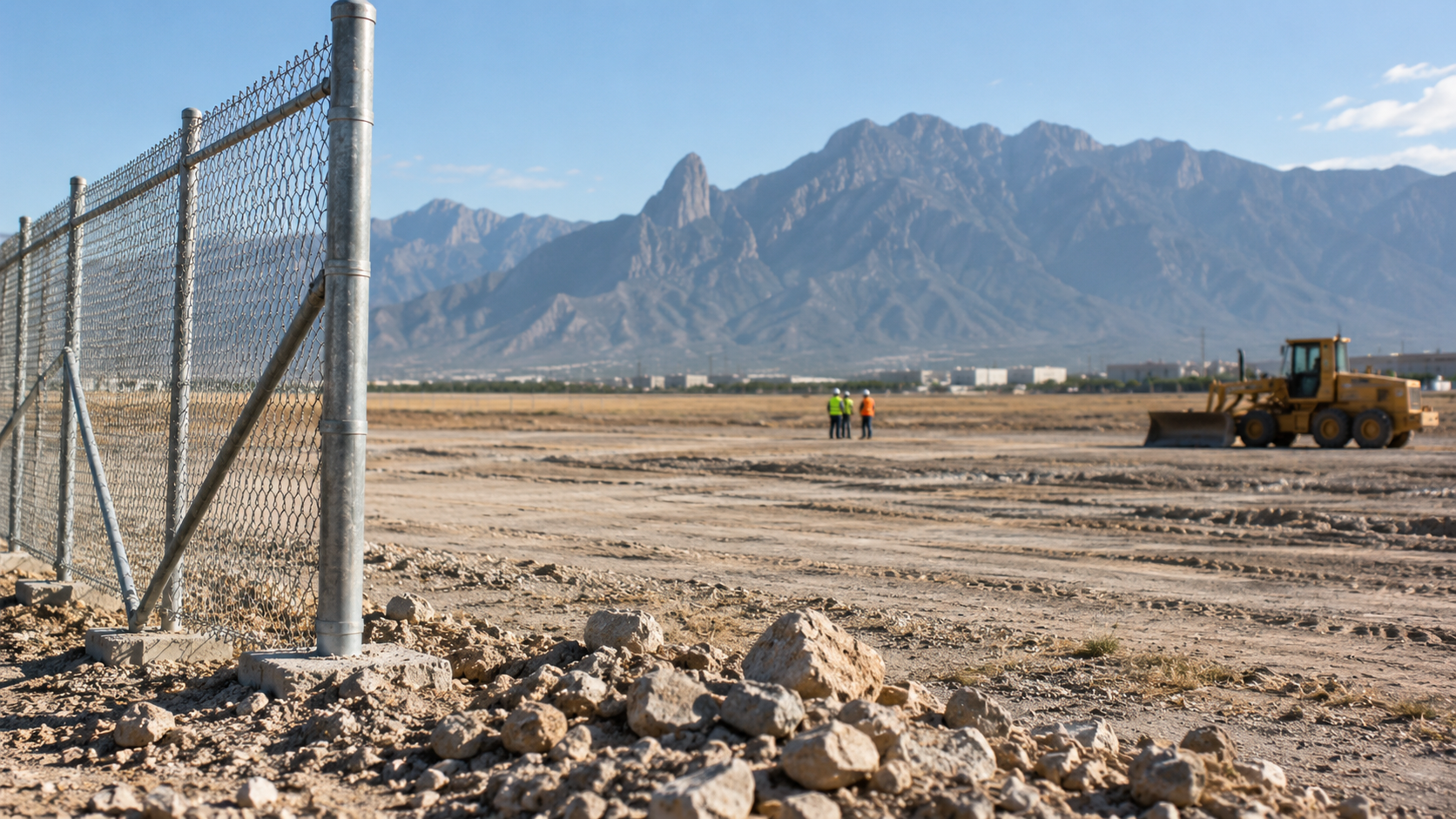
The site at Santa Catarina, on the northern edge of Monterrey, was prepared in 2023. Trees were cleared. Earthworks were levelled. A perimeter fence was raised. Tesla had announced, in March of that year, that its third international gigafactory would begin commercial operations in the first quarter of 2025, capable of producing the company’s next-generation low-cost vehicle at a scale that would, on the most optimistic forecasts, double Mexico’s automotive output. By the spring of 2026, no foundation had been poured. Elon Musk had told an earnings call in early 2025 that it “doesn’t make sense to invest” before the United States election; the project remained indefinitely paused into 2026 with the company’s revised “unboxed” production routed to existing facilities elsewhere. The empty field at Santa Catarina is the most visible single artefact of the nearshoring boom that did not arrive.
The headline numbers continue to support the boom narrative. Mexico booked a record $40.87 billion of foreign direct investment in 2025, an increase of 10.8 percent year-on-year, and the Sheinbaum administration has not been shy about citing the figure. The composition tells a different story. Reinvested earnings accounted for roughly 68 percent of the 2025 total. Genuinely new greenfield investment was 18 percent, or $7.38 billion. Intercompany loans made up the residual 14.3 percent. Nearshoring announcement value, the leading indicator favoured by industrial-park operators and consultancies, fell 23 percent against 2024 and 49 percent against the 2023 peak. Gross fixed capital formation in the first eight months of 2025 was down 6.8 percent. Auto investment, the segment to which the entire nearshoring thesis was anchored, collapsed 61.4 percent to $9.26 billion across 204 projects. Vehicle production fell below four million units for the first time in years. The headline FDI is real. The structural investment is not.
The Grid That Cannot Carry the Boom. The first binding constraint is the national electricity system. More than 60 percent of Mexico’s transmission grid runs near maximum capacity. The Centro Nacional de Control de Energía logged 104 emergency grid events in 2024, with 91 percent of industrial parks reporting supply failures and manufacturing-loss estimates near $200 million per hour during outages. On 26 September 2025, a single CFE failure knocked out 2.26 million users across Campeche, Yucatán and Quintana Roo, and produced a nationwide blackout in Belize, which draws 46 percent of its load from Mexico. The Sheinbaum government’s 2025-2030 energy plan promises 29,000 MW of new capacity and roughly 624 billion pesos of capital expenditure, but the secondary energy laws signed on 30 October 2024 reasserted Pemex and CFE as “strategic public companies,” granted dispatch precedence to state generation, and capped private participation in mixed contracts at 46 percent. The plan envisions only $6 to $9 billion of private capital expenditure for 6.4 to 9.5 GW of clean capacity by 2030. The grid is not being built at the scale the boom requires.
A City Running Dry. The second constraint is water. Monterrey, the manufacturing capital of the north and the geographical anchor of the nearshoring narrative, came within weeks of “Day Zero” in 2022 and 2023, with five million residents subject to rationing schedules that the city has not fully unwound. Roughly 45 percent of regional aquifers are overexploited. The El Cuchillo II aqueduct, the centrepiece of the federal supply solution, remains 70 percent complete. The data centres that the AI capex-supercycle narrative was supposed to deliver to northern Mexico run evaporative cooling at up to one million gallons per day, an inflow profile incompatible with the existing water balance. Industrial-park operators in Nuevo León now budget water-supply discounts as a routine condition of tenancy. The water question is not solvable on the timescale of the investment cycle that the nearshoring story implied.
The Ballot Box and the Bench. The third constraint is institutional. The judicial reform passed by the Mexican Congress on 11 September 2024 and signed by President López Obrador on 15 September 2024, which transferred the selection of the federal judiciary to popular election, was identified at the time by Morgan Stanley, the IMF in its Article IV consultation, and successive American Chambers of Commerce surveys as a signal investor risk. Mexico’s second-quarter 2024 FDI of $5.1 billion was the lowest second quarter in real terms since 2004. The first judicial elections were held on 1 June 2025; turnout was approximately 13 percent. Roughly 1,600 federal posts, half of the federal bench, were elected, and three justices identified with the governing Morena party were placed onto the Supreme Court. The IMF’s October 2025 Article IV statement called explicitly for “judicial independence” and the closing of “infrastructure gaps.” The investor calculus is not that the judiciary has been politicised. It is that the judiciary’s independence is now a discretionary input controlled by the same political coalition that controls the energy and water portfolios. The disposition of contract enforcement under USMCA, the central legal protection on which much of the boom narrative was predicated, has effectively shifted from a quasi-independent bench to a politically contingent one.
The Tax on Doing Business. The fourth constraint is criminal. The American Chamber of Commerce in Mexico’s 2024 survey found that one in eight member firms reported that organised crime had taken “partial control of sales, distribution and/or pricing” of their products. The Confederación Patronal de la República Mexicana puts business-extortion losses at roughly $1.3 billion in 2023 and reports incidents up 66 percent between 2018 and 2024. The pressure is concentrated in Nuevo León, Guanajuato and the Greater Mexico City metropolitan region, the same geography to which most of the nearshoring inflows have been directed. Cartel del Noreste, designated a Foreign Terrorist Organisation by the United States Treasury in February 2025, operates across the Tamaulipas-Coahuila-Nuevo León industrial corridor that hosts the bulk of the country’s automotive supply chain. American firms have begun reporting routine extortion of trucking, warehousing and last-mile distribution as a cost of doing business. None of this is new in Mexican corporate life. What is new is that it is being incurred in dollar-denominated cost lines on the same balance sheets that were modelling nearshoring as a margin-expansion thesis.
The Verdict. The Banco de México’s 2026 GDP growth forecast stands at 1.6 percent, revised up from 1.1 percent but still well below the 3-plus percent trajectory implied by the nearshoring dividend. The IMF puts 2026 at 1.5 percent. The first joint review of the United States-Mexico-Canada Agreement begins on 1 July 2026, with the United States Trade Representative seeking concessions on Mexican energy policy and labour enforcement, and the Sheinbaum administration unwilling to relinquish the state-control posture written into the 2024 secondary energy laws. The 2036 sunset of the agreement is now an active risk, not a procedural footnote. Mexico did not lose the nearshoring decade because the demand was not there. The demand was there. It lost the decade because it could not deliver electricity, water, contract enforcement, and physical security to the firms that had decided to bet on it. The boom did not stall because of Washington. It stalled in Monterrey, in Mexico City, and on the empty earthworks at Santa Catarina, before any tariff was announced. The next administration’s recovery problem is not external. It is the inherited domestic state.
Read our full Report Disclaimer.
Report Disclaimer
This report is provided for informational purposes only and does not constitute financial, legal, or investment advice. The views expressed are those of Bretalon Ltd and are based on information believed to be reliable at the time of publication. Past performance is not indicative of future results. Recipients should conduct their own due diligence before making any decisions based on this material. For full terms, see our Report Disclaimer.