On 7 April 2026, the European Commission published the first official Carbon Border Adjustment Mechanism reference price: €75.36 per tonne of carbon dioxide. The number, set as a quarterly average of EU Emissions Trading System auction settlements, looked technical. It is not. It is the first time in history that a single jurisdiction has translated an internal carbon price into a binding levy at its frontier, and it landed at the moment the CBAM definitive phase began on 1 January 2026, ending the transitional reporting regime that ran from October 2023. The covered scope is narrow but consequential: cement, iron and steel, aluminium, fertilisers, electricity, hydrogen. The political fallout is wider. CBAM has split the global industrial order into three camps, and the schism is now visible in trade flows, capex decisions, and counter-policy.
The Mechanism, In Hard Numbers. Free EU ETS allowances for CBAM-covered sectors begin a nine-step phase-out: 97.5 percent of historic free allocation in 2026, falling to zero by 1 January 2034. The steepest single-year cut runs 2029 to 2030, when the CBAM factor jumps from 22.5 percent to 48.5 percent of embedded emissions. The first sale of CBAM certificates was deferred from January 2026 to 1 February 2027, with retroactive compliance for 2026 imports. EU ETS allowances themselves traded in a €60 to €95 band across 2025 and 2026, sitting around €72 per tonne on EEX in April 2026. Consensus modelling places average prices in the €80 to €100 range through 2030. For an integrated blast-furnace producer running at roughly 2 tonnes of CO2 per tonne of crude steel, the implied marginal levy at full phase-out is €150 to €200 per tonne of imported steel. That is not noise. That is a structural tariff written in carbon.
Camp One: The Aligned. The United Kingdom legislated its own CBAM for entry into force on 1 January 2027, covering aluminium, cement, fertiliser, hydrogen, and iron and steel. Electricity, ceramics, and glass were dropped from the final scope. Scope 1 direct emissions are in from day one; Scope 2 and Scope 3 are deferred to 2029 at the earliest. Switzerland, anchored to EU ETS via formal linkage since 2020, is aligned by implication. Canada continues a long study process. Norway is integrated with the EU ETS. The aligned bloc represents roughly 19 percent of global GDP and approximately one-third of finished-goods import demand. Their convergence is not coordinated. It is gravitational: every jurisdiction with an internal carbon price has the same arbitrage problem CBAM was built to close, and the EU has now done the legal engineering work for them.
Camp Two: The Defensive Adopters. The most consequential response is not opposition. It is mimicry. China expanded its national ETS on 26 March 2025, adding steel, cement, and aluminium to the previously power-only system. The expansion brings roughly 1,500 new installations and approximately 3 billion tonnes of CO2 equivalent into coverage, about 5 percent of global emissions. The 2024 emissions compliance deadline ran through end-2025, with output-based intensity benchmarking for 2025 and 2026. Allowance prices, historically anchored in the 70 to 100 yuan range (€9 to €13 per tonne), are still an order of magnitude below EU levels, but the architecture is now legible to Brussels: Beijing can argue at the World Trade Organization that Chinese exports are already carbon-priced and CBAM is therefore double counting. India launched the Carbon Credit Trading Scheme with compliance obligations on aluminium, cement, chlor-alkali, pulp and paper, refining, petrochemicals, and textiles from FY2026, covering approximately 490 installations. Iron and steel targets are still being finalised, with first compliance dates of 31 July annually. The sector choice is not coincidence: it tracks the CBAM cover list almost line for line. Türkiye enacted its first Climate Law in July 2025 and will start a pilot ETS in 2026, also covering electricity, cement, iron and steel, aluminium, fertilisers, ceramics, chemicals, and refining. Roughly 40 percent of Turkish exports go to the EU, and an estimated 41 percent of that trade is within CBAM scope. The CBAM mechanism allows direct deduction of carbon fees paid in the country of origin, which is the legal hook the defensive adopters are walking through.
Camp Three: The Antagonists. The United States under the second Trump administration has rejected CBAM as a hostile climate tariff and the United States Trade Representative has called for it to be scrapped. The administration has already used retaliatory tariffs against carbon-pricing instruments in adjacent contexts, including threats over the International Maritime Organization shipping levy. Senate Bill 1325, the Foreign Pollution Fee Act of 2025, sponsored by Cassidy of Louisiana and Graham of South Carolina, runs in the opposite direction: it would impose a US import fee based on relative pollution intensity versus US benchmarks rather than absolute carbon content. The bill is more punitive than CBAM and explicitly designed to be unilateral, not reciprocal. Russia is structurally locked out of EU trade since 2022 and is not a meaningful CBAM counterparty. The antagonist bloc shares one feature: rejection of the principle that an internal carbon price is the legitimate reference for a border adjustment.
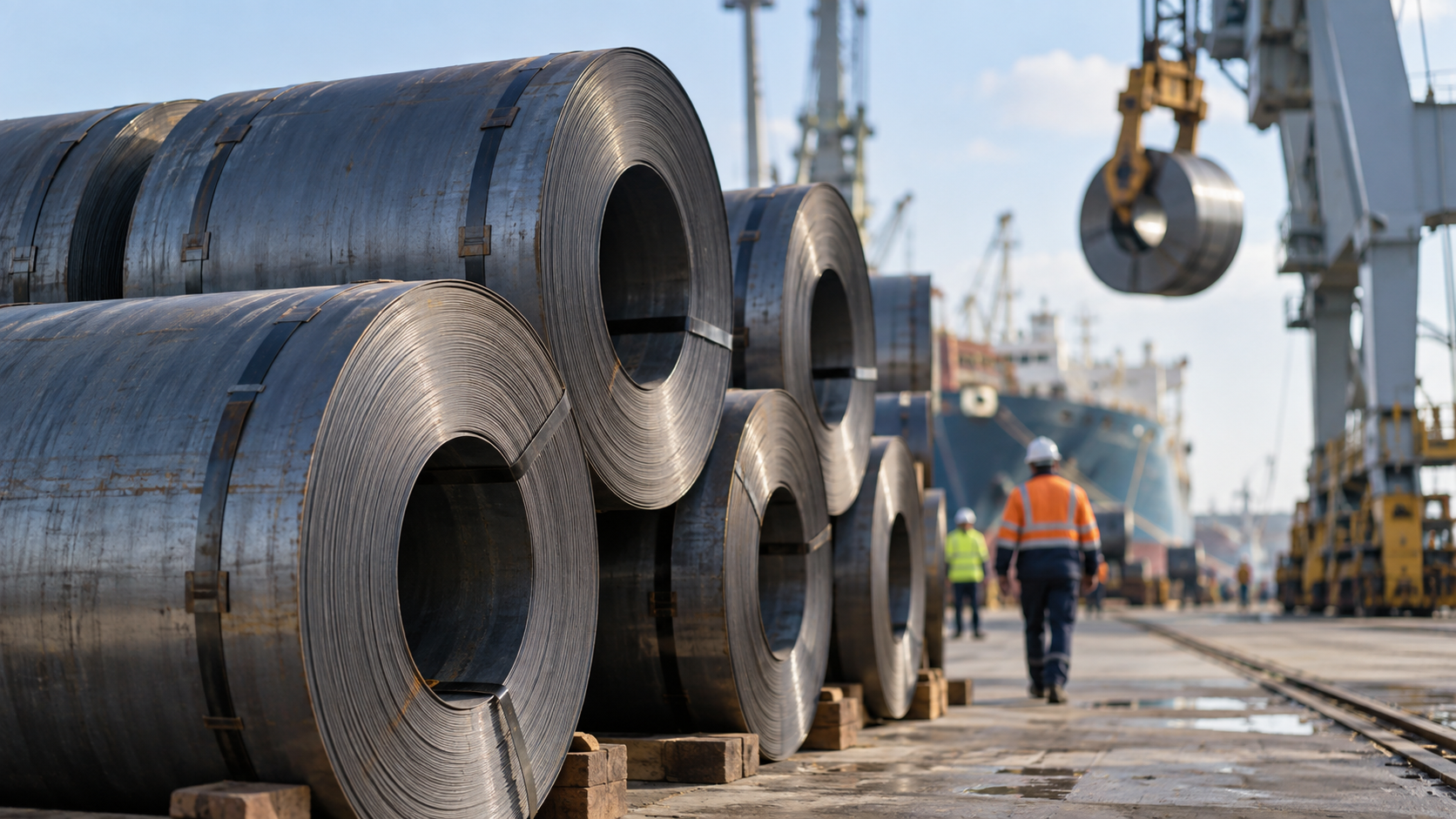
The Steel Stress Test. The cleanest read on whether CBAM is delivering is the European integrated steel industry. ThyssenKrupp Steel is building Germany’s largest direct reduction plant at Duisburg, 2.5 million tonnes per year of DRI capacity, targeting completion late 2026, backed by €2 billion in federal and North Rhine-Westphalia funding. Salzgitter’s SALCOS Phase 1 carries a €2.5 billion price tag, with €1.3 billion in public support after a €322 million top-up confirmed in February 2026, and first DRP-EAF steel scheduled for the first half of 2027. Phases 2 and 3 have been pushed by approximately three years, with the investment decision now slipping into 2028 to 2029. ArcelorMittal pulled the plug on the Dunkerque DRI and hydrogen project entirely, replacing it in February 2026 with a €1.3 billion electric arc furnace announcement for 2029 first production, citing in writing the inadequate predictability of CBAM enforcement and insufficient protection against unfair imports. ArcelorMittal also cancelled its German DRI projects in mid-2025. Voestalpine’s Linz greentec project continues at lower tempo. The pattern is unambiguous: domestic CBAM coverage tilts the math but does not close it. Green steel premiums of €100 to €200 per tonne over conventional product remain non-competitive in third markets without parallel CBAM-equivalent coverage in the destination jurisdiction.
The Scope Creep Vector. On 17 December 2025, the Commission published a draft regulation adding 180 downstream products to CBAM, targeting goods with 79 percent average steel or aluminium content, including washing machines, wire, cable, vehicle components, and construction hardware. Proposed entry into force is 1 January 2028. A Commission report on extending coverage to chemicals and other sectors is due in 2027. The mechanism is metastasising in line with the original design: every value chain that contains an in-scope feedstock becomes a circumvention vector unless absorbed. Each expansion sharpens the bilateral pressure on the defensive adopters and widens the trade-frontier surface area with the antagonists.
The Verdict. CBAM is succeeding where every Conference of the Parties failed: it is forcing a global price on carbon through import market gravity rather than through multilateral consensus. The cost is a tiered global trading system in carbon-intensive goods. By 2030, expect a meaningful share of EU imports under effective carbon pricing, accelerating ETS adoption in China, India, Türkiye, and likely Brazil and Indonesia, and a permanent trade frontier with the United States and the carbon-rejectionist bloc. The European steel restructuring will be slower and less ambitious than the 2021 net-zero plans implied, but the survivors will be the ones tuned to the CBAM gradient. The carbon schism is the new fault line in global trade. Position accordingly.
Read our full Report Disclaimer.
Report Disclaimer
This report is provided for informational purposes only and does not constitute financial, legal, or investment advice. The views expressed are those of Bretalon Ltd and are based on information believed to be reliable at the time of publication. Past performance is not indicative of future results. Recipients should conduct their own due diligence before making any decisions based on this material. For full terms, see our Report Disclaimer.