On 9 December 2025, the International Air Transport Association told its 350 member airlines that supply-chain dysfunction had cost the sector $11 billion in the calendar year. The line item that mattered was not fuel hedging or pilot wages. It was $2.6 billion in elevated engine leasing costs, $3.1 billion in additional maintenance spend, and $4.2 billion in fuel burned by older airframes that should have been retired in 2023. The narrative of the post-COVID aviation recovery has fixated on Boeing’s 737 MAX manufacturing chaos: door plug, FAA production cap at 38 per month, the slow climb back. That story is real, and it is incomplete. The binding constraint on the global commercial fleet in 2026 is not airframes. It is engines. Roughly 835 single-aisle jets sit in storage, of which 747 are powered by Pratt & Whitney’s PW1100G geared turbofan. The aircraft are new. The fault is in the hot section.
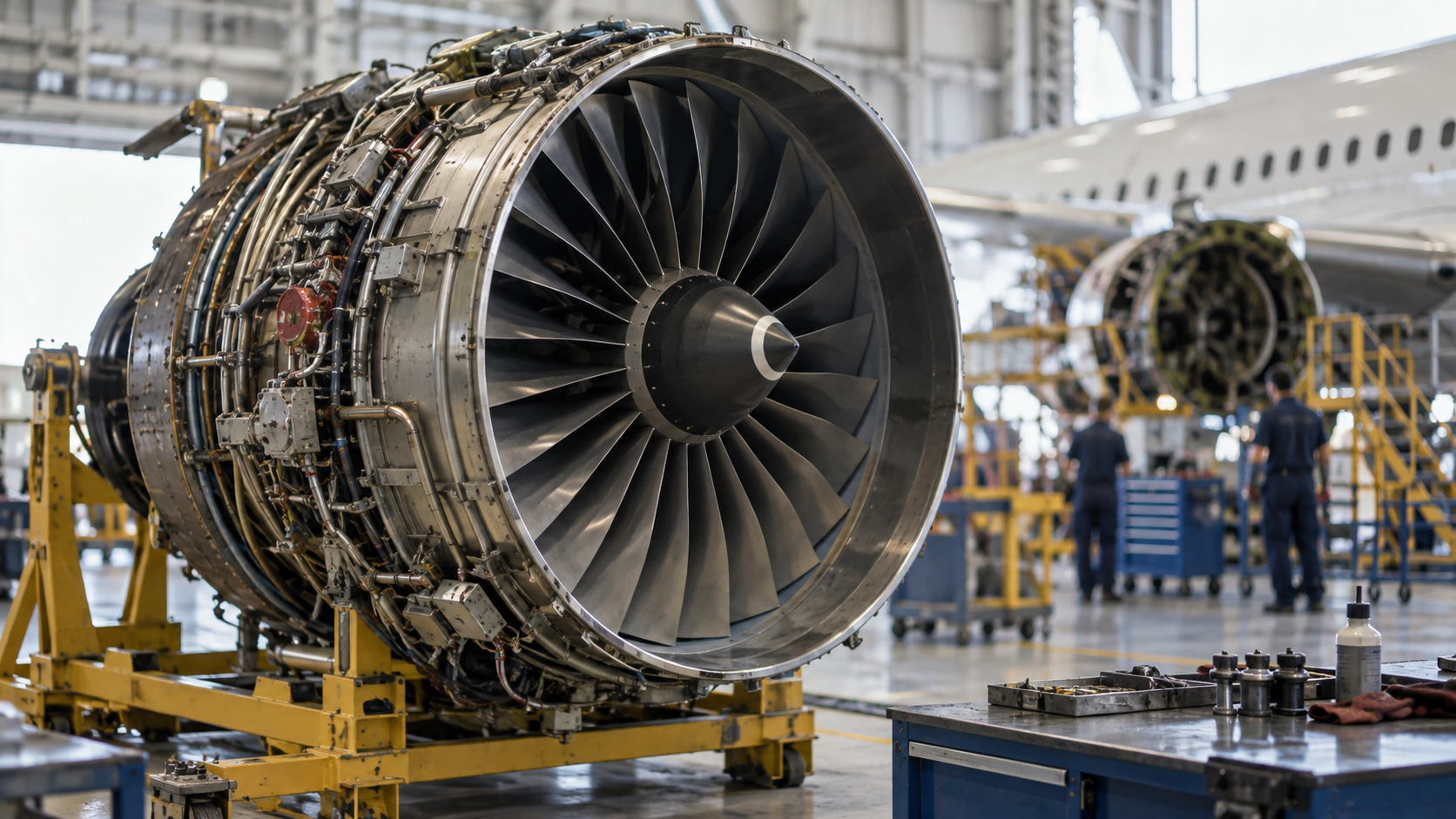
The Powder-Metal Inheritance. In September 2023, RTX disclosed that powder metal manufactured at Pratt & Whitney’s East Hartford facility between 2015 and 2021 carried microscopic contaminants. The affected parts were the high-pressure turbine and compressor discs of the GTF engine line, which powers the A320neo, A220, and Embraer E2. RTX took an initial $3 billion charge in Q3 2023, then expanded gross programme cost to a $6 billion to $7 billion range across multiple years. The 2025 cash-flow drag landed at $1.5 billion, with the partner-adjusted lifetime hit settling around $7.5 billion. Pratt & Whitney holds a 51 percent share of the PW1100G; Germany’s MTU and Japan’s JAEC absorb the residual. The mechanical problem is straightforward and the remediation is brutal. Contaminated discs must be removed, inspected via a fluorescent-penetrant process, and either re-lifed or scrapped. Roughly 600 to 700 engine removals were scheduled across the 2023 to 2026 window, equivalent to 27 percent of the in-service PW1100G fleet. Pratt initially modelled an average of 350 A320-family groundings per year through 2026. The actual peak overshot. By mid-2025 the AOG count for GTF-powered single-aisles passed 700; by Q4 of that year the broader aviation footprint of storage and AOG aircraft tied to engine availability had reached 835.
Shop-Visit Time As Hidden Variable. Industry shop visits for new-generation narrowbody engines have lengthened by over 150 percent versus the pre-pandemic baseline. For the PW1100G specifically, inspection turnaround sits at 250 to 300 days. The MRO network is running flat out: global engine MRO demand is projected to peak in 2026 and to exceed installed capacity by more than 17 percent before 2030. The order backlog at Pratt and CFM together stands near 30,000 engines, against an installed base that will require shop visits at historically elevated rates as the LEAP and GTF fleets age into their second and third overhaul cycles. The supply chain that supports a single engine overhaul touches roughly 14,000 part numbers; a single missing forging extends a 300-day shop visit by another 30 to 60 days. The arithmetic does not heal quickly.
CFM Is Not a Refuge. The other half of the narrowbody duopoly, CFM International, a 50/50 joint venture between GE Aerospace and Safran, faced its own durability problem. The LEAP-1A and LEAP-1B suffer accelerated high-pressure-turbine wear in hot-and-dusty operating conditions, with Middle Eastern and South Asian operators worst affected. CFM certified a high-pressure-turbine durability kit and a reverse-bleed system for the LEAP-1A in December 2024, produced 1,200-plus kits within twelve months, and retrofitted roughly half the in-service LEAP-1A fleet through 2025. The LEAP-1B fix for the 737 MAX is later, with introduction targeted from early 2026. The NTSB layered an additional concern in June 2025 with an urgent recommendation on smoke ingress in the cabin and cockpit. CFM Q1 2025 LEAP deliveries fell year-on-year, with LEAP-1A kit installations cannibalising new build capacity.
The Widebody Echo. The widebody market has its own version of the same disease. Rolls-Royce certified the Trent 1000 XE build standard in mid-2025 for the 787, aimed at doubling time on wing, and is rolling the same RR1073 disc alloy into the Trent XWB-84 and XWB-97 for the A350 family. The XWB-97 in particular drew durability complaints from Gulf carriers operating in high-dust environments. Rolls has explicitly prioritised durability fixes over new-product development, a strategic posture that pushes any clean-sheet UltraFan derivative further into the 2030s. The widebody engine bottleneck is narrower in absolute aircraft count than the narrowbody one but binds tighter on long-haul yield, where each grounded A350 represents 300-plus seats and a route-network anchor.
The Airline Casualty List. Wizz Air parked 40-plus aircraft, peaking near 60, with management telling investors that GTF groundings would not fully unwind before end-2027. IndiGo held 64 grounded A320neo-family jets at one point, around 17 percent of fleet capacity, and signed wet-lease arrangements with Qatar Airways and others to hold the schedule together. Lufthansa Group reports the impact distributed across subsidiaries. The collective effect is roughly 150,000 daily seats removed from global capacity. The downstream consequences are visible in yields: airlines with constrained-but-flying fleets are reporting load factor and average-fare improvements on routes where competitor capacity has been shaved. Some operators, particularly in the lessor secondary market, have been stripping new-build A320neos for spare GTF modules, where individual engine market values now exceed the residual airframe.
The Airframer Bind. Airbus targeted 820 deliveries for 2025, cut to 790, and landed at 793. Its 2026 plan is 870. CEO Guillaume Faury has publicly acknowledged that supply negotiations with Pratt & Whitney are unsatisfactory and that engine availability remains short of A320 final-assembly demand. Boeing, by contrast, is fighting a different war: the FAA lifted the 737 MAX production cap from 38 to 42 per month during 2025, Boeing delivered 325 MAX aircraft through end-September, and management is signalling a path to 47 in the first half of 2026 and 53 by year-end. Engine availability is a smaller constraint at Boeing than at Airbus because the LEAP-1B durability fix is further behind but the production volume is lower. The paradox is sharp: Airbus has out-delivered Boeing in three of the last four years, yet the gap is narrowing because Pratt’s powder-metal inheritance hits the A320neo line harder than CFM’s durability programme hits the 737 MAX line.
The Economics Behind the Curtain. Spare-engine lease economics have re-rated upward. CFM56-7B lease rates are up 40 percent versus 2021. V2500-A5 rates sit at $70,000 to $80,000 per month and rising. Short-term lift on the CFM56-7B regularly clears six figures monthly. Engine OEMs face a perverse strategic alignment: each shop visit is a cash-generative event, with the aftermarket carrying margins that new-engine sales do not. Pratt, CFM, Rolls, and MTU have ample financial incentive to fix the underlying durability without unduly compressing the shop-visit cadence. MTU’s quarterly reports show GTF MRO revenue growing while underlying programme economics remain encumbered by the powder-metal liability. The bottleneck is not just a manufacturing problem. It is a pricing-power realignment between engine OEMs and the airlines and lessors that operate the fleet.
The Verdict. Engine availability, not airframe production, is the structural constraint on global aviation through 2027 and likely into 2028. The IATA view that the structural mismatch between airline requirements and production capacity will not normalise before 2031 to 2034 is the correct framing. The transmission mechanism into the broader economy runs through air-cargo capacity, business-travel friction, and inbound-tourism volume in markets where carriers have parked 15 to 20 percent of fleet. Engine OEMs emerge from the cycle with re-rated pricing power and a captive aftermarket. Airbus has slipped relative to Boeing on the delivery scoreboard despite Boeing’s manufacturing chaos, because Pratt’s hot section is the binding constraint and CFM’s is merely a tight one. The aviation system will heal. It will not heal cheaply, and it will not heal on the timeline the airlines bought into when they placed their orders.
Read our full Report Disclaimer.
Report Disclaimer
This report is provided for informational purposes only and does not constitute financial, legal, or investment advice. The views expressed are those of Bretalon Ltd and are based on information believed to be reliable at the time of publication. Past performance is not indicative of future results. Recipients should conduct their own due diligence before making any decisions based on this material. For full terms, see our Report Disclaimer.