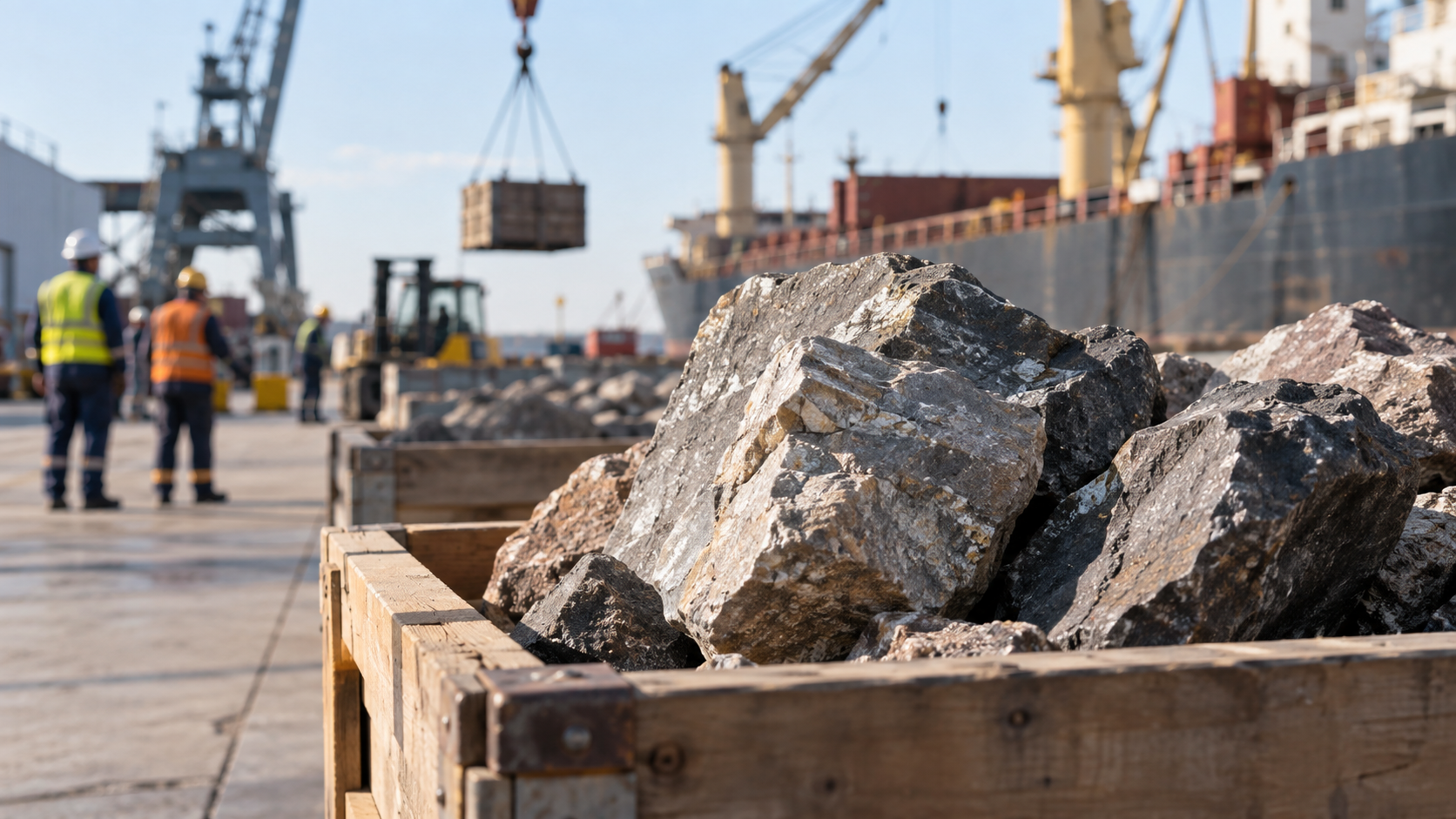
On 24 April 2026, US Secretary of State Marco Rubio and EU Trade Commissioner Maroš Šefčovič signed a Memorandum of Understanding on a Strategic Partnership for Critical Minerals at the Treaty Room of the State Department. The signing closed a year of bureaucratic stop-start work on transatlantic raw-materials policy and produced a document that is, on its face, an industrial framework: coordinated subsidies, joint stockpiles, common standards, aligned approaches to third countries. Beneath the diplomatic surface, it is a more unusual admission. Western governments have accepted that breaking China’s grip on rare earths, lithium, cobalt, gallium, germanium, and the dozens of other inputs that hold the Western industrial economy together cannot be done with mines alone. It will require markets.
The Pricing Asymmetry. China currently controls roughly 90 percent of global rare-earth processing capacity, dominant shares of tungsten, antimony, gallium and graphite, and a near-monopoly on the heavy rare earths that magnetise high-temperature motors. Bloomberg Intelligence projects that figure to fall to 69 percent by 2030 as Australian, American and African supply ramps. The shift sounds like progress, and it is. Yet the more telling data point sits inside Beijing’s pricing structure. Dysprosium oxide traded at roughly $190 per kilogram on the Shanghai Metals Market in early March, while the same product priced at $317 per kilogram FOB China for export. Terbium oxide moved at $804 domestic and $1,182 FOB. The differential is not a market signal. It is a tax on outsiders, set by Beijing through quota, licensing and informal allocation. Western buyers do not negotiate against a transparent benchmark. They pay what China decides they pay.
Mines Without Markets. Western capital has finally moved at scale. The US Department of Defense holds a ten-year offtake agreement with MP Materials at a $110 per kilogram price floor for neodymium-praseodymium oxide, the workhorse input of the rare-earth permanent-magnet supply chain. The Defense Production Act has $1 billion authorised through September 2027. The 2025 reconciliation legislation seeded a $2 billion National Defense Stockpile transaction fund. An April 2026 Kamoa Capital memo counted twelve federal agencies, more than $700 billion in authorised industrial capital, and a deployment rate of approximately 15 percent, choked by permitting bottlenecks. In Brussels, the Critical Raw Materials Act, in force since May 2024, has now selected 47 strategic projects inside the EU and 13 in partner countries, with benchmarks of 10 percent extraction, 40 percent processing and 25 percent recycling of bloc demand by 2030. The mines are coming. The plants are coming. The supply curve is being built. None of this answers the question of who sets the price.
The Metalshub Bet. A Düsseldorf-based digital trading venue, Metalshub, has positioned itself as the most plausible candidate for that role in Europe. The platform, which is supported by the European Institute of Innovation and Technology’s RawMaterials body, already runs structured tenders for ferroalloys, nickel and alumina, and has begun extending its architecture to rare earths and other strategic inputs. It is partnered with the London Metal Exchange on a verified low-carbon nickel benchmark, demonstrating the regulatory and audit machinery required to host a credible reference price. Specialist price reporting agencies such as Argus, Fastmarkets and Benchmark Mineral Intelligence already publish assessed rare-earth quotes drawn from bilateral data, but assessed prices are weaker than transacted ones for the purposes of bank financing and hedging. Its proposition is narrow and realistic. It does not promise to replace China as the marginal producer. It promises to host enough non-Chinese transactions, on a standardised contract, with auditable counterparty data, to allow a separate benchmark to emerge. Once that benchmark exists, Western buyers can index supply contracts to it, hedge against it, finance against it, and underwrite long-term offtake to mines that today cannot raise capital because no banker can model their forward revenue.
The Capital Wall. The financing logic explains why the MoU and the trading platform matter together rather than separately. A Western rare-earth project today faces a terms problem. Capital costs are dollar-denominated and structured around 10 to 15-year payback assumptions, but revenues are dictated by an opaque pricing system that Beijing can collapse at will. China demonstrated that capability between 2014 and 2017, when it engineered a price slump that drove Molycorp into bankruptcy in 2015 and pushed Lynas to the edge of insolvency. Without an independent benchmark, every Western project lives under the same overhang. A $110 per kilogram price floor from the Pentagon partly offsets the risk for one company. A liquid, audited Western reference price would offset it for an industry. The MoU language about joint standards to facilitate Western trade is, at its operational core, a commitment to build that infrastructure. It is also why Tokyo, Seoul and Canberra are watching for a permission slip to plug into the same standards.
The Strategic Logic. Beijing has read the trajectory and responded with calibrated escalation. The October 2025 export-control package and the early-2026 tightening on heavy rare earths produced licensing approval rates below 25 percent for some European applicants and price spikes of up to sixfold outside China, with terbium and dysprosium more than doubling year-to-date. The instrument is precise. It is not designed to starve Western industry; it is designed to demonstrate that Beijing retains the option to do so, and to keep capital allocators uncertain enough that Western mine investment continues to under-deploy relative to authorisation. The countermove is not symmetrical. The West cannot match Chinese processing capacity in five years. It can, however, build a market that pricing power cannot easily reach. Trading venues are harder to coerce than mines. They are governed by Western regulators, host Western counterparties, and settle in Western currencies. Tokyo runs a parallel architecture through JOGMEC, has held strategic rare-earth stockpiles since the 2010 Senkaku embargo, and recently expanded its offtake relationship with Lynas. Seoul and Canberra are aligned on the same direction. China can decline to participate in a Western pricing layer. It cannot capture the architecture.
The Verdict. Strategic autonomy in critical minerals will be measured in three places. The first is tonnes pulled out of the ground in Western Australia, Greenland, the Carolinas and the Iberian peninsula. The second is processing capacity installed in Texas, Estonia, Saskatchewan and the Pilbara. The third, and the one most easily forgotten in the political theatre of mine ribbon-cuttings, is whether a credible non-Chinese reference price exists by the time those tonnes need to clear. The Washington MoU acknowledges all three layers in the same document for the first time. It commits Western governments to fund the first two and to standardise the third. The execution risk is heavy. Permitting timelines remain a Western liability that Beijing does not face. Treasury financing tools are running into 2027 expiry dates. The Metalshub model still has to scale through products where Chinese transactions dominate volume. None of these problems are solved by signing ceremonies. They are solved by deployment, and the deployment ratio so far is unflattering. What changed on 24 April is not the answer. It is the question. Western strategy has moved from where do we dig to where does the price clear, and that is the more important conversation.
Read our full Report Disclaimer.
Report Disclaimer
This report is provided for informational purposes only and does not constitute financial, legal, or investment advice. The views expressed are those of Bretalon Ltd and are based on information believed to be reliable at the time of publication. Past performance is not indicative of future results. Recipients should conduct their own due diligence before making any decisions based on this material. For full terms, see our Report Disclaimer.