
On 24 November 2025, BHP formally withdrew from its eighteen-month pursuit of Anglo American, ending a sequence of bids that had started at $39 billion in May 2024 and crested at $49 billion before the target’s board walked into the arms of Teck Resources instead. The combined Anglo-Teck vehicle, valued at roughly $53 billion, will sit just inside the world’s top five copper producers. The defining fact of the episode is not the failed deal, but what it revealed: the two largest diversified miners on the planet would rather spend two years in a defensive auction than break ground on new copper supply. That preference is the heart of the squeeze now arriving in the market for the metal that physically carries the energy transition and the artificial intelligence build-out. The capital is real, the projects are not, and the price action of the past eighteen months has begun to confirm what most consumers of copper still refuse to model: refined supply will not meet demand growth for the rest of this decade, and probably not for the rest of the next.
Demand Pulls From Two Directions At Once. Copper’s structural call is no longer carried by Chinese property and white goods. It is now driven by two compounding curves running in parallel. A battery electric vehicle uses approximately 72 kilograms of copper against roughly 25 kilograms for the internal combustion equivalent, a near-tripling of intensity for every unit of automotive output that converts. Grid-scale stationary storage uses around one tonne per megawatt-hour of installed capacity. Offshore wind consumes between 5 and 15 tonnes per megawatt depending on cable routing, and a single HVDC interconnector project can absorb several hundred thousand tonnes of refined metal in conductor alone. Then comes the second curve. A hyperscale AI data centre runs between 26 and 33 tonnes of copper per megawatt of installed IT load once on-site power distribution, busways, and substation tie-ins are counted, with the largest reference campuses approaching 50 tonnes per megawatt at the upper end. A single 1 GW AI campus, of the kind now being permitted across Texas, Virginia, and the Gulf states, requires between 27,000 and 50,000 tonnes of refined copper. BHP estimates copper demand from data centres alone will reach 1.1 million tonnes per year by 2030, close to three percent of global consumption. Wood Mackenzie’s base case has total copper demand rising 24 percent to 42.7 million tonnes by 2035.
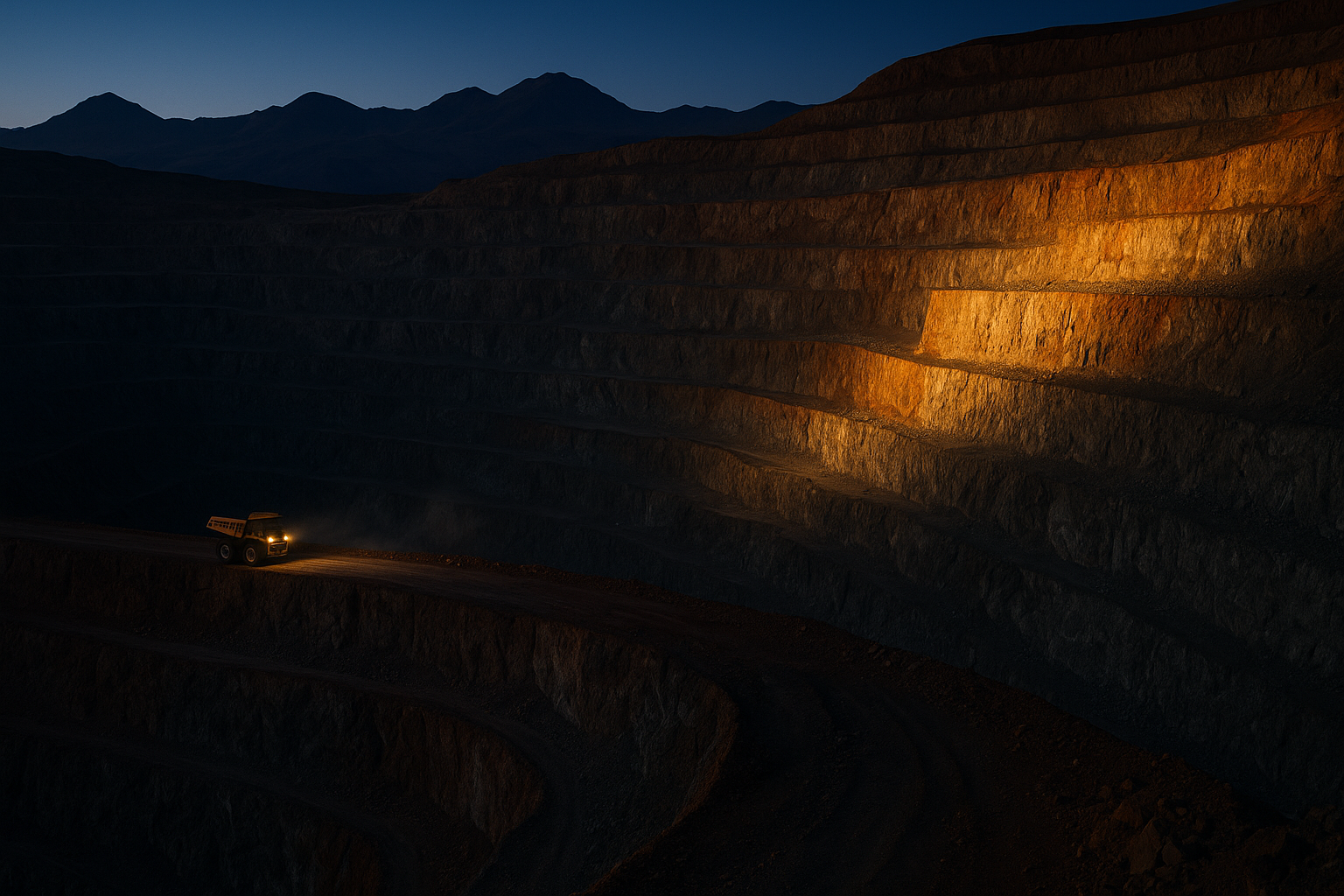
The Supply Side Has Stopped Working. The geology is exhausted before the spreadsheets are. BHP’s Escondida in northern Chile, the largest copper mine in the world, posted record output of 750,300 tonnes in fiscal 2025, a 16 percent year-on-year gain, but the company has already guided that concentrator feed grade will begin its structural decline from financial year 2027. The 410,000-tonne Full SaL leach project announced in 2025 spreads its production over a decade and is engineered explicitly to offset that decline, not to grow on top of it. Codelco, the Chilean state miner, lifted output to 1.328 million tonnes in 2024 against a 25-year low, then promptly cut its 2025 guidance after a fatal collapse at the El Teniente block-cave; direct C1 cash costs rose to 208.6 cents per pound, against a price that was carrying its industry but no longer rescuing its costliest producer. First Quantum’s Cobre Panama, a 350,000-tonne-per-year operation, has been shuttered since December 2023 after the Supreme Court of Panama ruled its operating contract unconstitutional; the government’s audit is expected to conclude in early 2026 but the political surface for a restart remains hostile. Rio Tinto’s Oyu Tolgoi in Mongolia is the rare bright spot, with underground output up 61 percent in 2025, but its plateau of 500,000 tonnes per year is not scheduled to begin until 2028. No major new copper mine has reached first ore on its original schedule since 2014.
Project Lead Times Are A Self-Inflicted Wound. S&P Global’s authoritative dataset on 127 mines puts the global average lead time from discovery to first production at 17.9 years for projects starting up between 2020 and 2023, up from 12.7 years for those commissioned fifteen years earlier. For copper specifically, the global figure rises to 24.1 years. The United States now sits at 31.8 years, second-longest in the world, with permitting alone accounting for between seven and ten years of that timeline before any earthworks begin. Resolution Copper in Arizona, a project capable of supplying roughly a quarter of US copper demand, finally received its federal Record of Decision on 16 March 2026, almost three decades after Rio Tinto and BHP first staked the deposit; production is still not scheduled before the early 2030s. Antofagasta’s Twin Metals copper-nickel project in Minnesota remains in legal and permitting limbo. PolyMet, Pebble in Alaska, Rosemont, and Black Butte have moved laterally or backward over the past decade. A country that wants to be a sovereign supplier of copper has chosen, through its courts and its agencies, not to be one.
Recycling Is Not The Backstop. The orthodoxy that secondary supply absorbs the gap does not survive contact with the numbers. Recycled copper supplied roughly 30 percent of global demand in 2024, a share that has been broadly flat since 2015 because scrap availability is gated by the rate at which previously installed copper enters its end-of-life cycle. The transformer in a substation lives 40 years; the windings in a motor live 25; the wiring in a building lives the life of the building. The International Energy Agency projects the recycled share will rise toward 40 percent only by 2050, and a meaningful surge in EV and battery scrap is not expected before 2030. Until then, the marginal tonne of copper required to wire a data centre, energise a battery, or string an HVDC line must come from a hole in the ground.
China Has Built The Smelters Anyway. The market signal of the deficit is already visible in the smelting layer. Spot copper concentrate treatment and refining charges, the fee miners pay smelters to process their ore, collapsed to minus $60 per tonne in 2025, meaning smelters were paying miners for access to feed. Antofagasta and one Chinese counterparty settled annual TC/RCs at zero. China’s smelter group, the CSPT, announced production cuts of more than 10 percent for 2026; the state-backed industry association declared it firmly opposes the structure of negative charges that its own overbuild created. Chinese smelting capacity now exceeds available global concentrate by a wide enough margin to invert the economics of the entire midstream. At the upstream end, Chinese capital has captured an estimated 40 percent of new African copper mine capacity over the past decade: Zijin holds 39.6 percent of Kamoa-Kakula alongside Ivanhoe, CNMC controls Chambishi, and CMOC operates Tenke Fungurume. The West’s largest miners spend their copper budgets on each other; China’s spend theirs on tonnes.
The Price Has Already Begun To Tell. LME three-month copper has held a $9,500 to $10,500 per tonne range through most of 2025 and broke to fresh highs into year-end. Goldman Sachs, having earlier called for a softer 2026, lifted its average forecast to roughly $11,400 per tonne in mid-December 2025. Citi expects the average to reach $10,500 in 2026 and exceed $12,000 by year-end. JP Morgan has the Q2 2026 print near $12,500 and a full-year average close to $12,075. Wood Mackenzie’s deficit math implies that 7.8 million tonnes of new primary supply must be commissioned by 2035 simply to balance the market on its base-case demand path, against an industry currently struggling to add a net 200,000 to 300,000 tonnes a year. The S&P Global Market Intelligence variant of the same exercise produces a 10 million tonne shortfall by 2040. The price needed to clear that imbalance, on any reasonable cost-curve assumption, is materially higher than today’s.
The Verdict. Copper is the one physical input that every credible energy-transition scenario, every AI capacity plan, and every grid-resilience programme converges on, and it is the input the West has chosen to underbuild. The capital is not absent, it is misallocated: into merger premia, share buybacks, and brownfield extensions of orebodies that geology is quietly retiring. The decade of inaction between 2014 and 2024 cannot be compressed; new primary tonnes that arrive in 2035 had to be sanctioned in 2025, and most were not. Investors who own the cost curve, the producing assets with multi-decade reserve life, and the rare permitted greenfield projects in stable jurisdictions hold a structurally short market by the throat. Governments that have outsourced their copper supply to Chinese balance sheets in Africa, and to their own permitting agencies at home, will discover that the metal does not care about industrial policy slogans. The squeeze is no longer a forecast. It is a price action, a TC/RC reading, and a failed $49 billion bid, and it will set the cost of every electron the West intends to consume.
Read our full Report Disclaimer.
Report Disclaimer
This report is provided for informational purposes only and does not constitute financial, legal, or investment advice. The views expressed are those of Bretalon Ltd and are based on information believed to be reliable at the time of publication. Past performance is not indicative of future results. Recipients should conduct their own due diligence before making any decisions based on this material. For full terms, see our Report Disclaimer.