
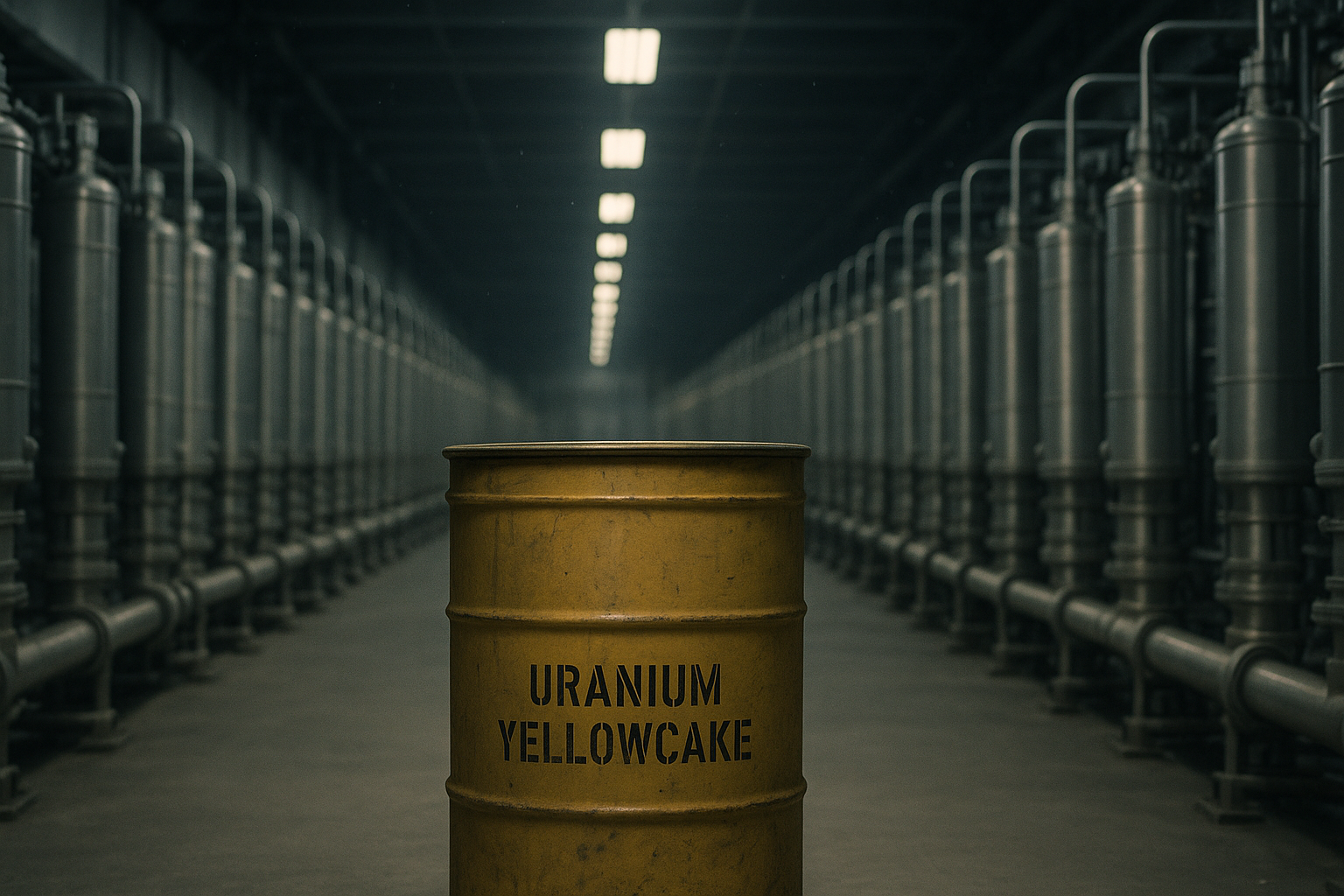
On 31 March 2026, TradeTech’s Long-Term Uranium Price Indicator closed at $93.00 per pound of U3O8, an 18-year high and a $6.50 jump in a single quarter. The spot market, meanwhile, hovered near $86.25 per pound after touching $101.41 on 29 January. The divergence is the tell: utilities are no longer buying pounds, they are buying decades, and the curve says they expect to keep paying. The atomic revival is now a settled fact. Twenty-five governments signed the COP28 Declaration in December 2023 pledging to triple global nuclear capacity to roughly 1,200 GW by 2050, a count that has since risen to thirty-three with Rwanda and Senegal joining at COP30 in Belém. Vogtle Units 3 and 4 in Georgia, the first new American AP1000s in a generation, are online and clearing 17.2 TWh of carbon-free electricity per year. EDF’s board has authorised an initial EUR 2.7 billion for the six-reactor EPR2 fleet at Penly, Gravelines and Bugey, with a final investment decision targeted for the end of 2026 against a EUR 72.8 billion programme cap. The UK closed the Sizewell C deal at GBP 38 billion in July 2025. The hyperscalers have stopped flirting and started signing.
The Hyperscaler Wedge. Microsoft and Constellation closed a 20-year offtake at the renamed Crane Clean Energy Center, the former Three Mile Island Unit 1, an 835 MWe restart targeted for 2028, backed by a USD 1 billion DOE loan and the largest single corporate clean-energy purchase ever signed. Amazon committed USD 500 million as anchor in X-energy’s Series C-1 plus an Energy Northwest Xe-100 four-pack scaling to 960 MW in central Washington. Google has a 500 MW order book with Kairos Power. Meta signed a 20-year nuclear PPA with Constellation’s Clinton plant alongside its 2.5 GW Louisiana build-out. The demand picture is unambiguous. The supply picture is where the realpolitik bites.
The Mine Side: Athabasca Misses, Kazakhstan Pulls Back. Cameco cut McArthur River and Key Lake guidance to 14-15 million pounds U3O8 for 2025 on a 100 percent basis, down from 18 million, citing slower ground freezing and development delays. Cigar Lake remains on track at 18 million pounds, with strong year-to-date performance offsetting roughly 1 million pounds of the McArthur shortfall. Kazatomprom, the world’s largest producer at roughly 40 percent of mine output, delivered 67.18 million pounds (25,839 tU) in 2025 on a 100 percent basis, a 10-11 percent year-on-year rise. Then it pivoted. For 2026 the national champion guided down by approximately 10 percent to 27,500-29,000 tU and explicitly told the market it does not view current contracted demand as sufficient to justify a full return to 100 percent subsoil-licence levels. Translation: Kazakh discipline is now a price-support policy. The second-tier names are picking up the slack thinly. Paladin’s Langer Heinrich in Namibia, restarted in March 2024, hit 1.07 million pounds for the September 2025 quarter and is on track for nameplate 6 million pounds per year by end-2026. NexGen’s Rook I and Arrow project in the Athabasca Basin remains the largest undeveloped Western deposit but is still pre-construction. The mine pipeline is real, but it is back-loaded and concentrated.
The Enrichment Bottleneck. Four entities control roughly 95 percent of commercial enrichment capacity. Rosatom’s TENEX sits at approximately 27 million SWU per year, around 44 percent of the world total. Urenco follows at 17 million SWU (about 27 percent), CNNC at 11 million SWU (about 17 percent), and Orano at 7.5 million SWU (about 12 percent). Russia and China together hold over 60 percent of global SWU. This is the input the West cannot substitute on a five-year horizon. Centrifuge cascades are five-to-seven year capital projects with long-lead bearings, magnetic suspensions and rotor steel; you cannot pour concrete and produce SWU next quarter. Urenco USA started a new cascade in Eunice, New Mexico in May 2025, the first phase of a 700,000 SWU annual expansion completing in 2027, with parallel 15 percent capacity additions in the Netherlands and Germany totalling over 1.45 million additional SWU. Orano is pushing Georges Besse II up by 30 percent. These are sizeable, but stacked against Rosatom’s footprint and a tripling demand vector, they buy time, not parity.
The Russian Uranium Ban and Its Loopholes. President Biden signed the Prohibiting Russian Uranium Imports Act on 13 May 2024, with enforcement beginning 11 August 2024. The teeth are real: a hard ban on natural uranium and unirradiated LEU from Russian entities. The carve-outs are realer. The Secretary of Energy retains waiver authority through 1 January 2028 where no alternative viable supply exists or where imports are deemed in the national interest. Centrus Energy holds one of those waivers, authorising Russian LEU imports for delivery to US customers in 2024 and 2025, with a DOE decision on 2026-2027 explicitly deferred. Moscow retaliated in November 2024 with its own counter-ban on enriched uranium exports to the US through end-2025 and revoked existing export licences, partially weaponising what Washington had tried to phase out on its own schedule. The EU has refused a full ban under the REPowerEU framework, blocked principally by Hungary’s dependence on Russian fuel for Paks. Brussels’ May 2025 plan now targets a coordinated end to Russian oil, gas and uranium contracts by end-2027 via a ban on contract extensions and new signings. Rosatom’s foreign revenues slipped to USD 16.5 billion in 2025 from USD 18-plus billion, its first decline in years.
The HALEU Cliff. The SMR pipeline lives or dies on High-Assay Low-Enriched Uranium, enriched to 5-20 percent U-235. Nine of ten US-funded advanced reactor designs require it. DOE projects more than 40 metric tonnes of HALEU needed by 2030 and roughly 50 MT per year by 2035, climbing to 520 MT per year by 2050 in a net-zero pathway. Against that demand, Centrus Energy’s American Centrifuge Plant in Piketon, Ohio is running at an annualised rate of 900 kilograms of HALEU UF6 under its DOE Phase II contract, which DOE extended through 30 June 2026 with USD 99.3 million in target cost. Centrus has cumulatively delivered over 920 kilograms to DOE. The arithmetic is brutal: at 900 kg per year versus a 40,000 kg-by-2030 requirement, the West currently produces about 2 percent of what its own reactor developers need by the end of the decade. Phase III options exist for up to eight years of additional production beyond mid-2026, but they remain at DOE’s sole discretion and subject to appropriations. NuScale’s US460 received Standard Design Approval in May 2025 and signed a 6 GW deployment framework with TVA and ENTRA1 in September 2025; X-energy’s Xe-100 four-packs are pencilled in for hyperscaler campuses; Kairos’s Hermes demonstrator is on track for 2027. Every one of those projects is a HALEU customer the West cannot yet supply at scale.
The Verdict. The atomic revival is real, financed and politically endorsed. Spot uranium at $86 and long-term contracts at $93 reflect demand discovery, not speculation. The structural short, however, is not in the ground. It is in the cascades. Western enrichment capacity additions of roughly 2 million SWU per year by 2027 buy time but do not displace Rosatom’s 27 million SWU within the relevant decision horizon for any utility signing today. HALEU sits at less than one tonne per year against a 40-tonne 2030 requirement, a gap that no single Centrus extension closes. The investable conclusions are narrow and durable. Mine-side exposure (Cameco, Kazatomprom, NexGen, Paladin) is the lowest-risk leg given Kazakh production discipline and Athabasca grade. Conversion and enrichment (Centrus, Cameco’s UF6, Orano, Urenco) is where the policy-driven repricing is concentrated and where five-year lead times create the deepest moats. Kazakhstan’s strategic posture remains the single largest non-Russian swing variable; should Astana be coerced or co-opted into closer alignment with Moscow on fuel-cycle pricing, the West’s revival timetable slips by years. Buy what the centrifuges cannot.
Read our full Report Disclaimer.
Report Disclaimer
This report is provided for informational purposes only and does not constitute financial, legal, or investment advice. The views expressed are those of Bretalon Ltd and are based on information believed to be reliable at the time of publication. Past performance is not indicative of future results. Recipients should conduct their own due diligence before making any decisions based on this material. For full terms, see our Report Disclaimer.