
On 6 August 2025, Karol Nawrocki was sworn in as President of Poland after defeating Warsaw mayor Rafal Trzaskowski 50.89 to 49.11 in the second round on 1 June. The result froze, but did not reverse, the shift that had defined the preceding eighteen months under Prime Minister Donald Tusk. The fact that the world noticed at all is itself the story. Poland, a country whose strategic weight was once measured in how loudly it lobbied larger capitals, is now the country those capitals lobby. Within NATO it spends the most. Within the EU it grows the fastest. Along the eastern flank it stores the heaviest equipment. The Polish decade has begun on the simple arithmetic that Berlin is stalled, Paris is unstable, and Warsaw is paying cash.
The Defence Budget As Statement. Poland’s 2025 defence budget is PLN 186.6 billion, equivalent to roughly $47 billion and 4.7 percent of GDP. That is the highest share in NATO, ahead of the United States, and more than double the alliance’s still-aspirational 2 percent floor. Warsaw is now lobbying for a new 3 percent NATO minimum. In 2013 the same line item was PLN 21.28 billion at 1.72 percent of GDP. The 2025 number is up 18.1 percent year-on-year, a direct rebudgeting in response to the war in Ukraine, and the government has signalled it will push to 5 percent in 2026. Money on this scale is no longer a political signal. It is an industrial policy.
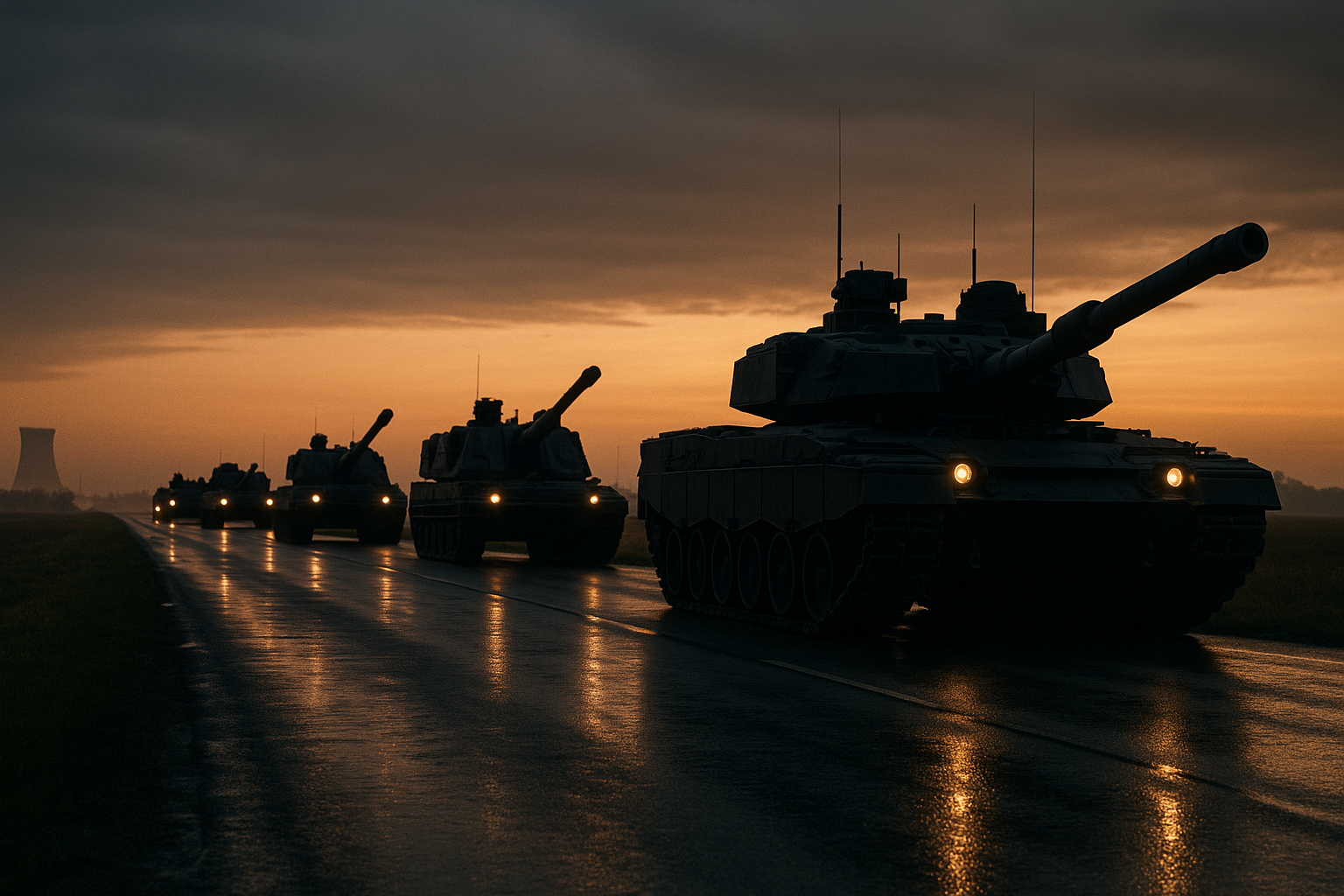
The Order Book. The hardware procured since 2022 reads like a NATO theatre command’s wish list, ordered in bulk and largely off the shelf. From the United States: 32 F-35A fifth-generation fighters with first deliveries scheduled in 2026, 96 AH-64E Apache attack helicopters under a deal of approximately $10 billion, 250 M1A2 SEPv3 Abrams tanks already in service, Patriot batteries, and 500 HIMARS rocket launchers. From South Korea, under contracts worth tens of billions of dollars: 1,000 K2 Black Panther tanks, 672 K9 Thunder self-propelled howitzers (the first batch of 212 already delivered), 290 K239 Chunmoo rocket systems rebadged as Homar-K, and 48 FA-50 light fighters. The active force expands from roughly 110,000 in 2015 and 205,000 at the end of 2024 to a planned 230,000 by year-end 2025, en route to a programmed 300,000 active-duty troops plus 200,000 reservists under the Armed Forces Development Programme 2025-2039. No other European army is growing at this pace from this base.
From Customer To Producer. The procurement story matters less than the industrial absorption story. In April 2026, Hyundai Rotem and PGZ subsidiary Bumar-Labedy in Gliwice signed a localisation deal for K2 production in Poland. Under the framework, Hyundai Rotem builds 117 tanks in South Korea and at least 63 are assembled at Bumar-Labedy, which is being upgraded to a 50-unit annual cadence by 2028, with full transfer of production, assembly, and MRO technology. Since July 2025, Hyundai Rotem has redirected its entire K2 production line to fulfil the Polish contract, more than tripling monthly output from three or four units to over ten. On the ammunition side, Mesko, also part of the Polish Armaments Group, will receive PLN 887 million of a PLN 2.4 billion ($663 million) FIK injection to scale 155mm shell output toward 150,000 rounds per year, with a new plant in Krasnik breaking ground in October 2025 and serial production targeted for early 2028. A new Eurenco-Mesko line for 155mm modular charges in Pionki reached operational readiness on 25 July 2025. The eastern flank’s logistics base, Powidz, was completed in October 2023 at a cost of $360 million in NATO and US funds, with around 650,000 square feet of climate-controlled warehousing housing roughly 2,700 weapons systems for the US Army’s V Corps forward element in Poznan.
The Economic Floor Under The Rifle. The defence push is sustainable only because the macro picture is. Polish real GDP grew 3.6 percent in 2025 against an EU average of 1.6, the fourth-fastest rate in the union behind Ireland (12.3 percent, distorted by multinationals), Malta, and Cyprus. Household consumption contributed 2.1 of those 3.6 points. Brussels and Warsaw forecast acceleration toward 4 percent in 2026 as private investment recovers. The capital flowing in is partly EU money that the previous government could not access. In February 2024, Tusk unlocked up to EUR 137 billion in EU funds, EUR 59.8 billion of which sits in the Recovery and Resilience Facility and up to EUR 76.5 billion in 2021-2027 cohesion envelopes, after the new government tabled judicial reforms judged sufficient to satisfy rule-of-law conditionalities. EUR 6.3 billion landed within weeks of the assessment. This is the single largest inward fiscal transfer to a European state since reunification-era Germany.
Demography, Borrowed And Owned. The labour-supply story is also unflattering when examined alone but transformative when paired with the Ukrainian inflow. Roughly 1.5 million Ukrainians moved into Poland after February 2022. As of May 2025, 987,000 held temporary protection status, the second-largest pool in Europe after Germany’s 1.2 million. Their employment rate hit 78 percent in 2024, the highest for displaced Ukrainians in the OECD, contributing a net 2.7 percent to Polish GDP that year. The workforce expanded by nearly 5 percent. Polish wages did not collapse; firm productivity rose. The longer-run native demographic curve remains negative, but Poland has, on the cheap, absorbed a Slavic, largely skilled labour cohort that no other European country has matched on retention or labour-market participation. Berlin spent more, retained fewer, and integrated worse.
The Cohabitation Constraint. Nawrocki’s August inauguration installed a PiS-aligned head of state opposite a Tusk-led coalition that controls the Sejm but not the presidential veto. The new president has pledged to block elements of Tusk’s judicial and social agenda. In a parliamentary republic this matters less than commentators in capitals further west tend to assume. Defence procurement, EU fund absorption, the Westinghouse-Bechtel AP1000 programme at Choczewo (Engineering Development Agreement signed April 2025 in Tusk’s and US Energy Secretary Chris Wright’s presence, EPC contract and Final Investment Decision targeted end-2025), and the Powidz logistics architecture all run through the executive and the defence ministry, not the presidential palace. Nawrocki can slow domestic legislation. He cannot rewrite the strategic posture, and on the central question of Russia, Ukraine support, and the US security relationship his instincts align with Tusk’s even where his domestic agenda does not. Berlin still hopes for a Polish-German axis under Friedrich Merz’s CDU-led coalition; Warsaw quietly prefers the Berlin-Warsaw axis to the Paris-Warsaw one, having concluded that Emmanuel Macron’s strategic-autonomy framing is a vehicle for French industrial policy rather than alliance hardening.
The Verdict. By the end of this decade Poland will field NATO’s largest European land force, operate the continent’s deepest 155mm production base, host the eastern flank’s primary US logistics hub, run three AP1000 reactors under construction or commissioning at Choczewo, and absorb the second-largest tranche of EU cohesion money in the bloc’s history. On current trajectories Polish GDP overtakes Spanish per-capita output before 2030 and approaches Italian aggregate output by the early 2030s. The defence industry, repolonised through localisation of K2, K9, Borsuk IFV, and 155mm production, becomes the second-largest in Europe behind France’s. None of this is the result of charisma in Warsaw. It is the result of a structural defence shock applied to a country with EU institutional access, NATO security guarantees, a young Slavic immigrant labour pool, and a political class across left and right that has converged on a single thesis: spend, build, and stop waiting for permission from Berlin or Paris. The Polish decade is not a forecast. It is a procurement schedule, and the cheques have cleared.
Read our full Report Disclaimer.
Report Disclaimer
This report is provided for informational purposes only and does not constitute financial, legal, or investment advice. The views expressed are those of Bretalon Ltd and are based on information believed to be reliable at the time of publication. Past performance is not indicative of future results. Recipients should conduct their own due diligence before making any decisions based on this material. For full terms, see our Report Disclaimer.