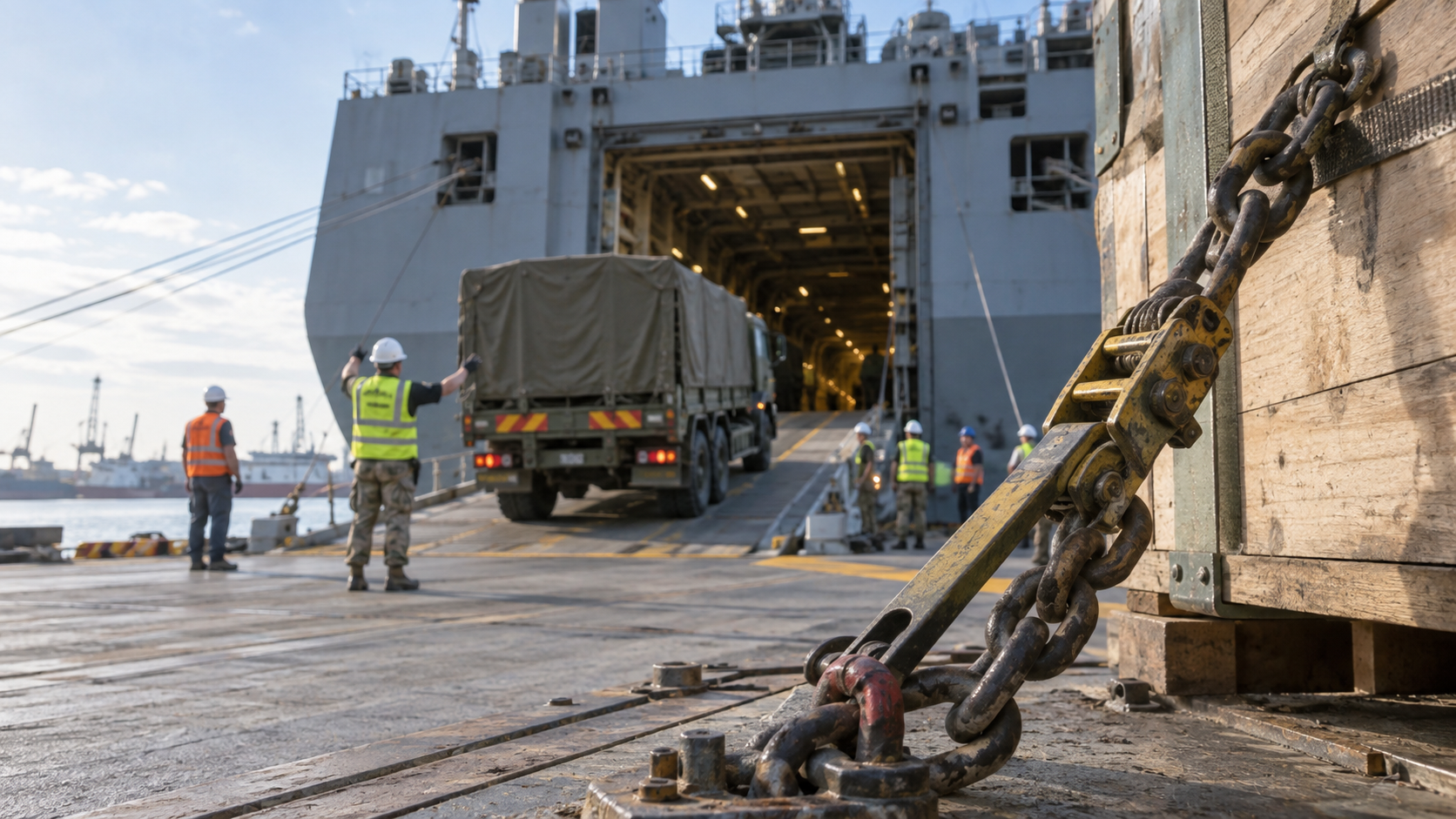
There is a line, usually credited to General Omar Bradley though more reliably traced to Marine Corps commandant Robert Barrow around 1979, that amateurs talk tactics while professionals talk logistics. It is quoted often and understood rarely. The reason it endures is that it describes the actual structure of military power, which has little to do with the platforms that fill recruitment films and procurement debates. A fighter jet that cannot be fuelled is a static target. A division that cannot be moved is a garrison. An army that outruns its supply lines does not win faster; it stops. The headline weapons absorb the attention and the budgets, but the contest beneath them, the one that actually determines who can fight, where, and for how long, is fought over fuel, hulls, spare parts and the dull arithmetic of throughput. The West has spent two generations admiring its swords while letting the supply train rust, and the gap between the firepower it owns and the firepower it can sustain has become the central, under-examined vulnerability of its defence posture.
The Tooth Is Cheap, the Tail Is Decisive
Militaries divide themselves, somewhat self-deprecatingly, into the “tooth” and the “tail”: the combat units that do the killing and the logistics apparatus that keeps them alive. The instinct of politicians and publics is to fund the tooth, because the tooth is visible and emotionally legible. A new tank, a stealth aircraft, a hypersonic missile, these photograph well and survey well. The tail, by contrast, is invisible until it fails, and then it fails catastrophically. The ratio matters because the tooth consumes the tail at a rate most observers never grasp. A modern mechanised division in sustained operations can burn through hundreds of thousands of gallons of fuel in a single day, on top of ammunition, water, food and a constant flow of replacement parts.
This is not new arithmetic. In the late summer of 1944, US armoured spearheads racing across France were drinking fuel at a rate the supply system could not match; a single armoured division in heavy fighting could consume on the order of 350,000 gallons of gasoline a day. The famous dash toward Germany did not stall because the Germans stopped it; it stalled because the fuel could not be brought forward fast enough. The Red Ball Express, an improvised truck convoy system, moved more than 400,000 tons of supplies in under three months and still could not keep the spearheads moving. The lesson, learned and relearned in every major conflict since, is that operational tempo is set by the supply system, not by the commander’s ambition. The professional studies logistics because logistics is the binding constraint, and a binding constraint cannot be wished away by courage or doctrine.
Sealift: The Backbone Nobody Photographs
For any power that intends to fight at a distance, and the entire premise of Western defence is expeditionary, the decisive instrument is sealift. The large majority of the tonnage required to move and sustain a deployed army travels by ship, because only ships can carry the volume at a cost that does not bankrupt the campaign. The United States maintains this capacity through the Military Sealift Command and the Maritime Administration’s Ready Reserve Force, together a government-owned strategic fleet of roughly sixty large vessels intended to surge a heavy force across an ocean within weeks.
The state of that fleet is a quiet scandal. The Ready Reserve ships average more than forty years of age, many built when American yards still produced commercial hulls in number. They sit pierside, much of the fleet steam-driven and increasingly orphaned of spare parts and of engineers who still know how to run them. In repeated activation exercises a meaningful share has failed to sail on schedule. The head of the Maritime Administration has said publicly that he is not at all confident the reserve fleet could even be crewed in a genuine crisis, because the United States is short on the order of 1,800 credentialed mariners needed to man the surge fleet and the commercial ships enrolled to support it. A ship that cannot be manned is a museum exhibit, not a strategic asset.
Fuel Is the Currency of Operations
Beneath sealift sits an even more basic dependency: fuel, and the means of moving it to where the fighting happens. A carrier strike group operating at high tempo consumes well over a million gallons of fuel a day, the bulk of it for aviation. Keeping such a force at sea requires a continuous shuttle of replenishment oilers cycling between the fleet and rear fuel points. The US Navy’s underway replenishment capability rests on a modest number of Kaiser-class oilers, now being slowly replaced by the John Lewis class built at General Dynamics NASSCO, supplemented by a handful of chartered commercial tankers.
The fragility here is twofold. First, the margin is thin: sustaining several carrier groups simultaneously in a contested theatre would consume essentially the entire available oiler force, leaving no slack for losses. Second, these vessels are soft. They are unarmoured, lightly defended, and in serious wargames of a Pacific contingency they are modelled as priority targets, precisely because an adversary that sinks the oilers defeats the fleet without ever engaging the warships. Firepower at the front is meaningless if the fuel chain behind it can be severed. The professional understands that the most valuable ship in a naval campaign is frequently the ugliest one, the tanker, and that protecting it is not a secondary task but the campaign itself.
Airlift: Fast, Indispensable, and Ruinously Expensive
Airlift is the glamour cousin of sealift, and it has its mythology: the Berlin Airlift of 1948 and 1949 delivered well over two million tons of coal and food into a blockaded city by air alone, breaking a siege without a shot fired. But airlift’s strategic limitation is brutal arithmetic. A heavy transport such as the C-17 Globemaster III costs north of twenty thousand US dollars per flight hour to operate and carries only a small fraction of what a single cargo ship moves. Air can deliver the first brigade and the urgent spare part; it cannot move an army or sustain a war. Anyone who proposes to substitute airlift for sealift is, knowingly or not, proposing to fight a very short and very small war.
Air mobility is best understood as the high-speed, low-volume tier of a system whose mass must always ride on water. Its value is in time, not tonnage. And like sealift, it depends on an unglamorous web of aerial refuelling tankers, forward bases, materials-handling equipment and trained crews, each a single point of failure that no missile in the inventory can compensate for.
The Industrial Floor Beneath It All
Sustainment is not only about what a military owns on day one; it is about what a nation can replace on day one hundred. Here the structural picture is stark. China’s shipbuilding capacity, by the US Navy’s own intelligence assessment, exceeds America’s by a factor of more than two hundred. In a recent year Chinese yards captured more than half of all commercial vessels built worldwide by tonnage, while American yards accounted for roughly a tenth of one percent of the global commercial total. The share of American foreign trade carried in US-flagged ships, the large majority of it in the immediate postwar years, has fallen to under two percent.
This matters for war because the commercial maritime base is the strategic maritime base. The shipyards that build tankers build oilers; the mariners who crew container ships crew the reserve fleet; the welders and pipefitters who sustain a merchant marine are the surge capacity that repairs battle damage and replaces losses. A country that cannot build or man commercial hulls in peacetime cannot conjure a sustainment fleet in wartime. The atrophy of the Western, and especially the American, merchant marine is therefore not a trade-policy footnote. It is the slow disarmament of the logistics enterprise, conducted quietly, over decades, with no debate and no headline.
When the Tail Snaps
The cost of neglecting logistics is rarely theoretical for long. The most vivid modern demonstration came when a large mechanised column, tens of miles in length, advancing on a defended capital, simply stopped; immobilised not by enemy fire in the first instance but by fuel exhaustion, food shortages, cheap tyres that failed under load, and a maintenance system that could not keep its own vehicles running. An army that had been measured by its number of tanks discovered that tanks without fuel and spares are scrap arranged in a traffic jam. The firepower was real; the sustainment was fiction; and the campaign broke on the gap between the two.
This is the recurring verdict of military history, and it is the verdict procurement politics is structurally incapable of hearing. Voters and legislatures fund what is visible and emotive, and nothing about an oiler, a forty-year-old roll-on roll-off ship, or a mariner training pipeline is either. Yet these are the assets that convert a military into power that can actually be projected and held. The strategic implication is uncomfortable but clear. Western advantage, where it still exists, rests less on the superiority of any individual weapon than on the ability to move, fuel and sustain force at scale and over distance, and that ability has been hollowed while the weapons were polished. The side that rebuilds its logistics enterprise, its ships, its fuel chain, its industrial floor and its trained crews, will hold the decisive advantage in any extended conflict, regardless of whose missiles fly farther. Amateurs will go on talking about tactics; the powers that intend to prevail will be counting hulls and gallons.
Read our full Report Disclaimer.
Report Disclaimer
This report is provided for informational purposes only and does not constitute financial, legal, or investment advice. The views expressed are those of Bretalon Ltd and are based on information believed to be reliable at the time of publication. Past performance is not indicative of future results. Recipients should conduct their own due diligence before making any decisions based on this material. For full terms, see our Report Disclaimer.