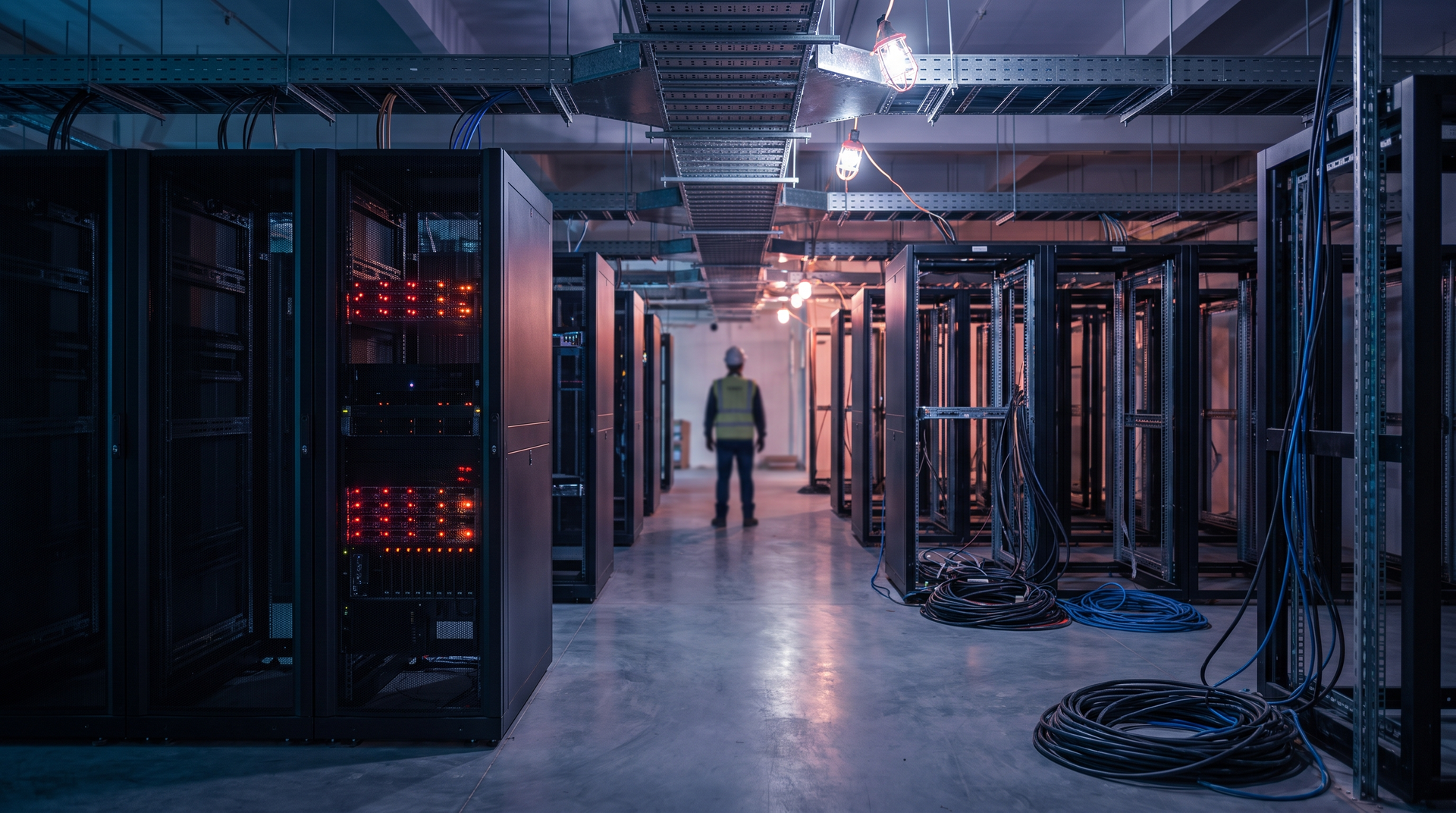
For three years the artificial intelligence build-out was paid for the way the largest technology companies pay for most things: out of profits. That arrangement is ending. The data centre boom that Amazon, Meta and Alphabet once funded from cash flow now depends on money raised in the bond and private credit markets, and this week those markets delivered their first serious verdict on the shift. CoreWeave, the most prominent of the so-called neoclouds, saw its bonds trade at distressed yields. Anthropic, one of the two leading frontier laboratories, was reported to be offering Blackstone a yield above 10% to finance its chips. The Nasdaq Composite fell 2.1% on Friday and roughly 4.5% over the week, its worst week since June. The question is no longer whether demand for compute is real. It is who can afford to finance it, and at what price.
The Week Credit Spoke
CoreWeave’s bonds, sold this year with coupons in the high single digits, traded at yields of around 15% and above by midweek, a level that usually marks distress. The cost of insuring its debt through five-year credit default swaps climbed past 1,000 basis points, which Bloomberg described as a record, implying better than 60% odds of default within five years. A year ago the same instruments priced roughly 30%. The shares fell more than 15% on Wednesday and sit more than 65% below the peak reached shortly after the March 2025 listing.
The trigger was almost banal. Co-founder Brannin McBee told the Financial Times that CoreWeave wanted to borrow from insurers and pursue an investment-grade rating, which he said would open access to “unlimited” capital. The market heard the other half of the sentence: a company paying near-double-digit coupons that talks about cheaper money is a company that needs it. Chief executive Mike Intrator replied in an internal memo that the contracted backlog “more than covers” the company’s debt and that markets can “misunderstand and act irrationally.” Max Frumes of the credit research firm 9fin offered the cleaner summary: “CoreWeave is absolutely the canary in the coal mine.”
The Marginal Borrower
CoreWeave’s problem is structure, not demand. It carries about $50 billion of debt by Reuters’ count, against a contracted backlog of more than $100 billion. It says 98% of its revenue comes from take-or-pay contracts, and its three largest customers produced 72% of second-quarter revenue. In August it raised its capital spending forecast for the year to as much as $39 billion. Analysts expect roughly $13 billion of revenue in 2026 and a loss of about $2.1 billion. Nvidia has agreed to buy any unsold capacity through April 2032, a backstop that reassures on volume but deepens the circularity that investors already distrust: the chip supplier underwrites the customer that buys its chips.
The arithmetic is unforgiving. A borrower whose principal assets are graphics processors with short economic lives, whose revenue is concentrated in a handful of counterparties, and whose growth depends on continuous refinancing is not a utility. It is a leveraged position on the credit of its customers and on the openness of capital markets. When either is questioned, the equity takes the first loss and the bonds reprice for the possibility of the second. Gartner estimates that 80% of neocloud providers will stop operating independently by 2030. That is not a forecast of collapsing demand. It is a forecast of consolidation into stronger balance sheets.
The Ten Percent Laboratory
Anthropic’s financing shows the same pressure from the top of the quality curve. According to the draft prospectus reported by Reuters, the company has committed $125.2 billion to a five-year lease of tensor processing unit capacity built on chips that Broadcom develops with Google, and Broadcom has agreed to lend it up to $42 billion through notes that could convert into Anthropic equity. The filing itself flags the conflict of interest in a supplier that is also a lender. Bloomberg reported on 2 October that Broadcom was assembling a $60 billion debt package to finance access to the chips, split between a $42 billion senior secured tranche and an $18 billion junior tranche led by Blackstone. On 16 October the Financial Times reported that Anthropic was offering Blackstone a yield above 10% on $9 billion of that junior debt, secured on the company’s five-year lease payments. The remaining junior debt would be offered to a wider group of investors in the coming months, possibly at a lower yield.
This is a company that raised $65 billion in May at a $965 billion post-money valuation, and whose draft prospectus, as reported, shows second-quarter 2026 revenue of $11.5 billion. It is paying a junk-plus yield on chip debt. The point is not that Anthropic is weak. It is that lenders are pricing the collateral rather than the brand: five-year leases on specialised silicon, whose value depends on one tenant’s continued ability to pay, issued by a firm that reported an operating loss of more than $8 billion in 2025. A double-digit yield is what private credit charges when the security is narrow and the borrower has yet to prove profitability through a full cycle. If the strongest name in the sector pays that rate, every weaker name pays more, or does not borrow at all.
The Rate Shock
The credit repricing did not happen in isolation. Wednesday’s US consumer price report showed headline inflation at 3.7% for September, above expectations, in the last such print before the November midterms. The ten-year Treasury yield rose eight basis points to 5.3%. Futures-implied odds of a quarter-point Federal Reserve hike at the 27 and 28 October meeting jumped from about 20% to about 44%, according to CME FedWatch. Brent crude traded above $100 a barrel on attacks against shipping in the Strait of Hormuz.
Every one of those numbers lands on the cost of AI capital. A build-out financed from free cash flow is indifferent to the ten-year yield. One financed with bonds, leases and private credit is not. Deutsche Bank’s Jim Reid put it carefully: AI financing costs “aren’t dramatic overall,” but there are “worrying themes at the edges.” The edge is where the neoclouds live, and where the laboratories borrow against leases rather than earnings.
The Window Narrows
The equity selloff was the symptom. The financing data is the diagnosis. Global AI-related debt issuance fell to $23 billion in September from a June peak of $113 billion, according to Morgan Stanley data reported by the Financial Times. About $18 billion of bank loans for an Oracle data centre campus in New Mexico has moved into stressed territory as banks struggle to distribute them. Nvidia-backed Firmus Grid pulled an initial public offering meant to raise as much as $5.5 billion after investors balked at a $30 billion valuation. Bloomberg reports that high-yield buyers are increasingly freezing out technology borrowers, and the Philadelphia Semiconductor Index shed more than $1.6 trillion of market value across six sessions to midweek.
Set that against the scale of the commitment. US technology giants are expected to spend more than $700 billion on the build-out this year. Gartner projects nearly $1 trillion of AI infrastructure spending in 2026 and a further $6 trillion from 2027 to 2030. Spending on that scale cannot be funded from operating cash alone, and the marginal dollar now comes from investors who demand to be paid for risk. Yorkville’s Dan Ives estimates that 5% to 10% of planned AI data centre projects will never be built. Saurav Sen of Gimme Credit warned that CoreWeave’s selloff “risks becoming a self-fulfilling prophecy”: the danger is not that customers stop wanting capacity, but that the supplier cannot afford to deliver it.
Discipline, Not Collapse
The correct reading of this week is not that the AI build-out is over. It is that the build-out has been handed to the most unsentimental judge in the Western system: the credit market. That judge is doing what it is for. It is separating borrowers with diversified cash flows from those carrying concentrated, refinancing-dependent structures, and it is doing so in public, early, before weak balance sheets spread losses through the banking system. American capital markets have never guaranteed that every participant survives. Their advantage is the speed with which they reallocate capital from fragile structures to durable ones.
The likely outcome is consolidation rather than retreat. Hyperscalers with operating cash flow gain bargaining power over neoclouds that need refinancing. Laboratories with contracted revenue keep borrowing, at a price that will shape their margins for years. Specialist operators that cannot reach investment-grade funding are absorbed or wound down, and their hardware finds new owners at lower cost bases. The strategic risk for the West is not the failure of individual neoclouds. It is a sustained rise in the cost of capital that slows the build-out at the margin while the policy response is still being debated.
What to Watch
The Federal Reserve’s decision on 28 October determines whether the rate shock deepens. The pricing of the remaining junior tranche of Anthropic’s chip debt will show whether 10% was a ceiling or a floor. CoreWeave’s ability to reach insurer and investment-grade capital will test whether contracted backlog can substitute for profits in the eyes of conservative lenders. And Anthropic’s own public offering, which Reuters reported in September could begin marketing as early as mid-October, now faces a market that has started to price compute as credit rather than as growth. The build-out continues. It has simply acquired a cost of capital, and that cost will decide who owns the infrastructure at the end of it.
Read our full Report Disclaimer.
Report Disclaimer
This report is provided for informational purposes only and does not constitute financial, legal, or investment advice. The views expressed are those of Bretalon Ltd and are based on information believed to be reliable at the time of publication. Past performance is not indicative of future results. Recipients should conduct their own due diligence before making any decisions based on this material. For full terms, see our Report Disclaimer.