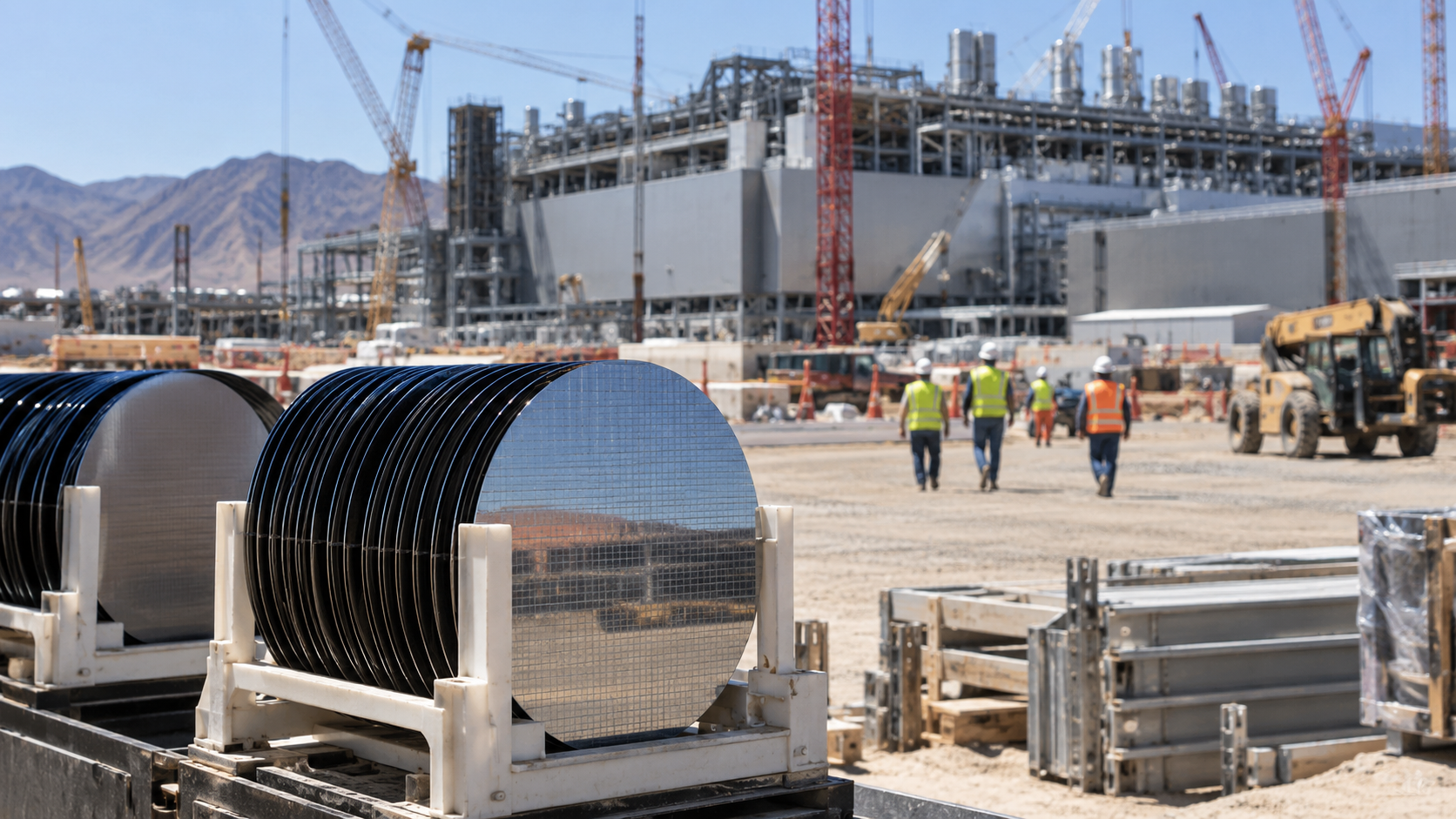
On 25 March 2026, Bank of America raised its TSMC capex forecast to USD 56 billion for the year, with more than seventy percent of that spend pointed at advanced nodes, much of it routed through the company’s Arizona campus, where the total commitment under President Trump’s August 2025 tariff arrangement now reaches a notional USD 165 billion across six fabs, with a long-horizon framework gesturing at USD 465 billion. The same week, the Bureau of Labor Statistics reported a 59,000-job decline in US manufacturing employment since the April 2025 “Liberation Day” tariffs took effect. The two data points are the entire story of post-2020 reshoring in compressed form: enormous capital announcements at the top, contracting payroll at the bottom, and a widening gap in between that the taxpayer is being asked to close. Reshoring is the consensus position in Washington, London, Tokyo, Berlin and Brussels. It is also dramatically more expensive than the rhetoric admits, and the bill is being itemised in real time.
The Headline Numbers Hide the Real Cost. The CHIPS and Science Act, signed in 2022, authorised USD 52 billion in direct semiconductor incentives plus a 25 percent investment tax credit projected to cost the Treasury USD 14.73 billion over 2025-2034. As of July 2025, Commerce had awarded USD 30.9 billion across 40 projects but had actually disbursed only USD 6 billion, having verified 18 of 35 milestone-based reimbursement requests. The disbursement lag matters because the headline figure is what voters and analysts cite, while the real fiscal exposure compounds quietly through tax credits and outyear obligations. TechInsights concluded in March 2025 that producing a wafer at TSMC Arizona costs roughly 10 percent more than in Hsinchu, well below the 30 to 50 percent gap commonly assumed, because labour is only 2 percent of fab cost and ASML and Applied Materials charge identical equipment prices on both continents. That finding actually strengthens the case for fab reshoring on national-security grounds. It does not strengthen the case for reshoring as a general industrial policy.
Foxconn Is Still the Cautionary Tale. The 2017 Wisconsin announcement promised USD 10 billion of capex and 13,000 jobs in exchange for nearly USD 3 billion in state subsidies. By end-2025, the Wisconsin Economic Development Corporation estimated cumulative Foxconn spend at USD 672 million, roughly 6.7 percent of the original pledge, with 1,452 jobs created against the original 13,000 target. The state’s contract was renegotiated downward from USD 4 billion to USD 80 million in 2021. In November 2025, Foxconn announced a fresh USD 569 million expansion focused on AI server assembly and 1,300 additional jobs, which is a perfectly respectable industrial outcome and also a reminder that the original deal was political theatre dressed as economic strategy. Intel’s USD 100 billion Ohio complex, announced in 2022 with a 2025 production date, has now slipped to 2030 for the first fab and 2031 for the second, with CEO Lip-Bu Tan describing the European arm of the same strategy as “unwise and excessive” when he cancelled the EUR 30 billion Magdeburg fab and the USD 4.6 billion Wroclaw facility in July 2025. Germany had committed EUR 9.9 billion of subsidy. Poland had committed EUR 1.7 billion. Both governments are now holding the political bag without the asset.
Northvolt Was the Test Case for European Sovereignty. The Swedish battery champion filed Chapter 11 in the United States on 21 November 2024 with USD 5.8 billion of debt against USD 30 million of cash, then filed for Swedish bankruptcy on 12 March 2025 in what became the largest industrial insolvency in modern Swedish history. The Skellefteå gigafactory was meant to reach 16 GWh of annual capacity. It produced 1 GWh. BMW cancelled a USD 2 billion supply contract in June 2024. The lesson is uncomfortable for Brussels: Europe could not stand up a single integrated battery manufacturer at scale even with USD 15 billion of equity and debt across the cap table, and the Inflation Reduction Act’s tax credits across the Atlantic actively pulled capital westward. Canada’s response, USD 13.2 billion in pledged production subsidies plus USD 700 million in capex grants for Volkswagen’s USD 7 billion PowerCo plant in St Thomas, Ontario, is more honest about what it costs to build a strategic asset from a standing start. It also implies a subsidy of roughly USD 1.9 million per direct job at full ramp, which is a number a Canadian voter will eventually be asked to defend.
Tariffs Are the Other Half of the Tax. Customs duties for US fiscal year 2025 reached USD 195 billion, a 150 percent increase year-on-year, and calendar-year collections ran above USD 236 billion through November. That is real revenue, equivalent to roughly 3.7 percent of federal receipts and a measurable dent in the deficit. It is also a regressive consumption tax paid by US importers and passed through to downstream manufacturers and consumers, with the burden concentrated in goods categories where Walmart, Amazon and Costco set the price ceiling. Kearney’s 2025 Reshoring Index fell 311 basis points back into negative territory: imports from fourteen Asian low-cost countries rose 10 percent, or USD 90 billion, while domestic manufacturing gross output grew 1 percent. Mexican exports to the United States slowed. The mechanism is unforgiving. Tariffs raise input prices for the same US factories the policy is meant to encourage, which is why CEO reshoring intent rose 15 percent in survey data while manufacturing payrolls contracted for eight consecutive months into late 2025.
Beijing’s Asymmetric Reply. China escalated gallium and germanium export controls to a full US embargo in December 2024, lifting it conditionally until 27 November 2026 as part of the broader trade settlement. The intervening price action established the leverage. Rotterdam gallium reached USD 687 per kilogram in May 2025, a 150 percent rise over pre-control levels, with European spot up 365 percent. Wrought germanium exports fell 60 percent and prices rose 400 percent. China supplies 98 percent of global low-purity gallium and 68 percent of germanium, both critical inputs to compound-semiconductor manufacturing, radar, fibre optics and the very night-vision and AESA systems Western defence ministries are counting on. Beijing’s strategy is now clear. Hold dominant production at scale, accept thinner margins to keep capacity utilised, and reserve a small set of chokepoints for retaliatory leverage. Boeing illustrates the parallel pressure on legacy Western industry. The 737 line reached 42 aircraft per month by Q4 2025 with FAA approval to push to 52 by end-2026, while Airbus closed 2025 with 60 percent narrowbody share and the A320neo family overtaking the 737 as the most-delivered jetliner in history. The reshoring debate fixates on building new sectors. The harder problem is preventing the loss of existing ones.
Where the Policy Actually Works. Reshoring pays when the buyer is the state or a state-regulated entity, willing to absorb a 10 to 30 percent premium because the alternative is unacceptable supply risk. Leading-edge logic for hyperscalers and defence, advanced packaging, EV batteries with IRA-credit-conditioned offtake, vaccine and active-pharmaceutical-ingredient capacity tied to national stockpiles: in each of these the price taker is not a margin-conscious consumer but an institution writing the rules. Outside that perimeter, the economics revert. Tradeable consumer electronics, white goods, textiles, low-margin metal fabrication, commodity chemicals, the categories where 14 Asian low-cost countries added USD 90 billion of US imports in 2025 alone, will not reshore at scale because the marginal customer is Amazon, and Amazon optimises for landed cost. Subsidising reshoring in those categories is a transfer from the median household to politically favoured firms with no enduring industrial asset created.
The Verdict. The reshoring tax is real, measurable and unevenly distributed. American taxpayers will spend roughly USD 52 billion of direct CHIPS Act money and an additional USD 14.7 billion of foregone tax revenue over a decade to acquire a credible domestic leading-edge fab base, which is probably worth it given Taiwan’s geography. They will also pay, through tariffs and supplier-level cost inflation, for a much broader reshoring agenda that the data already shows is not producing manufacturing jobs at the promised rate. Europe has paid the steepest tuition: Magdeburg and Wroclaw cancelled, Northvolt liquidated, and the EUR 11.6 billion of pledged Intel subsidy alongside roughly USD 15 billion of Northvolt capital structure now serving as a warning rather than an industrial base. Canada has at least priced its sovereignty honestly at roughly USD 1.9 million per direct job. The correct policy posture is not to retreat from reshoring but to stop treating it as a uniform virtue. Reshore the categories where the state is the customer. Tax-credit the categories where supply-chain failure is a national-security event. Let Walmart’s suppliers find their own equilibrium. Treating the entire goods economy as a strategic asset is the fastest way to ensure that none of it is treated as one.
Read our full Report Disclaimer.
Report Disclaimer
This report is provided for informational purposes only and does not constitute financial, legal, or investment advice. The views expressed are those of Bretalon Ltd and are based on information believed to be reliable at the time of publication. Past performance is not indicative of future results. Recipients should conduct their own due diligence before making any decisions based on this material. For full terms, see our Report Disclaimer.