On 6 January 2025, the Brazilian foreign ministry, holding the rotating BRICS presidency, confirmed by consensus that Indonesia had been accepted as the bloc’s tenth full member. Foreign Minister Sugiono had flown to Kazan in October 2024, days after Prabowo Subianto’s inauguration, to convert a 2023 invitation into a signature. Western capitals registered the news, then moved on. They should not have. Indonesia is the fourth most populous country on earth at roughly 286.6 million people, a $1.44 trillion economy by IMF nominal accounting, the supplier of approximately 62 percent of the world’s mined nickel, and an active OECD accession candidate since 20 February 2024. The same government that signed the BRICS accession papers is simultaneously negotiating chapters of an OECD roadmap whose technical reviews span 26 committees. This is not a tilt eastward. It is a hedge formalised, executed at scale, and it deserves to be read as doctrine rather than drift.
The Doctrine of Two Doors. Indonesian foreign policy has been described since 1948 as bebas dan aktif, free and active. Under Prabowo it has been operationalised into something more specific: simultaneous membership of mutually suspicious clubs, with each membership extracting a distinct concession from a distinct counterpart. The OECD accession, opened in Paris on 20 February 2024, is a discipline mechanism. Twenty-six technical committees will examine open trade, public governance, anti-corruption and environmental policy against advanced-economy benchmarks, with Jakarta targeting full accession by 2027 as a bridge to its Vision 2045 high-income objective. The BRICS membership, formalised eleven months later, is an optionality mechanism. It opens the New Development Bank window, to which Indonesia committed $1 billion in paid-in capital over seven years and has already proposed 77 projects, and it gives Jakarta a seat at the conversation on alternative trade-settlement architecture without forcing a public renunciation of the dollar. No other state of comparable weight is attempting both doors at once.
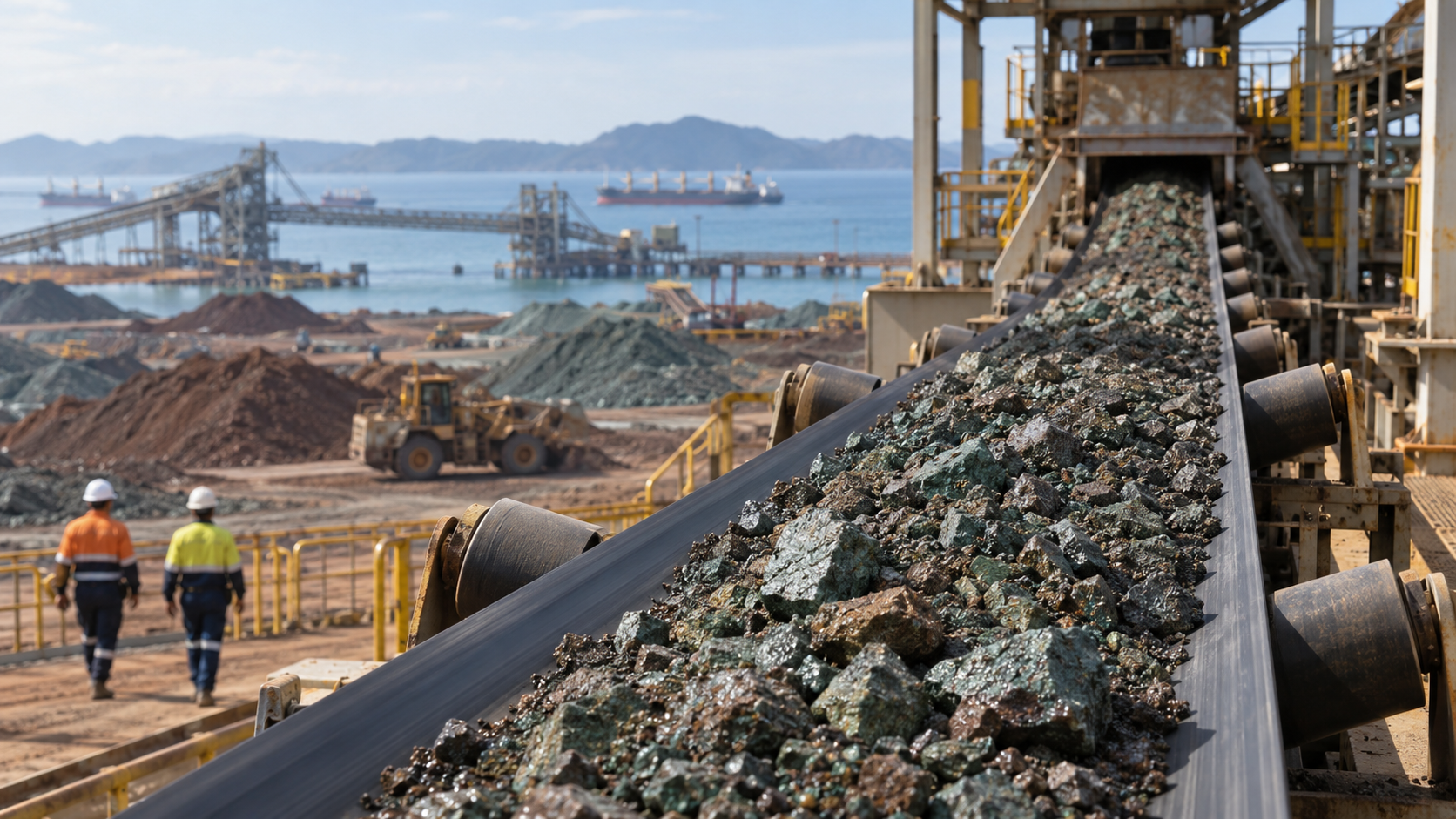
The Resource Lever. The economic basis for Indonesian leverage is unambiguous. Jakarta banned the export of raw nickel ore in January 2020 and used the resulting downstream investment boom, financed largely by Chinese capital into Sulawesi smelter parks, to grow its global nickel market share from 31.5 percent in 2020 to roughly 60.2 percent in 2024 and an estimated 62 percent in 2025. Mined nickel export value rose from about $1 billion before the ban to approximately $20 billion within two years. In November 2025 Jakarta then cut national mining quotas from 272 million tons to 150 million tons for 2025, tightening supply into a global EV battery market where Indonesia is already the marginal producer and therefore the marginal price-setter. The WTO ruled against the original ore ban; Indonesia is appealing, and meanwhile the policy has not been reversed. BRICS membership is not the cause of this resource power, but it is the multilateral cover for it. The bloc’s communiques on critical-minerals coordination give Jakarta language to defend a policy the Geneva system has formally disallowed.
The Money Plumbing. Bank Indonesia held the BI-Rate at 4.75 percent through April 2026 after foreign reserves fell to $146.2 billion from $149.9 billion in October 2025, equivalent to 5.8 months of import cover, and as the rupiah weakened to 17,140 to the dollar by 21 April 2026. The central bank’s room to cut is constrained by capital-flow sensitivity to the Federal Reserve, which is exactly the structural vulnerability that makes alternative settlement options operationally interesting rather than merely rhetorical. In September 2025 the People’s Bank of China and Bank Indonesia signed a renewed local-currency settlement framework, and on 23 November 2025 Jakarta confirmed plans to launch foreign-exchange operations centred on the renminbi, with new yuan-rupiah instruments under development. Indonesia-China bilateral trade reached $135.15 billion in 2024 and recorded $70.78 billion in the first half of 2025 alone. Even a partial shift of that flow out of dollar intermediation would meaningfully reduce Jakarta’s exposure to dollar funding stress and to United States secondary-sanctions risk. BRICS membership is the political wrapper that makes such a shift politically defensible at home.
The Western Bill of Sale Continues. The hedge interpretation only holds if Indonesia’s procurement of Western and Western-aligned military hardware continues at meaningful scale. It does. The February 2022 Rafale contract with Dassault for 42 F4-standard aircraft at roughly $8.1 billion remains live and deliveries began on 23 January 2026 at Roesmin Nurjadin Air Base in Pekanbaru. A memorandum of understanding with Boeing for 24 F-15EX airframes remains pending. At IDEF 2025 in Istanbul, Jakarta signed an implementation contract with Turkish Aerospace Industries for 48 KAAN fifth-generation fighters at approximately $15 billion, with first deliveries scheduled for 2032 and a deliberate ITAR-free specification that frees Indonesia from United States re-export controls. A $300 million order for 12 Anka-S combat drones is in delivery, with six built in Türkiye and six locally assembled by PTDI. Indonesia is buying European, American and Turkish platforms while joining a bloc whose senior members are Russia and China. The contradiction is the point. The contracts are insurance against the bloc; the bloc is insurance against the contracts.
The Comparative Frame. Among the relevant ASEAN-five, only Indonesia has the scale and willingness to attempt this. Malaysia accepted BRICS Partner Country status on 1 January 2025 rather than full membership, citing electronics-export exposure to United States markets after the April 2025 Trump warning of punitive tariffs on bloc participants. Kuala Lumpur’s bilateral trade with the United States exceeded RM320 billion in 2024 and that figure disciplines its rhetoric. Vietnam upgraded to a Comprehensive Strategic Partnership with Washington in September 2023 and recorded $209.4 billion in two-way goods trade with the United States in 2025, up 40 percent year on year, even as it weathered a 20 percent country-specific IEEPA tariff and accepted a reciprocal-trade framework in October 2025. Manila under Marcos has gone the opposite direction, expanding EDCA to nine bases and committing $128 million in fiscal 2025 to associated infrastructure. Bangkok remains passive. The region is sorting itself; Jakarta alone is sorting on both axes simultaneously.
The Domestic Stakes. Prabowo’s 8 percent growth target, against a structural average closer to 5 percent and a Q4 2025 print of 5.11 percent, requires capital at a scale neither domestic savings nor traditional Western lenders are likely to supply on acceptable terms. The Danantara sovereign-wealth holding, established 24 February 2025, now claims roughly $900 billion in assets under management consolidated from more than 1,000 state-owned enterprises, with approximately $8 billion in annual dividends available for reinvestment. The Free Nutritious Meals programme, the administration’s signature social spend, was lifted from Rp71 trillion to Rp171 trillion, around $10.4 billion, and is on track to reach $24 billion annually if it scales to its 82.9 million beneficiary target. The IKN Nusantara relocation, downgraded by Prabowo from national capital to political capital, retains a Rp48.8 trillion 2025 phase-two allocation against a total project cost of Rp440 trillion of which only Rp71.8 trillion had been disbursed by end-2024. Each of these lines requires financing channels that are not the IMF and not principally the World Bank. The NDB window matters precisely because it offers local-currency lending at sub-Bretton-Woods rates.
The Verdict. Indonesia is the only Indo-Pacific state with sufficient demographic mass, mineral leverage and fiscal optionality to credibly construct its own pole rather than choose a side. The simultaneous pursuit of BRICS+ membership, OECD accession, French and Turkish fighter procurement, Chinese settlement plumbing and a $900 billion sovereign holding company is not incoherent. It is the deliberate construction of a foreign-policy portfolio in which no single counterparty holds more than a manageable share. Western capitals should read the BRICS step neither as defection nor as provocation. They should read it as the cost of doing business with a power large enough to set its own terms, and they should pay that cost. The alternative is to lose access to 286 million people, the world’s nickel marginal supply and the only Southeast Asian economy of trillion-dollar scale, in return for a symbolic alignment that Jakarta was never going to grant on demand. The Jakarta hedge will define the next decade of Indo-Pacific statecraft because Indonesia will be the one drawing the perimeter, not the great powers competing to draw it for her.
Read our full Report Disclaimer.
Report Disclaimer
This report is provided for informational purposes only and does not constitute financial, legal, or investment advice. The views expressed are those of Bretalon Ltd and are based on information believed to be reliable at the time of publication. Past performance is not indicative of future results. Recipients should conduct their own due diligence before making any decisions based on this material. For full terms, see our Report Disclaimer.