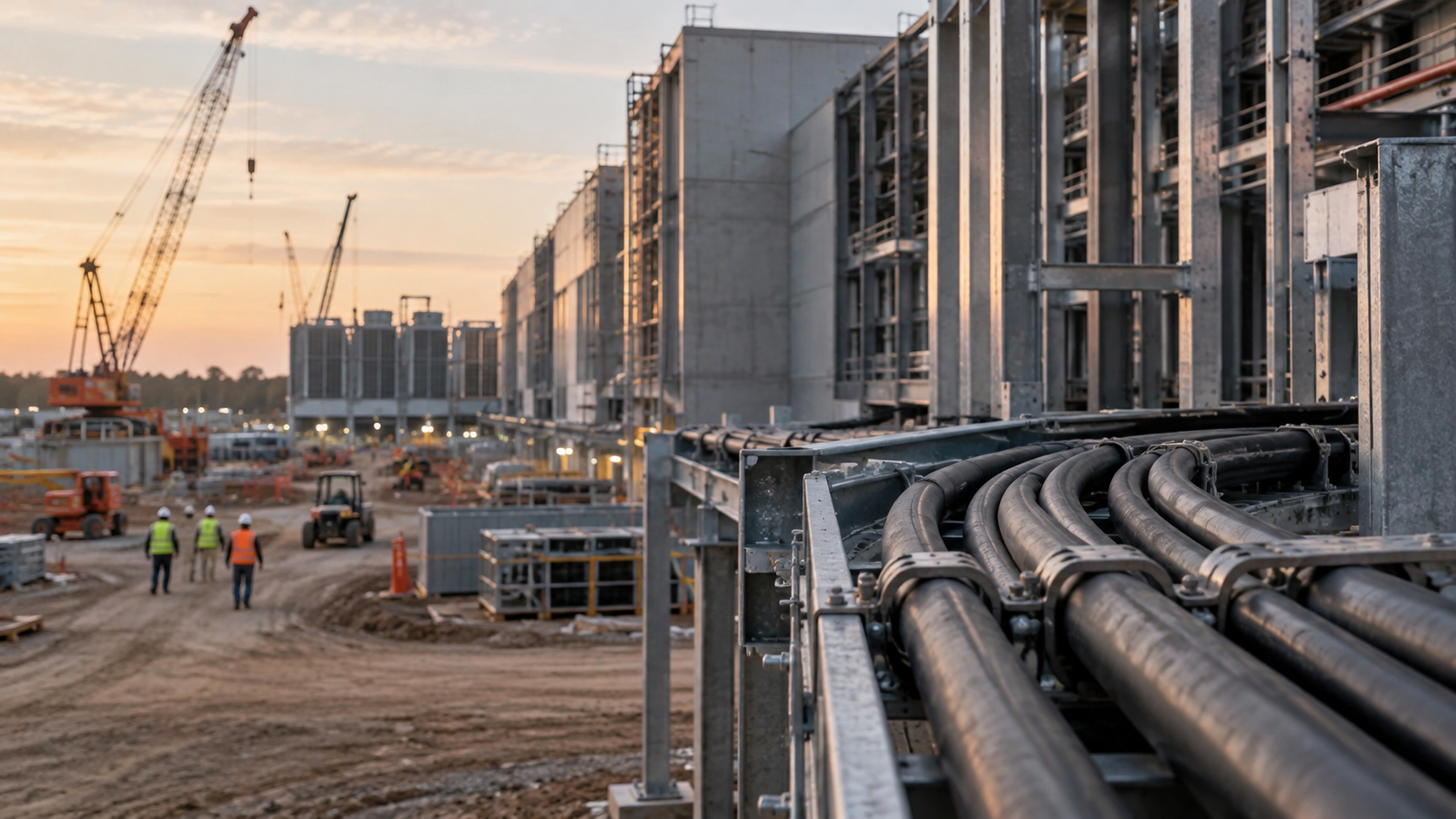
In October 2025, Meta and Blue Owl Capital closed a $27 billion financing for a single data-center campus in Richland Parish, Louisiana. It was the largest private-credit transaction ever executed. PIMCO took roughly $18 billion of the bond stack; BlackRock took another $3 billion. Meta retained a 20 percent equity slice through a Morgan Stanley-arranged special purpose vehicle. Months later, Oracle closed a $16.3 billion package for a Stargate site in Saline Township, Michigan, after US banks walked away citing demand-sustainability concerns. PIMCO anchored about $10 billion of that bond. By early 2026, Oracle had assembled at least $72 billion in partner debt across three campuses and signalled a further $45 to $50 billion capital raise to keep pace with hyperscaler demand.
These are not ordinary debt deals. They are project-finance vehicles dressed in the clothes of corporate credit, secured against power-purchase agreements, hyperscaler leases, and the implicit guarantee that artificial intelligence will keep absorbing compute at the rate the equity narrative requires. They are also being underwritten almost entirely by non-banks. Morgan Stanley estimates that roughly $800 billion of private-credit capital, about a third of the $2.9 trillion projected AI-infrastructure capex through 2028, will be sourced from outside the regulated banking system. Private credit, a $1.9 trillion asset class that scarcely existed in its present form before the 2008 settlement reshaped bank balance sheets, is now the primary financier of Western digital infrastructure. That fact carries strategic and systemic implications that have not yet been priced.
The Hyperion Blueprint. The Hyperion structure deserves attention because it is the template for everything that follows. Meta does not sit on the debt; the SPV does. The campus is jointly owned by Blue Owl-managed funds (80 percent) and Meta (20 percent). The $27 billion of A+ rated bonds and $2.5 billion of equity sit inside that vehicle, off Meta’s reported leverage, secured by the physical asset and the long-dated lease that Meta itself signs with the SPV as anchor tenant. PIMCO booked roughly $2 billion in paper gains on the bonds within weeks of issue. The structure delivers three things at once. It moves debt away from the hyperscaler’s balance sheet. It gives institutional bond buyers, particularly insurers and pension funds searching for duration, an investment-grade instrument tied to a triple-A counterparty’s compute appetite. And it slots private credit into a role that thirty years ago belonged to syndicated bank lending and the public bond market.
Where the Banks Withdrew. Oracle’s Michigan deal made the dynamic explicit. According to reporting on the transaction, US banks pulled back from the Stargate Michigan financing on the view that AI compute demand might not sustain the sized lease. PIMCO stepped into the gap and took the senior tranche. The asset-class implication is unambiguous. Where Basel III, leveraged-lending guidance, and stress-test capital charges make it expensive for federally regulated institutions to hold $10 billion concentration positions in single-asset, long-duration deals, private credit funds, business development companies, insurance general accounts and direct-lending arms have neither the capital surcharge nor the daily mark-to-market that would force them to sell on a wobble. The same regulatory architecture constructed after 2008 has, in 2026, deposited a generation’s worth of infrastructure financing into vehicles that are less observable, less liquid, and less obviously stress-tested than the institutions they replaced.
Why the Asset Fits the Lender. The match between AI infrastructure and private credit is, in narrow financial terms, elegant. Data-center build-outs require seven-to-fifteen-year capital with a back-loaded payoff profile; private credit funds offer matched-duration, illiquid liabilities to investors who want yield without daily liquidity. Hyperscaler leases provide investment-grade cash flow against which the debt can be sized and rated. Power commitments, which are the binding constraint in 2026, can be financed alongside the silicon. None of this is available through public investment-grade bond markets in the volumes required, because the public bid for bespoke single-name infrastructure paper at $20 billion-plus tranche size is shallow. The private-credit channel solves a real coordination problem. It also concentrates risk in a small group of asset managers whose redemption terms, leverage profiles, and counterparty relationships are disclosed mostly to their limited partners.
The Systemic Question. The April 2026 IMF Global Financial Stability Report devotes substantial space to private credit and AI-related investments. The Fund warns that changing investor expectations about AI margins could trigger a repricing of asset valuations and that bank-nonbank interconnection has reached a level capable of spreading stress in either direction. The Bank of England’s second System-Wide Exploratory Scenario, launched in late 2025 and running through 2026, is explicitly designed to test how private markets behave under a severe but plausible global downturn. Its working concern is whether bank credit lines extended to non-bank lenders amplify rather than absorb a shock. Warren Buffett, in remarks earlier this year, observed that troubles in one corner of the banking system rarely stay there. As of the first quarter of 2026, roughly 40 percent of private-credit borrowers were reporting negative free cash flow, and default-warning indicators had risen toward double digits. The pressure is concentrated, for now, in the cohort of mid-market software credits whose competitive moats artificial intelligence is actively eroding. Whether it migrates upstream into the infrastructure stack will depend on whether hyperscaler lease commitments hold through the next equity-market drawdown.
The Strategic Frame. It is worth stating plainly that the alternative to private credit financing AI infrastructure is not nothing. The alternative is sovereign or state-aligned capital, on the model Beijing has used to finance its own compute build-out, with all the strategic-direction effects that implies. The Western answer to scale has historically been deep, deregulated capital markets and a tolerance for the cycles that follow. The Stargate joint venture, anchored by US capital sources and ringed with US-domiciled infrastructure, is in that tradition. Private credit is the price of keeping AI infrastructure inside the perimeter of Western institutional ownership without requiring federal balance-sheet commitments at a moment when the US deficit and gilt yields in the United Kingdom both constrain headline borrowing. That is a defensible trade. It is not a costless one. It places concentrated long-duration assets in lightly regulated vehicles at the precise moment those vehicles are being asked to absorb retail-channel inflows through interval funds and BDCs.
The Test Ahead. The first stress test will likely come not from a counterparty failure but from a duration mismatch. Private-credit funds with quarterly redemption gates have begun to see institutional redemption pressure in early 2026. If those gates are pulled while a $20 billion infrastructure bond sits in a portfolio that needs to mark against a thinning secondary bid, the discovery process will be unforgiving. The second test is the demand assumption itself. Hyperscaler leases are only as durable as the equity stories behind them; a meaningful repricing of the AI capex thesis would force lease renegotiation, and SPV bondholders would discover what their security package is actually worth without the anchor tenant. None of this needs to end badly. Project finance has weathered worse, and AI demand has so far overshot most forecasts. But the asset class is now central to Western financial-stability arithmetic, and it is being supervised primarily through the disclosures of the funds themselves. In the next eighteen months, the IMF and the Bank of England will get the data they have asked for. The relevant question is what they do with it, and whether they do it before the cycle does it for them.
Read our full Report Disclaimer.
Report Disclaimer
This report is provided for informational purposes only and does not constitute financial, legal, or investment advice. The views expressed are those of Bretalon Ltd and are based on information believed to be reliable at the time of publication. Past performance is not indicative of future results. Recipients should conduct their own due diligence before making any decisions based on this material. For full terms, see our Report Disclaimer.