On 20 May 2026 OpenAI published a paper claiming that one of its internal reasoning models had disproved a conjecture of Paul Erdős that had stood since 1946. Eighty years of mathematical orthodoxy was revised in a single notebook, then refined further by a Princeton mathematician within days. The episode is being read in three different registers at once. In Silicon Valley it is a marketing coup. In academic mathematics it is a quietly significant data point. In the realpolitik of Western technological supremacy it is something more consequential: the first publicly verified case of an AI system generating an original mathematical idea in a field where the prior could not have been retrieved from a textbook. The detail matters, and so does the timing.
The Unit Distance Problem
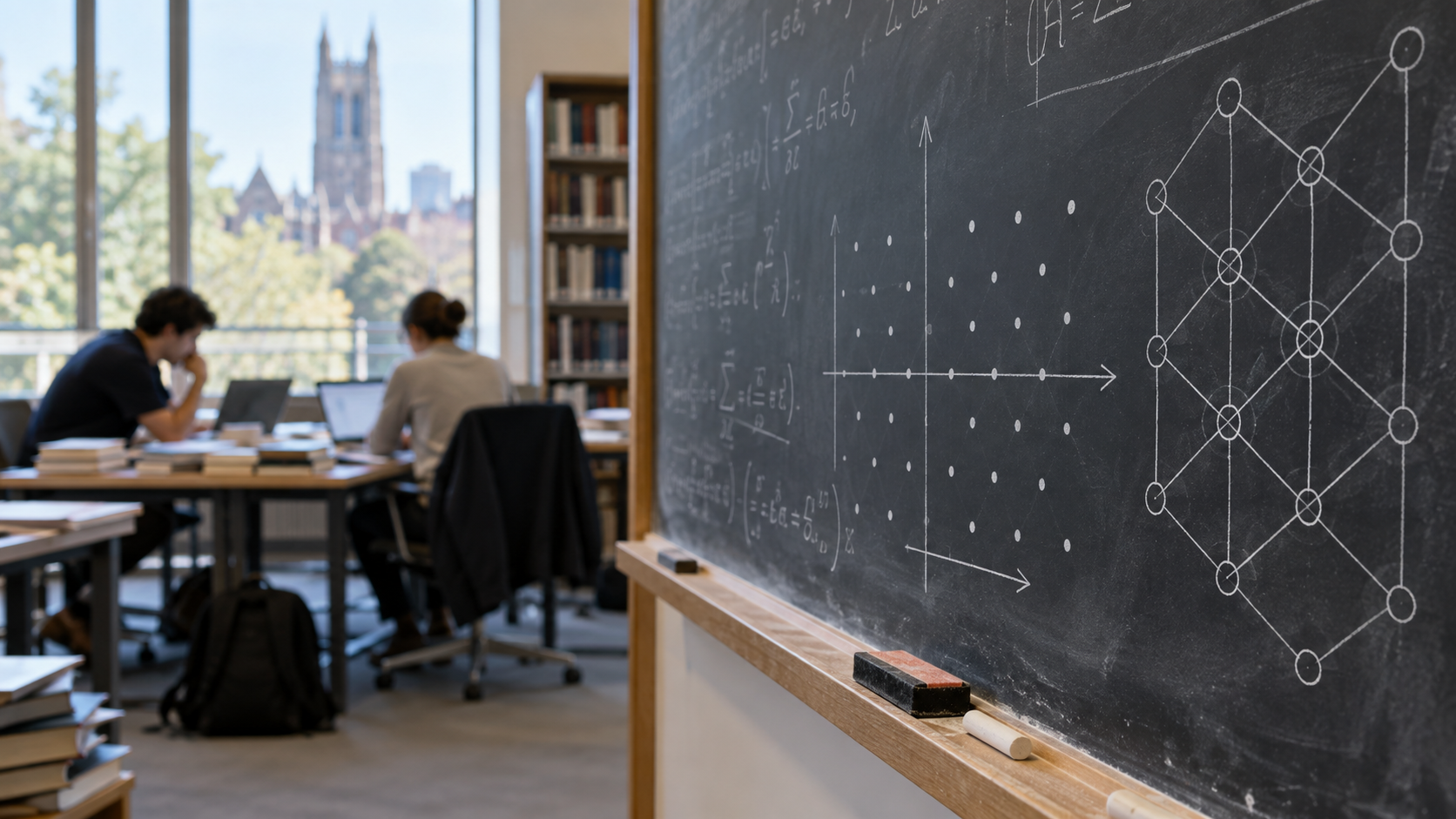
The conjecture in question concerns one of the oldest puzzles in combinatorial geometry. Place a finite set of dots on a flat plane. How many pairs of those dots can sit at exactly the same unit distance from each other? Erdős asked the question in 1946 and produced the first non-trivial answer. For decades the working assumption among researchers was that the optimal arrangements would look essentially like a finely tuned square grid, with the maximum number of unit-distance pairs growing only marginally faster than the dot count itself. Subsequent attempts shaved fractions off the exponent but always within sight of the grid. Erdős himself conjectured a specific upper bound that the geometric community came to treat as the working ceiling.
The new result identifies an entire infinite family of point arrangements that beat the grid by a polynomial factor. The exponent improvement is small in absolute terms, but in this corner of mathematics small exponent improvements are career-making. The conjectured ceiling is now formally false, and a fresh direction of inquiry has been opened on a question that had effectively been mothballed for two generations.
From Pattern Matching to Discovery
What makes the proof notable is not the result alone but the route. The model did not refine a known geometric construction. It connected the planar unit-distance problem to algebraic number theory, specifically to the machinery of infinite class field towers and the Golod-Shafarevich inequality, a 1964 result from Soviet-era algebra that no mathematician working on unit distances had previously thought to invoke. The closest human analogue is the kind of cross-domain transfer that wins mid-career mathematicians their reputations. It is the move that distinguishes a working research mathematician from a graduate student.
The contrast with OpenAI’s previous attempt at this kind of claim is instructive. In October 2025 the company’s then vice president Kevin Weil announced that GPT-5 had solved ten previously unsolved Erdős problems and made progress on eleven more. Within forty-eight hours Thomas Bloom, who maintains the canonical Erdős problems registry, established that the model had simply located proofs already in the published literature and reformatted them. The reputational damage was substantial. This time OpenAI sequenced the release differently. Independent verification by Will Sawin at Princeton, Daniel Litt at Toronto, Thomas Bloom at Manchester and Arul Shankar at Toronto preceded the announcement. Sawin, working from the model’s argument, has already produced a refined version with a cleaner exponent and shorter combinatorial scaffolding.
Verification, Not Acceptance
Fields Medallist Timothy Gowers called the result the unique interesting outcome produced autonomously by an AI to date. The phrasing is careful. Gowers is not claiming the proof is the work of a fully autonomous mathematician. He is making a much narrower observation. Every previous high-profile AI mathematics result has either been the formalisation of an existing proof, the solution of a closed problem with a known answer, or a benchmark performance in a curated competition setting. This is the first time the artifact under examination is a new theorem in an open field where the answer was not known and the technique was not pre-supplied.
That is the threshold being discussed. It does not mean the AI is a mathematician. It does mean the loop of generate-verify-refine-publish has closed for the first time in a field that matters. Once that loop closes, it tends to industrialise. Shankar’s own framing was that the work shows AI can begin generating genuinely original ideas rather than merely assisting human ones. Whether the ratio of original to derivative output rises or stays vanishing is the next data point worth watching.
The Parallel Track: Drugs, Proteins, Olympiads
The Erdős proof is the most photogenic example, but it is far from isolated. In January 2026 Demis Hassabis confirmed at Davos that the first AI-designed cancer drug, generated through the Isomorphic Labs pipeline built on AlphaFold 3, would enter Phase 1 human clinical trials this year. The compound was identified in roughly thirty days against an industry baseline of two to four years, and targets a previously poorly characterised conformational state of a tumour-associated protein. In parallel, Google DeepMind’s Gemini Deep Think achieved a clean gold-medal performance at the 2026 International Mathematical Olympiad, solving five of six problems perfectly, two years after the AlphaProof system managed only silver. Materials Project benchmarks for inorganic crystal discovery, protein-folding accuracy and small-molecule binding prediction have all shown similar step-changes.
Three separate research frontiers, all moving in the same direction at roughly the same time. None of these results is a finished product. All of them are evidence that the underlying capability curve has crossed a threshold where AI-generated artifacts are now contributing to the open scientific literature rather than merely accelerating known workflows.
Strategic Geometry
The geopolitical reading is the one most likely to be missed by the technology press. The Erdős proof was generated in California, verified at Princeton, Toronto, Cambridge and Manchester, and published in an English-language preprint within a week of being reproduced by a second mathematician. Every node in that chain sits in a Western or Western-aligned jurisdiction. The Isomorphic Labs trial will run in jurisdictions with functioning regulatory authorities and capital pools willing to underwrite a decade-long approval gauntlet. The IMO performance was demonstrated under public adversarial scrutiny, with problem statements and grading criteria fixed before the model ran.
None of these conditions obtains in the rival blocs in the same combination. Beijing’s AI research output is substantial, but the verification loop, peer review by independent academic mathematicians, regulatory approval by an autonomous drug authority, public adversarial benchmarking, runs through institutions that the Chinese system structurally cannot reproduce without ceding political control. The compute that produces the result is necessary but not sufficient. The Western advantage in AI-for-science is increasingly the advantage of the surrounding civilisational infrastructure: open universities, independent journals, credible regulators, capital markets willing to fund uncertainty. The compute moat alone is contestable. The verification moat is far harder to replicate.
The Honest Limit
The asterisks are real and worth stating plainly. The model that produced the Erdős proof did not invent algebraic number theory. It drew on Golod-Shafarevich because the theory exists in the corpus on which it was trained, and the connection it found, while non-obvious, sits within the universe of moves a sufficiently well-read human mathematician could in principle have made. The proof was checked, refined and partly improved by humans. The result is closer to a very capable research assistant generating a publishable seed than to a fully autonomous mathematician. The distance to the latter remains unknown.
There is also the risk of a familiar pattern. October 2025 demonstrated that the gap between a real breakthrough and a marketing artifact can be slim, and only adversarial scrutiny separates them. The credibility of this result rests on the speed and independence of the verifying mathematicians, not on the press release. That credibility should not be assumed to transfer to subsequent announcements without the same scrutiny. The same caution applies in pharmacology, where the gap between a docked molecule and a clinically efficacious drug is measured in years and tens of millions of dollars per failure.
What is no longer reasonable to claim is that AI systems cannot generate original mathematical or scientific ideas at all. That bar has been cleared in public, on a problem old enough that everyone available to verify it had spent a career failing to solve it. The frontier has moved. The Western system of open verification is, for now, the only system in the world capable of confirming that the frontier has moved, and the only one able to compound on the result. Whether that advantage entrenches or dissipates is now a question of policy and capital allocation, not of underlying capability.
Read our full Report Disclaimer.
Report Disclaimer
This report is provided for informational purposes only and does not constitute financial, legal, or investment advice. The views expressed are those of Bretalon Ltd and are based on information believed to be reliable at the time of publication. Past performance is not indicative of future results. Recipients should conduct their own due diligence before making any decisions based on this material. For full terms, see our Report Disclaimer.