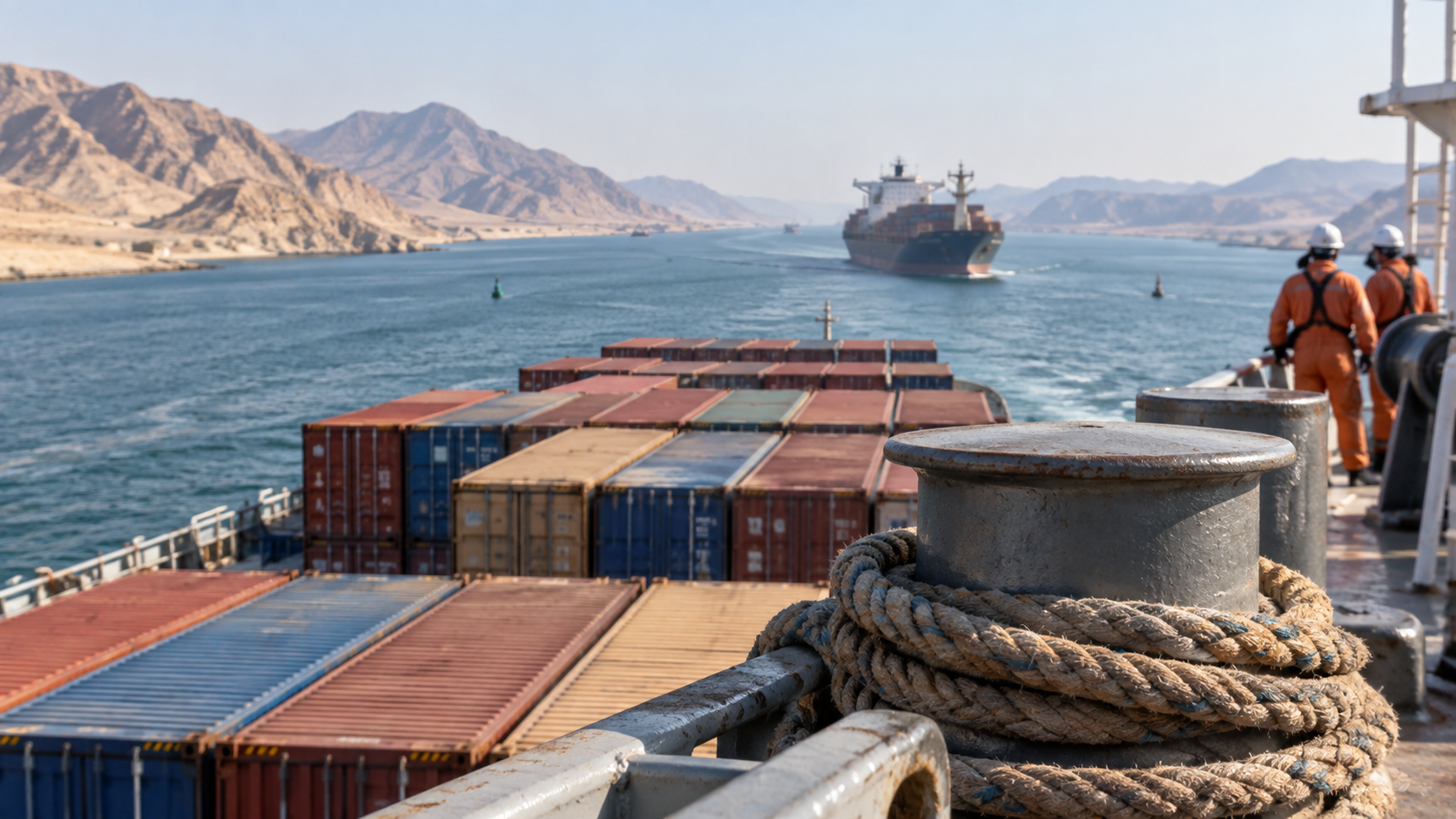
On 21 August 2024, the MV Sounion, a Greek-flagged Suezmax tanker carrying one million barrels of Iraqi crude, was struck by Houthi small-arms and missile fire off the coast of Hodeidah. The vessel did not sink. It burned, untended, for three weeks, while salvage tugs were warned away by the same Yemeni group that had hit it. By the time the EU’s Operation Aspides finally towed the hulk to safety in September, the Joint War Committee at Lloyd’s had already done what no warship could. It had repriced the entire chokepoint. War-risk premiums on hulls transiting Bab el-Mandeb, which had stood at roughly five basis points of vessel value before October 2023, settled into a band of 0.5 to 1 percent. After the June 2026 American and Israeli strikes on Iran, that band stepped again, to 1.5 to 3 percent on most flags and as much as 5 percent on US, UK and Israeli-linked tonnage. The market had answered the geopolitics before any minister had.
The Strait of Hormuz, with its televisable headlines and its lone American carrier strike group, has absorbed the public attention. Bab el-Mandeb has done the structural damage. Roughly 12 percent of global trade by value, and as much as 30 percent of East-West container flows, has been permanently rerouted around the Cape of Good Hope. The detour adds approximately 4,000 nautical miles and 10 to 14 days to a Shanghai-Rotterdam voyage, raises bunker fuel burn by 30 to 40 percent, and absorbs around 2.5 million TEU of container capacity, roughly 7 percent of the global fleet. UNCTAD records the resulting ton-mile bulge at 6 percent in 2024, three times the underlying trade-volume growth, and shipping greenhouse-gas emissions up 5 percent in the same period. The disruption is the worst on the artery since the 1967 Suez closure. It is not, on present trajectory, ending.
A Fire That Insurers Could Read. The pricing layer is the freight insurance market, not the navies. Lloyd’s Market Association’s Joint War Committee maintains the Bab el-Mandeb, Red Sea, Gulf of Aden, Arabian Sea and Persian Gulf jointly on its Listed Areas of Perceived Enhanced Risk under JWLA-32, which is the trigger for Additional War Risk Premium pricing. Each named attack moves the rate. The Sounion in August 2024 was a step. The double-tap on the Magic Seas and Eternity C in July 2025, in which two Greek-owned bulkers were struck within seventy-two hours by skiffs, unmanned surface vessels and small-arms fire, four crew killed and eleven missing, was a step change. The Minervagracht, a Dutch-flagged general-cargo vessel hit on 29 September 2025, was the last attack before the Houthi suspension of 11 November 2025. By that point Skuld’s claims had risen from $11.7m to $25.2m year-on-year, P&I clubs were running combined ratios above 100 percent, and reinsurers had quietly cancelled war-risk reinsurance on Red Sea P&I exposure. The premium ladder is not a side effect of the conflict. It is the conflict’s permanent record.
The Egyptian Ledger. The cost of all this lands first on Cairo. Suez Canal revenue collapsed from $10.3 billion in 2023 to $4 billion in 2024, a 61 percent fall, and Suez transit volumes from roughly 26,000 ships in 2023 to 13,213 in 2024. Container-ship traffic in the fourth quarter of 2025 stood 86 percent below 2023; bulkers were down 55 percent, crude tankers down 32. By the first week of 2026, total transits remained 60 percent below pre-crisis levels, despite a hundred days without a Houthi attack. Suez Canal Authority chairman Osama Rabie introduced a 15 percent discount for heavy-tonnage container ships above 130,000 net tons in May 2025 and extended it through March 2026. The discount is not a commercial offer. It is an admission that pricing, not policing, is the only lever left to him. Egypt’s aggregate revenue loss since the crisis began exceeds $8 billion, and the country’s foreign-exchange reserves have absorbed it during the same window in which the IMF programme has had to be doubled to $8 billion.
The Carriers’ Quiet Verdict. The container carriers have written the structural answer in their schedules. Maersk announced in January 2026 that its Mediterranean service was making a structural return to the Suez routing, the first major line to do so since December 2023. CMA CGM sent the 23,000-TEU Jacques Saade, the largest LNG-powered boxship ever built, southbound through the canal in the same month. Forty-eight hours after the June 2026 strikes on Iran, the same carrier re-diverted its FAL 1, FAL 3 and MEX services to the Cape. MSC and Hapag-Lloyd never returned in volume. Drewry’s World Container Index has the Shanghai-Rotterdam rate above $2,100 per forty-foot equivalent in late April 2026, against a pre-crisis floor near $1,200 to $1,500. Peter Sand of Xeneta has stated openly that operators will not “base safety of crews on the word of the Houthi militia,” and his outlook for 2026 is that the Cape rotation has become the planning baseline. A return that requires a peace settlement to hold is not a return. It is a hedge.
Beijing’s Free Lane. The premium is not paid uniformly. CENTCOM disclosed in March 2024, and OFAC’s later sanctions trail confirmed, that the Houthis had brokered safe-passage understandings with Russia and China through Omani intermediaries. The price was largely informational, with sanctions-trade flows tolerated in return. The result is a parallel pricing regime: Chinese-flag vessels saw their share of Suez transits rise roughly 25 percent above their pre-October 2023 baseline through the worst of the crisis, and Russian-controlled tonnage moved unhindered. Western flags and Israeli-linked owners pay the war-risk premium that finances the chokepoint. Eastern flags do not. This is not an insurance peculiarity. It is the operational expression of a strategic divergence in which a sub-state actor has been able to enforce a discriminatory transit regime that no Western navy has materially reversed. The 380 Houthi projectiles intercepted by US destroyers between October 2023 and January 2025, at a real cost in SM-2, SM-6 and SM-3 missile inventory rarely admitted publicly, did not change the discount.
The Permanent Tax. What looks from a distance like a temporary disruption has begun to settle into the structural cost base of European trade. The 14 million extra tonnes of CO2 emitted on Cape rotations between December 2023 and April 2024 alone, equivalent to the annual emissions of nine million cars, are being passed through the EU Emissions Trading System at roughly $400,000 of carbon cost per Asia-Europe diverted voyage on a 24,000-TEU ULCV. UNCTAD, BIMCO and Drewry have all reached the same conclusion in different language: the floor for container freight rates has been permanently raised, the global merchant fleet has effectively absorbed a single-digit percentage of its capacity into a longer rotation, and the Suez artery will not return to its 2023 baseline within the planning horizon of any major liner. The Houthi truce of November 2025 is conditional on Gaza, the Iran exchange of June 2026 has reset the risk register, and the underwriters have priced what the politicians have not. Bab el-Mandeb did not close. It became expensive in a way navies cannot fix. Western consumers pay the difference at the till, and so far they have done so without complaint.
Read our full Report Disclaimer.
Report Disclaimer
This report is provided for informational purposes only and does not constitute financial, legal, or investment advice. The views expressed are those of Bretalon Ltd and are based on information believed to be reliable at the time of publication. Past performance is not indicative of future results. Recipients should conduct their own due diligence before making any decisions based on this material. For full terms, see our Report Disclaimer.