On 22 December 2023, the last French military aircraft lifted from Air Base 101 in Niamey, completing a withdrawal that had begun, in formal terms, with Operation Barkhane’s closure on 9 November 2022 and that ran on through Mali in August 2022, Burkina Faso by February 2023, Niger that December and Chad in November 2024. Eleven years of French Sahel deployment, fifteen hundred troops at peak in Niger alone, ended in a sequence of departures that none of the four host governments had previously felt politically free to demand. Six weeks after the Niamey runway emptied, the three core junta-led states signed the Liptako-Gourma Charter that would become the Alliance of Sahel States. Four months after that, the first Africa Corps instructors landed at the same airfield. Power, as the realpolitik tradition has it, abhors a vacuum. In the Sahel it has filled the vacuum at speed, on terms that nobody in Paris or Brussels has yet been willing to describe in the public register the events warrant.
A Cash Tariff for Coercion. The basic transaction is straightforward and is not a secret. The Malian government pays Russian paramilitary contractors approximately $10.8 million per month, a figure cited in United States intelligence assessments and unchallenged by Bamako, in exchange for direct combat support against Tuareg separatists and jihadist insurgent groups. Wagner Group at peak deployment held roughly 1,500 personnel in country; the formal handover to Africa Corps, the Russian Ministry of Defence-controlled successor entity that took over Wagner’s African networks after the Prigozhin death and the June 2023 mutiny, was completed on 6 June 2025. Burkina Faso hosts a Russian unit that scaled from approximately 100 instructors in January 2024 to a 300-man Bear Brigade now tasked with the personal security of Captain Ibrahim Traoré. Niger hosts roughly 100 Africa Corps instructors deployed from April 2024. The model is a rental state: the host government purchases coercive capability and freedom from Western conditionality, the contracting party in Moscow purchases hard-currency revenue and political leverage, and the territory pays the difference. The largest single Wagner combat loss in Africa, at the Tinzaouaten ambush of 25 to 27 July 2024 in which Tuareg rebels and JNIM jointly destroyed a Wagner-FAMa convoy with reported casualties between 50 and 84 Russian dead and 47 Malian, did not change the contract. It changed the price.
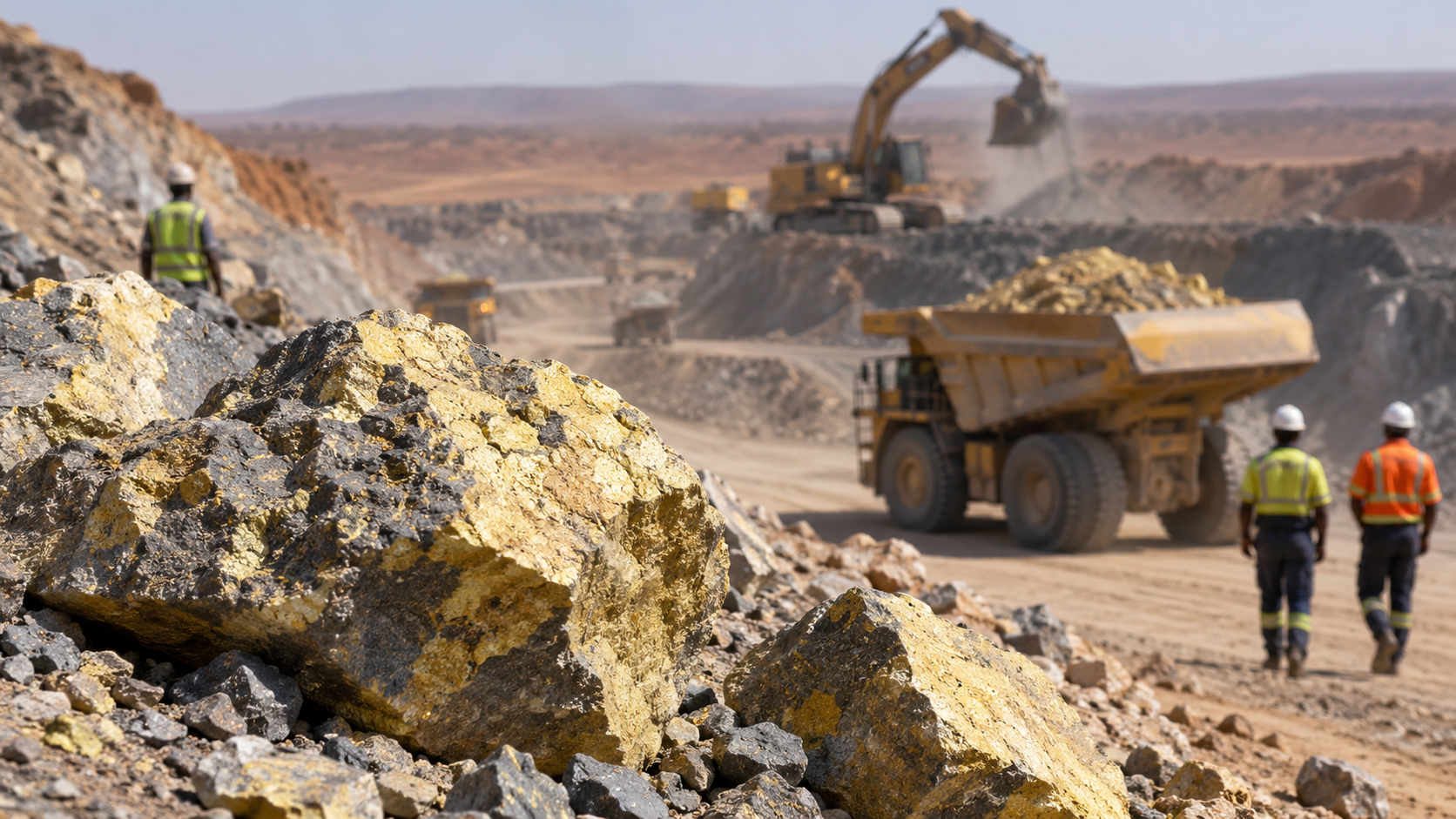
Yellowcake and Bullion. The collateral on the contract is mineral. Niger was, before the 2023 coup, the world’s fourth-largest uranium producer, supplying roughly 6.9 percent of global output, approximately 25 percent of European Union uranium imports in 2022, and between 15 and 20 percent of French civil-nuclear demand. The military government in Niamey withdrew Orano’s operational licence at Imouraren in June 2024 and nationalised the Somaïr operation at Arlit in June 2025; Cominak had already been closed. Orano, the French state-controlled nuclear-fuel group with a 63.4 percent stake in the Niger operations, has filed multiple cases at the International Centre for Settlement of Investment Disputes. The arbitration outcome will be measured in years; the uranium will not. In Mali, the government’s settlement with Barrick Gold in November 2025, in which Bamako received $430 million plus the return of approximately three tonnes of seized gold, ended a sixteen-month standoff and delivered a ten-year licence extension on the Loulo-Gounkoto complex; Yatela and Morila were nationalised in parallel. A 200-tonne-per-year gold refinery in Bamako, 62 percent state-owned and 38 percent owned by Russia’s Yadran Group, broke ground in June 2025. In Burkina Faso, gold output of 53.37 tonnes in 2024 declined modestly from 57 tonnes in 2023, but the strategic shift was that Russia’s Nordgold was awarded the Niou licence in April 2025, with a 20.22-tonne reserve, on terms that effectively close the previous Western mining-investor pipeline. Yellowcake out, bullion out, hard currency in.
The Brand Refresh. Africa Corps is not Wagner. The institutional difference, while still operationally subtle, matters for the political-economy frame. Wagner under Yevgeny Prigozhin operated as a parastatal with revenue-sharing terms negotiated bilaterally between Prigozhin’s commercial network and host-state principals; Africa Corps operates as a Ministry of Defence asset whose revenues flow to Russian state accounts and whose deployment decisions are taken in Moscow rather than St Petersburg. The transition produced, predictably, a more legible state-to-state relationship and, less predictably, a roughly equivalent operational tempo. The Africa Center for Strategic Studies and the International Crisis Group have both noted that the rebrand has not changed the fatality profile or the relationship to civilian populations. Aggregate Kremlin revenue from African gold operations since the start of the Ukraine war exceeds $2.5 billion on the World Gold Council’s accounting, with a Canadian government estimate of $3.4 billion. The mercenary-state model is, on present trajectory, profitable for Moscow at a margin Western capitals have not been willing to match through aid or counter-insurgency budgets. That is the entire transaction.
The Confederation of the Coup Belt. The political infrastructure that Mali, Burkina Faso and Niger have built around their security pivot is more substantial than the brief diplomatic press has registered. The Liptako-Gourma Charter signed at Niamey on 6 July 2024 created the Alliance of Sahel States, a confederal structure with explicit mutual-defence provisions. Mali, Burkina Faso and Niger formally exited the Economic Community of West African States on 29 January 2025. The AES introduced a 0.5 percent Confederal Levy on third-country imports in March 2025, the first material common-tariff instrument in West Africa not anchored to the CFA franc bloc, and Bamako, Ouagadougou and Niamey have been openly discussing a common currency that would supplement, and eventually replace, CFA-zone integration. The architecture is thin, the budgets are minimal, and the operational cohesion is contested by every Africa specialist who has examined it. The political fact remains that three contiguous Sahel states have, in eighteen months, formally exited the dominant Western-aligned regional order, signed a defence treaty with each other, brought in Russian paid security, transferred mineral concessions to Russian and Chinese counterparties, and rebased their external trade outside the European-Atlantic frame. The reversibility of the move is, on present trajectory, modest.
The Third Player. The architecture is not bilateral. Beijing has been a quiet but consequential third party. Mali’s Goulamina lithium project, one of the largest hard-rock lithium deposits in West Africa, was acquired by Ganfeng Lithium in 2024 under the country’s 2023 mining code, which grants Bamako a 30 percent state share and 5 percent local participation. China’s CNPC operates oil-production assets in Niger that the military government has periodically harassed, including the April 2025 expulsion of three Chinese executives over a revenue dispute. Burkina Faso has secured Chinese concessional finance for a 2,000-tonne-per-day cement plant and roughly $290 million of green-energy lending in 2023. The pattern is the reverse of the Russian one: Russia provides coercive capability and political durability, paid in metals and gold; China provides infrastructure and concessional finance, paid in lithium, oil and access. The two flows are, for now, complementary. They will not necessarily remain so.
The Bill in Blood. The deterrence question is the one Western capitals have most consistently misread. Aggregate fatalities from militant Islamist violence in the Sahel reached approximately 10,400 in 2024, with the first half of the year alone delivering 7,620, a record. Burkina Faso recorded 1,532 terrorism deaths and was rated the most-impacted country in the Global Terrorism Index 2025. The Sahel accounted for more than half of global terrorism deaths in the same period. Through end-November 2025 the three AES states had passed 10,000 deaths again. Jamaat Nusrat al-Islam wal-Muslimin imposed a fuel blockade on Bamako in September 2025 and laid siege to roughly 40 Burkinabe towns in the first half of the year. The mercenary-state model has not delivered counter-insurgency outcomes; it has delivered regime durability. France’s mistake was attempting counter-terrorism on a development budget. Russia’s offer is the inverse trade, regime survival as a paid service with mineral concessions as collateral. Both are arguably failures by the metric of territorial pacification. Only one is a failure by the metric of who pays the bill. Until the West offers a proposition more attractive to the men holding power in Bamako, Ouagadougou and Niamey than the one currently on the table from Moscow, the Sahel will not return to the Western strategic perimeter on terms the West can dictate, and the next decade’s mineral and security architecture in the region will be set by parties Brussels does not negotiate with.
Read our full Report Disclaimer.
Report Disclaimer
This report is provided for informational purposes only and does not constitute financial, legal, or investment advice. The views expressed are those of Bretalon Ltd and are based on information believed to be reliable at the time of publication. Past performance is not indicative of future results. Recipients should conduct their own due diligence before making any decisions based on this material. For full terms, see our Report Disclaimer.