On 25 February 2026, Statistics Korea announced that the country’s total fertility rate had risen to 0.80 in 2025, up from 0.75 the previous year and 0.72 at the trough in 2023. It was the first two-year rise in nine years, and the press hall in Daejeon was permitted, briefly, the language of a rebound. The arithmetic does not co-operate. A child born in 2025 will reach the age of conscription in 2046. By that point, the South Korean military will already have lived through the demographic moment that defines its century: the halving of its annual conscript pool, from roughly 333,000 twenty-year-old males in 2020 to 226,000 in 2025 to a projected 143,000 in 2040. The fertility curve does not pivot in time to fix the force-structure curve. The two are running on different clocks, and only one of them is the deterrent.
Across East Asia the same arithmetic is converging. Japan’s TFR has fallen to 1.12, with births below 670,000 in 2025, the lowest figure since 1899 and roughly sixteen years ahead of demographic projections. Taiwan has overtaken South Korea at 0.72, the world’s lowest national figure. Singapore stands at 0.87. The Philippines, long the regional outlier, dropped below replacement for the first time since 1968, recording 1.7 in 2025. North Korea, by United Nations and external estimates, sits at roughly 1.77, declining but more than double the South. The democratic, market-economy partners of the United States in the Western Pacific have, with one exception, fallen below the demographic threshold at which a conscription-based military can be reproduced. Their adversary has not.
The 130,000 Problem. The Korea Institute for Defense Analyses has been explicit about what this means in uniformed numbers. South Korea’s active-duty force has fallen from roughly 563,000 in 2019 to approximately 450,000 in July 2025, a 20 percent contraction in six years and roughly 50,000 below the Ministry of National Defence’s own readiness threshold. The former director of KIDA, Kim Yun-tae, has projected that on present demographics the force will reach approximately 300,000 by 2040, which he has described in public terms as “a complete collapse” of the 500,000-based force structure on which the entire Republic of Korea-United States combined deterrent posture is currently built. The conscription term, cut from 21 to 18 months in 2021 to extract more inductees from a smaller cohort, cannot be cut further without breaking trained-force generation. The adjustments left to the system, immigration of recruits, women in the ranks, retention bonuses, automation, are each individually consequential and collectively insufficient.
A Closing Window Across the Sea of Japan. The contrast across the demilitarised zone is structural. The Korean People’s Army holds approximately 1.2 million on active duty, with 600,000 reserves and roughly five million paramilitary on the rolls. North Korea extended its conscription term in April 2023 to 10 to 11 years for males, reversing a 2021 shortening. Pyongyang’s force quality is widely understood to lag the Republic of Korea Armed Forces in equipment, training and combat readiness, but force quality is a gradient and force mass is a threshold. A peninsula on which the conscript pool is halving in the South while terms are lengthening in the North is a peninsula on which the deterrence balance is being rewritten in slow motion. The window in which the asymmetric ROK-US response, technology over manpower, can hold the line is real, but it is not indefinite, and it depends on choices Beijing has not yet made.
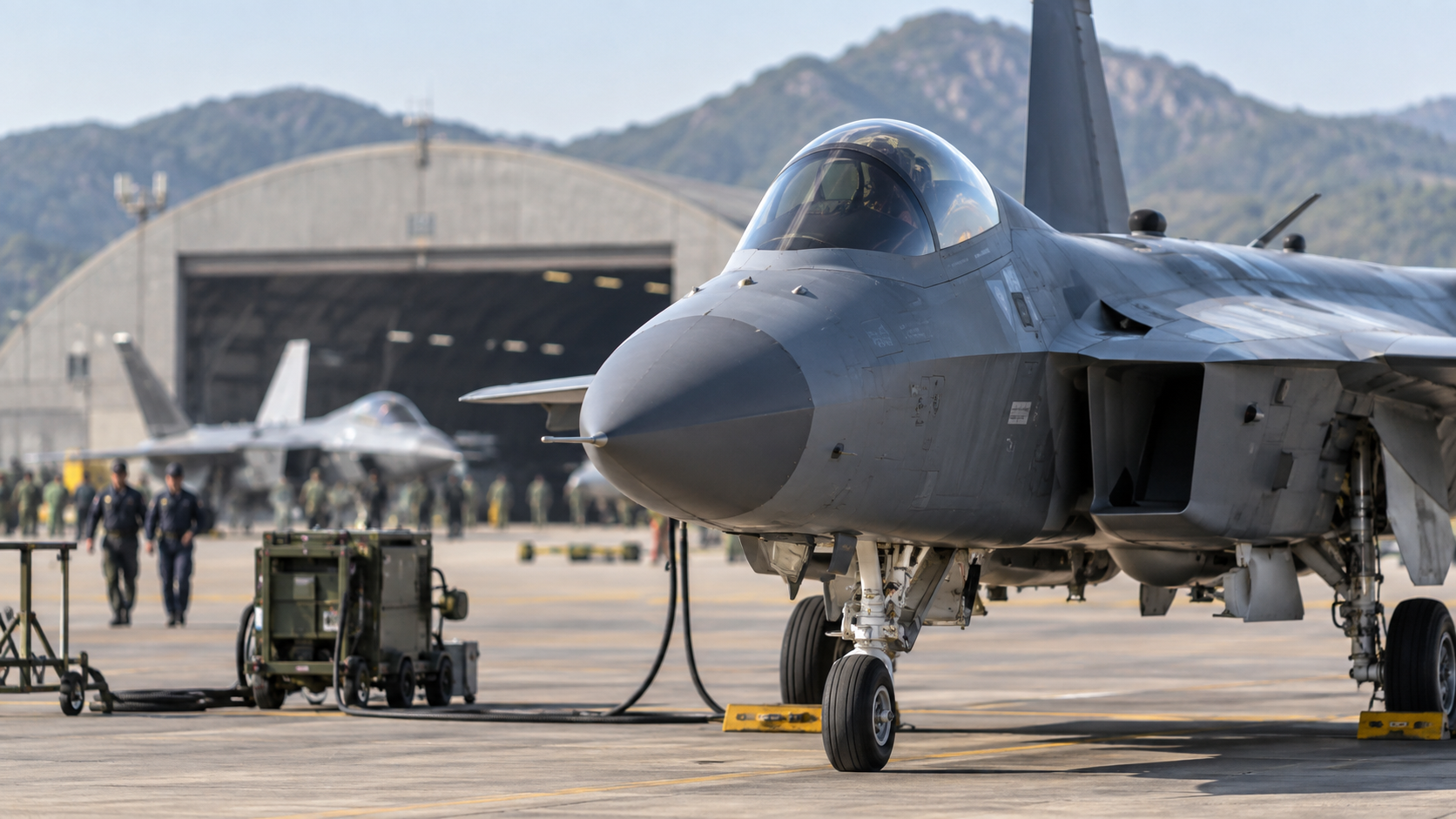
Drones, Hulls and 3.5 Per Cent. The substitution path is the one route open. President Lee Jae-myung has set a target of 3.5 percent of GDP defence spending by 2035, against the current 2.32 percent, and has floated operational control transfer back to Seoul by 2030. The 2026 defence budget rose 8.2 percent year-on-year to ₩66.3 trillion, approximately $47.6 billion, the largest hike in seven years. Korea Aerospace Industries rolled out the first production KF-21 Boramae in March 2026, with 120 airframes targeted by 2032. Hanwha Ocean and HD Hyundai Heavy Industries formed a “One Team” naval-export combine in February 2025, pitching jointly into the $242 billion United States Navy programme; an October 2025 green light from the Trump administration has opened the prospect of Korean-built nuclear-powered attack submarines under an AUKUS-style framework. The Republic of Korea Navy has placed a Combat Unmanned Surface Vessel concept-design contract with HD Hyundai, established a Drone Operations Command in September 2023, and signed a Hanwha-Vatn unmanned-undersea agreement in December 2025. The United States Air Force activated the 431st Expeditionary Reconnaissance Squadron at Kunsan in September 2025, the first permanent MQ-9 Reaper unit in Korea. Each of these is a capital-for-labour substitution, and each is necessary. None individually closes the manpower gap, and the assumption that they collectively do is the central assumption of the next decade.
The Squad’s Math Problem. The pooling thesis, that the United States, Japan, Australia, South Korea and the Philippines can substitute alliance integration for individual force mass, runs into the same arithmetic. Japan’s Self-Defence Force has acknowledged in successive white papers that recruitment is “in a difficult situation,” running roughly 10 percent short for two consecutive years. Taiwan has lifted conscription to one year and is moving toward an asymmetric defence posture explicitly designed for force-mass scarcity. The Philippines, on present trajectory, will face by 2040 a recruit pool roughly 30 percent smaller than today’s. The Squad and AUKUS frameworks are real, and the trilateral exercises off Jeju in September 2025 demonstrate that the operational machinery exists. But pooling cannot conjure recruits. Five shrinking conscript bases combined into one combined-arms structure is still five shrinking conscript bases, and the political and constitutional barriers to genuine integration of command authority remain higher than any of the participating capitals will publicly say.
The Bodies the Recruiters Cannot Find. The two reform paths that would directly add bodies, immigration and women in the ranks, run into a domestic political topology that is unlikely to shift on the timescale required. The Republic of Korea is the most ethnically homogeneous OECD economy by recorded measure, with naturalised citizens accounting for less than 4 percent of the population and naturalisation flows running at roughly 10,000 per year, an order of magnitude below what would be required to backfill the conscript shortfall on its own terms. The proposal to extend conscription, full or partial, to women has been raised in successive parliamentary sessions, has been the subject of a 2026 Foreign Policy briefing, and remains politically inert; the equivalent is more advanced in Israel and Norway and is moving slowly in the smaller European states, but Seoul has not built the social consent for it. Japan’s Self-Defence Force has begun lifetime career-plan and treatment reforms that the 2025 Defence of Japan white paper now treats as core force-design problems rather than human-resources issues, but the Japanese case is, on present trajectory, worse than the Korean. The recruitment shortfall is not solvable on the inputs the political class has so far been willing to authorise.
Deterrence by Inventory. The structural conclusion is unwelcome but plain. The binding constraint on Western Pacific deterrence in the 2030s is not budget, doctrine or political will. It is bodies. South Korea, Japan, Taiwan and the Philippines are converging on a force-structure profile in which capital, automation and allied integration are asked to compensate for a manpower base that the underlying fertility data say will not arrive. The substitution is feasible, and the Republic of Korea has gone further along it than any other partner. It is not, however, free of risk. A deterrence posture that depends on autonomous systems, missile inventories and combined-fleet logistics is one in which a single dis-coordinated procurement decision, a single budget cut, or a single Chinese capability surprise has consequences that no amount of conscription can backfill. The fertility rebound announced in Daejeon will, in 2046, deliver a class of conscripts. The questions that have to be answered between now and then are about the deterrent that has to hold without them.
Read our full Report Disclaimer.
Report Disclaimer
This report is provided for informational purposes only and does not constitute financial, legal, or investment advice. The views expressed are those of Bretalon Ltd and are based on information believed to be reliable at the time of publication. Past performance is not indicative of future results. Recipients should conduct their own due diligence before making any decisions based on this material. For full terms, see our Report Disclaimer.