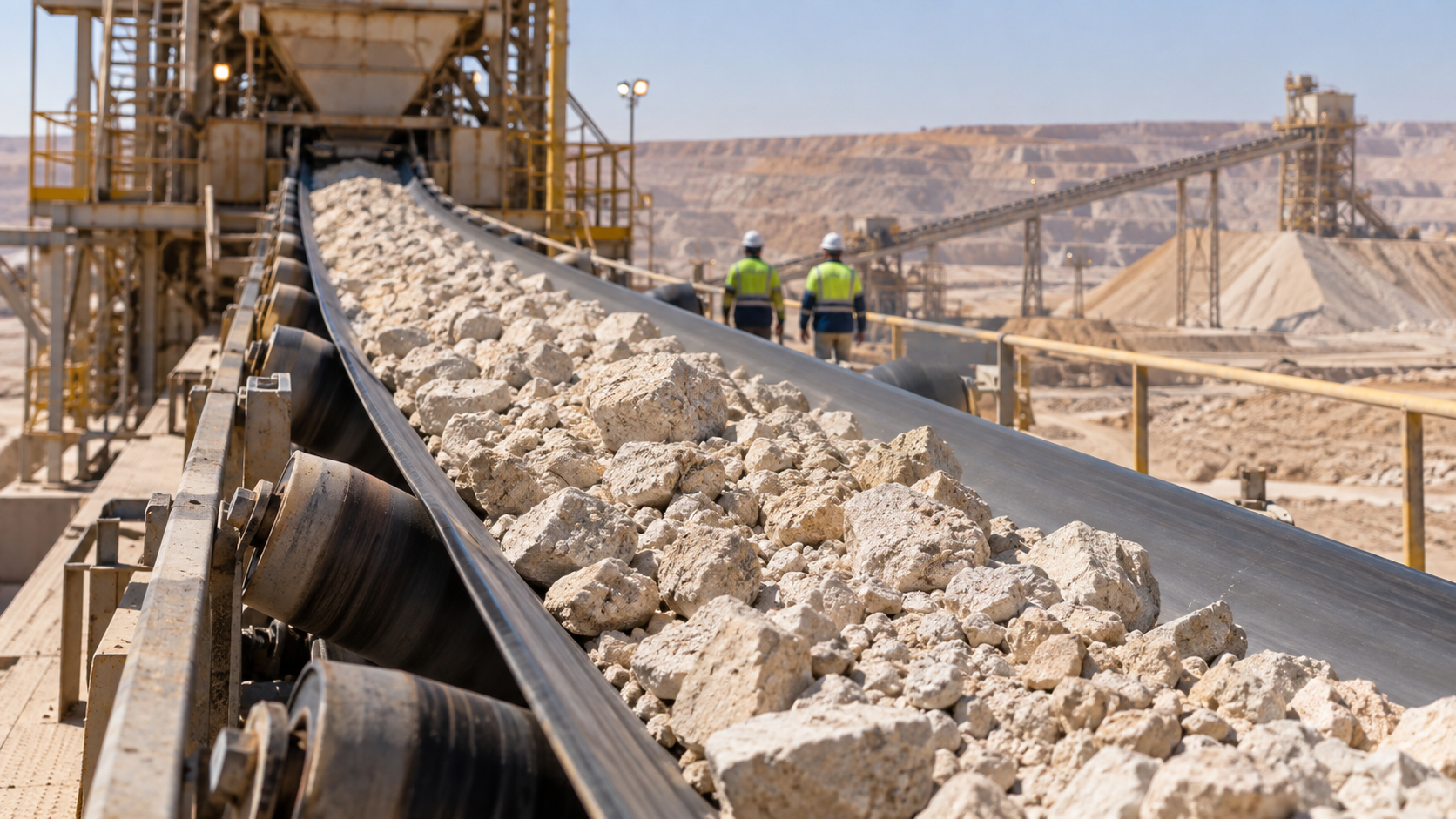
The 2025 Mineral Commodity Summaries published by the United States Geological Survey contain a single line that ought to keep European agriculture ministries awake. Of the 74 billion tonnes of phosphate rock catalogued globally, approximately 50 billion sit beneath one country: Morocco. Africa as a whole holds roughly 80 percent of the world’s reserves, and Morocco accounts for the bulk. The number is not contested. It is one of the most concentrated commodity reserve positions on the planet, larger in market-share terms than any single oil exporter except Saudi Arabia, and unlike oil it underpins a substance for which there is no chemical substitute. Phosphate is non-substitutable for fertiliser. Fertiliser is non-substitutable for food. The throne sits in Rabat, and most Western treasuries have not yet noticed.
The Quiet Sovereign. The instrument is the OCP Group, the Moroccan state phosphate company, which reported revenue of MAD 114 billion, approximately $11.4 billion, for the full year 2025, up 17 percent year-on-year, with a half-year EBITDA margin of roughly 36 percent. Record fertiliser exports of 12.37 million tonnes in 2024 placed the firm at approximately 31 percent of the global phosphate-product market. OCP’s $13 billion Green Investment Programme, running from 2023 to 2027, will lift nutrient capacity from 15 to 20 million tonnes, deliver 5 gigawatts of clean electricity, and target one million tonnes of green ammonia output by 2027 and three million by 2032. In April 2025 OCP issued a $1.75 billion Eurobond. The order book closed at more than four times that figure. The buyer of last resort for global food security had become a buyer of choice for institutional credit. The vehicle is no longer a national mining concession. It is a sovereign-backed industrial platform with a balance sheet, a development programme and a strategic agenda independent of any private board.
Beijing’s Withdrawal, Rabat’s Window. The structural shift in the global market over the last four years has been Chinese, not Moroccan. China holds roughly 5 percent of phosphate reserves but produces approximately 40 to 44 percent of global output, and exported the difference into the world market for two decades. That posture has reversed. Beijing imposed export curbs on phosphate-fertiliser shipments in 2021-2022 and reinforced them with a customs-inspection regime that took effect in December 2024. Chinese exports of diammonium phosphate fell 23.6 percent year-on-year in the first nine months of 2025, with monoammonium phosphate down 20.5 percent. The reasons are domestic: lithium-iron-phosphate battery demand is projected to absorb an additional 4.4 million tonnes of Chinese phosphate by 2025, and Beijing’s grain-security calculus prioritises the domestic farmer over the foreign buyer. The world’s largest producer has stepped back. The world’s largest reserve holder has stepped forward. India locked in 2.5 million tonnes per year from Morocco for the 2025-26 season in March 2026, after Chinese DAP supply to Indian buyers fell from 2.23 million tonnes to 0.85 million tonnes year-on-year. The substitution is not a Moroccan marketing success. It is a structural rebalancing imposed on an inelastic market.
The Continent Gets a Patron. OCP’s Africa strategy is the geopolitical instrument the company’s revenue line will not capture in isolation. The group operates blending and distribution units in fifteen African countries and is investing $5.2 billion in pipeline plants in Nigeria, including a one-million-tonne ammonia facility, and Ethiopia, including a 2.5-million-tonne fertiliser plant. The Nigerian footprint alone is planned to scale from one to three million tonnes per year of supply. The diplomatic content of this build-out is substantial. African agriculture is structurally fertiliser-deficient, with sub-Saharan use rates a fraction of the global average; the country that resolves the deficit on terms acceptable to local treasuries inherits the political receivables. OCP’s pricing power into a food-insecure decade dwarfs the cobalt and lithium attention that has dominated the critical-minerals discussion. Brussels has built a Critical Raw Materials Act that lists “phosphate rock” and “phosphorus” as Critical, but excludes both from the Strategic sub-list, the layer that triggers joint purchasing, recycling targets and Strategic Project funding. The exclusion is not a clerical oversight. It is the visible signature of a policy class that has not yet treated food-security commodities as strategic ones.
The Western Sahara Question. The legal frame around OCP carries one significant and underdiscussed exposure. Roughly 1.23 million tonnes of OCP’s phosphate-rock production in 2022 came from the Bou Craa mine in Western Sahara, the disputed territory south of the recognised Moroccan border. The Court of Justice of the European Union ruled on 4 October 2024 that the EU-Morocco trade and fisheries agreements were inapplicable to Western Sahara without the consent of the Sahrawi people, a decision Rabat rejected and the European Commission has been navigating with diplomatic care. The volume from Bou Craa is small relative to OCP’s 12-million-tonne fertiliser export base, but the legal exposure on European import lines is material, and any tightening of customs interpretation in the wake of the 2024 ruling would force European buyers to reckon with a question they have so far been allowed to ignore.
The Potash Mirror. The same concentration logic applies on the potash side, where Russia and Belarus together account for roughly 40 percent of global exports. Belarusian potash output rose 56 percent in 2024 to seven million tonnes, the United States lifted some Belaruskali sanctions in March 2025, and the European Union retains its sanctions but has imposed sliding tariffs on Russian and Belarusian fertiliser inflows that the World Bank’s commodity-markets desk identifies as a price-amplifier. The combined effect is a fertiliser supply landscape in which phosphate runs through Morocco, potash runs through Russia and Belarus, nitrogen runs through Russia and Trinidad after the death of European ammonia, and the United States’ Mosaic Company has had to revise 2025 output guidance downward to 7.0 to 7.3 million tonnes after hurricane damage in 2024. The World Bank fertiliser index is up 15 percent year-to-date through the second quarter of 2025, with diammonium phosphate up 23 percent and triple superphosphate up 43 percent. The price floor has been raised, and the buyers most exposed to the rise are the import-dependent middle-income economies of Africa, South Asia and Latin America that the West has counted as partners in its food-security architecture.
The Throne Holds. The structural conclusion is not catastrophic, and it is not transitory. Morocco does not behave as Saudi Arabia behaved in 1973, and OCP is not OPEC. The company has built a credible reputation as a price-stable, long-horizon supplier with a development agenda. The point is not that the throne will be misused. The point is that it exists, that it is not contested, that the European policy regime has not yet recognised it, and that the lithium and cobalt anxieties absorbing critical-minerals strategy in Brussels and Washington concern materials whose substitutability is, in chemistry terms, considerably greater than phosphate’s. The next decade of food security in Asia and Africa runs through Rabat. The European screening regime treats it as an ordinary mineral. The disposition of OCP’s pricing in any meaningful future demand shock will be a Moroccan decision made on Moroccan timelines, in conversation with Indian and Brazilian customers, with the West as a price taker rather than a co-architect. That is not a crisis. It is a quiet, structural transfer of agricultural agency, and it has already happened.
Read our full Report Disclaimer.
Report Disclaimer
This report is provided for informational purposes only and does not constitute financial, legal, or investment advice. The views expressed are those of Bretalon Ltd and are based on information believed to be reliable at the time of publication. Past performance is not indicative of future results. Recipients should conduct their own due diligence before making any decisions based on this material. For full terms, see our Report Disclaimer.