Just over a year ago, in these pages, we examined a war that appeared to be decided by donated hardware. Our April 2025 analysis weighed the Gepard against the Leopard 2, the F-16 against its Soviet predecessors, and concluded that reliability, maintainability, and battlefield context mattered more than the model year stamped on a platform. That assessment held for its moment. It has since been overtaken by events.
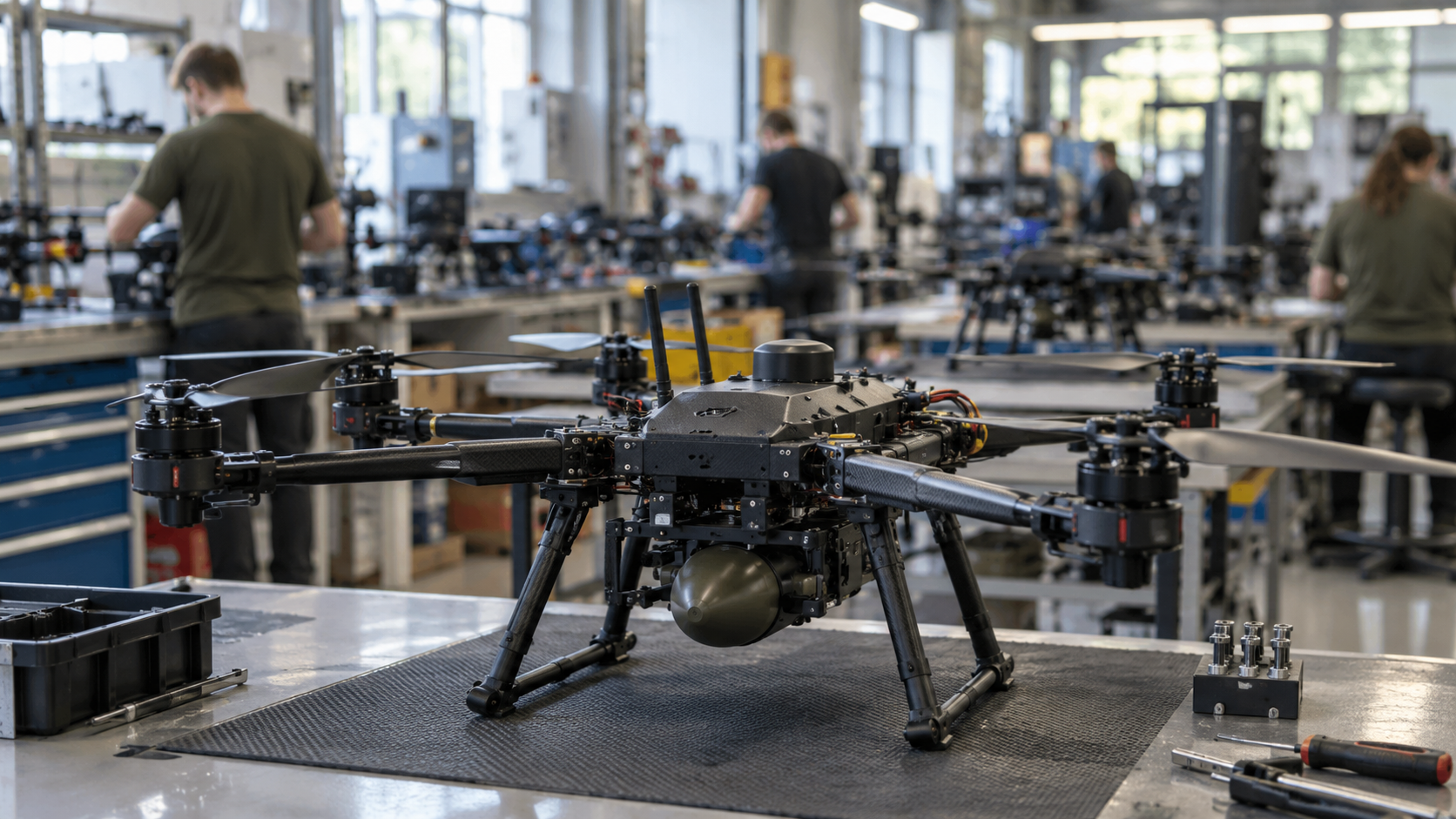
The detail worth revisiting is why the Gepard earned its praise. We lauded it because it shot drones out of the sky cheaply and reliably. In hindsight, that was the whole story arriving early. The decisive instrument of this war is no longer the tank, the fighter jet, or the donated air-defence vehicle. It is the cheap, mass-produced, and overwhelmingly Ukrainian-built drone. The question that animated 2024, namely which Western platform performs best once handed to Kyiv, has given way to a different and more important one: which side can design, iterate, and manufacture unmanned systems fastest. On that axis Ukraine has built a commanding and largely indigenous lead.
From Borrowed Platforms to Built Swarms
The inversion is industrial before it is tactical. In 2024 Ukraine produced an estimated 2.2 million drones of all classes. Through 2025 annual capacity climbed past four million units, with President Zelensky citing a four-million ceiling and Bloomberg describing the country as a drone superpower. The supplier base expanded from roughly seven firms before the 2022 invasion to around five hundred, and monthly first-person-view output rose from about twenty thousand units to roughly two hundred thousand. The Brave1 defence-technology cluster now coordinates more than one and a half thousand companies, and procurement has been pushed down to the brigade level through marketplace schemes that let frontline units buy directly from manufacturers and earn credits for confirmed kills. We flagged the early contours of this shift in our March 2025 assessment of Ukraine’s domestic defence base; the scale it has since reached is the surprise. The inversion fits in a single sentence. A country that spent 2023 lobbying allies for several dozen main battle tanks now builds more strike drones in a week than the Western alliance fields in armour.
The Kill Zone
That output has reshaped how soldiers and vehicles die. Multiple analyses, including those of the Polish Centre for Eastern Studies, now attribute the majority of Russian battlefield casualties to drones, with credible estimates ranging between roughly two-thirds and four-fifths, and an even larger share of destroyed vehicles. These are estimates rather than audited counts, and they vary by sector and by month, but the direction is not in dispute. Ukraine’s Line of Drones initiative, launched in early 2025, has woven FPV teams, reconnaissance craft, and ground robots into a contiguous kill zone reaching ten to fifteen kilometres behind the line of contact, a band in which anything that moves is likely to be seen and struck within minutes. The spread of fiber-optic FPV drones, which trail a hair-thin filament and cannot be jammed, has hardened that zone further. Honesty requires noting that Russia fielded fiber-optic drones first, in the Kursk fighting of 2024, and that Ukraine spent much of 2025 closing the gap. The consequence for last year’s armour debate is blunt. A first-person-view drone costing a few hundred dollars now disables a Leopard 2 and a T-90 with equal indifference, and the question of whose tank is superior has been overtaken by the question of whether concentrated armour can survive on this battlefield at all.
Reaching the Rear
Exactly one year ago today, on 1 June 2025, Ukraine demonstrated that the drone had also dissolved the idea of a safe Russian rear. In Operation Spiderweb, the SBU smuggled 117 short-range drones into Russia aboard modified trucks and launched them against strategic bomber bases as far as 4,300 kilometres from the front. Kyiv claimed 41 aircraft hit and roughly 7 billion dollars in damage. Satellite imagery independently confirmed the destruction of about 13 aircraft, including Tu-95 and Tu-22M3 bombers, while United States officials assessed a smaller total. Even on the conservative figure, a handful of concealed drones reached the aircraft that carry Russia’s cruise missiles. The same logic powers a sustained campaign against Russian oil refining. Long-range drones such as the Liutyi, with a reach well beyond a thousand kilometres, struck more than twenty of Russia’s largest refineries during 2025. The measured effect is more modest than some headlines imply, with a few percent shaved from annual throughput rather than the fifth of capacity periodically knocked offline, yet fuel exports fell to their lowest level since early 2022. Ukrainian drones have even begun killing the high-value air defences meant to stop them, including satellite-confirmed strikes on S-400 batteries near Novorossiysk in late 2025.
A Navy Made of Drones
Nowhere is the reversal starker than at sea. Ukraine, with no conventional surface fleet worth the name, has driven the Russian Black Sea Fleet out of the western Black Sea using uncrewed surface vessels that cost a fraction of the ships they destroy. Magura and Sea Baby drone boats sank the corvette Ivanovets and the landing ship Tsezar Kunikov in early 2024, and have since damaged or destroyed a substantial portion of the fleet, with assessments ranging from a third to forty percent rendered combat-ineffective. The boats then did something no uncrewed vessel had done before. A missile-armed Magura downed a Russian Mi-8 helicopter at the close of 2024, the first air kill by a sea drone, and Ukrainian intelligence claims a later variant destroyed two Su-30 fighters in May 2025, a claim not independently confirmed. Moscow has withdrawn its surviving warships to Novorossiysk and ports further east, the grain corridor has reopened, and seaborne exports have recovered. A blue-water fleet has been beaten by a navy that barely exists.
Russia’s Answer: Mass Without the Edge
A sober account must credit Russia’s one genuine advantage, which is volume. The Alabuga plant has scaled production of the Geran-2, its licensed copy of the Iranian Shahed-136, to thousands of units a month, and Russia now launches swarms that have exceeded seven and eight hundred drones in a single night against Ukrainian cities. A jet-powered variant, the Geran-3, reaches around 600 kilometres an hour, and the Lancet loitering munition remains a capable tank-killer. Volume, however, is not the same as superiority. Russia’s drone effort leans heavily on Chinese and Iranian components, from engines to fiber-optic cable, and on reverse-engineering rather than origination. It has produced no answer to Ukraine’s naval drones, no operation comparable to Spiderweb, and a slower cycle from idea to fielded system. Ukraine has even begun to neutralise Russia’s lone advantage with cheap drone-on-drone interceptors, downing record numbers of incoming Shaheds at a small fraction of the cost of a surface-to-air missile, a programme we examined earlier this year. By early 2026 Ukraine had overtaken Russia in the sheer volume of deep-strike drone attacks. Where Russia leads, it leads by tonnage. Where the war is being redefined, in naval strike, deep precision, and software-driven targeting, Russian systems lag.
The Lesson, Re-Written
A year ago we concluded that context and adaptability trump pure modernity. That principle survives intact, but the unit of measure has changed beneath it. The relevant variable is no longer which donated platform a quartermaster should prize. It is which side can compress the journey from battlefield problem to manufactured solution into weeks rather than years. Ukraine has turned a dispersed ecosystem of small workshops, software engineers, and frontline tinkerers into the most consequential weapons programme of the war, and it has done so largely on the strength of its own industry rather than allied generosity. The Gepard we praised last year earned its keep by shooting drones down. The deeper truth, legible only in hindsight, was always the drones themselves. For Western defence ministries still buying small numbers of exquisite platforms on decade-long timelines, the Ukrainian inversion is not a curiosity to admire. It is a warning about the shape of the next war, and about who is currently better prepared to fight it.
Read our full Report Disclaimer.
Report Disclaimer
This report is provided for informational purposes only and does not constitute financial, legal, or investment advice. The views expressed are those of Bretalon Ltd and are based on information believed to be reliable at the time of publication. Past performance is not indicative of future results. Recipients should conduct their own due diligence before making any decisions based on this material. For full terms, see our Report Disclaimer.