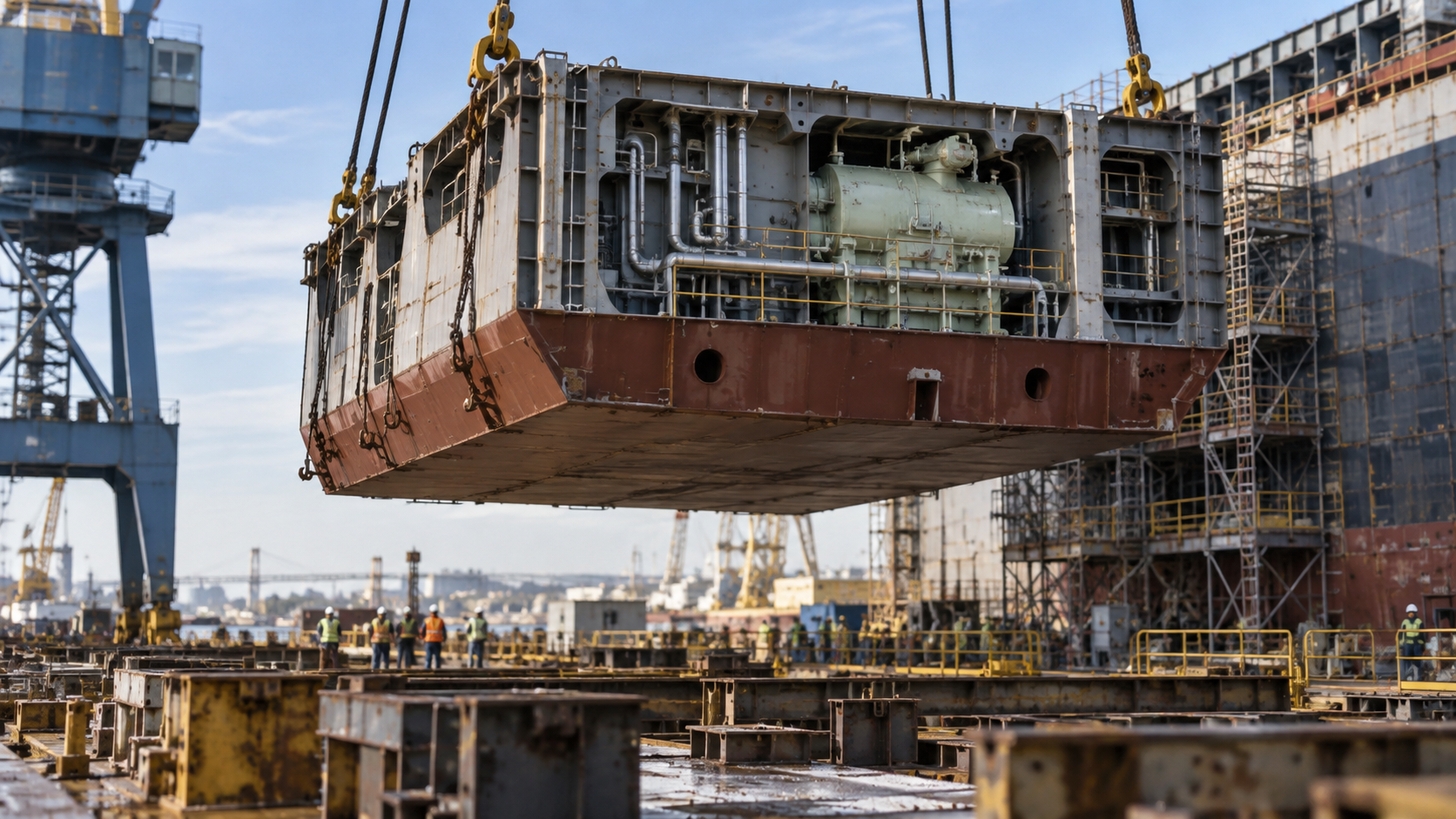
On 4 August 2025, in a dry dock on the Delaware River, a 420-tonne block of marine engine room was lowered into position under a Korean banner. Coins were placed beneath the section in the maritime tradition. The block belonged to the first hull of the Aloha Class, the Jones Act-qualified containership Matson will not see at sea until 2027. The yard that fitted the section was Hanwha Philly Shipyard, a Pennsylvania facility that Hanwha Group of Seoul had purchased outright for $100 million in December 2024 and announced a further $5 billion of infrastructure investment in by August 2025. The Aloha Class is being constructed in the United States by Korean capital, on a Korean industrial template, by an American workforce being retrained on Korean methods. It is the most American container ship under construction. It is also a measure of how thoroughly the West has lost the capacity to build hulls without external help.
The arithmetic is bracing. Korea, China and Japan together account for roughly 89 percent of global commercial new orders by compensated gross tonnage in 2025. The Baltic and International Maritime Council reports that Chinese yards alone took 70 percent of all contracting in the first quarter of 2026, with Japan at 1 percent, the lowest single-quarter share recorded since the series began in the mid-1990s. The global orderbook stands at 191 million CGT, 17 percent of the world fleet, the highest ratio since 2011. The United States ranks 19th in commercial shipbuilding, builds fewer than five oceangoing commercial vessels per year, and maintains a Jones Act-qualifying oceangoing fleet of 93 hulls as of April 2025. The US-flag oceangoing merchant fleet is approximately 0.35 percent of global deadweight tonnage. Less than 2 percent of American international trade moves on American-flagged bottoms. The Royal Navy has slipped its first Type 26 frigate from October 2027 to October 2028. The European Union’s commercial shipbuilding sector has contracted at a 3.1 percent compound annual rate over the five years to 2025. The numbers describe a structural condition, not a cyclical dip.
The Korean Annexation. The most consequential single transaction in Western shipbuilding in a decade was Hanwha’s $100 million acquisition of Philly Shipyard. It marked the first time a foreign industrial group had purchased a strategically significant American yard outright. The follow-on commitment of $5 billion in August 2025 placed Hanwha as the single largest investor in American shipbuilding capacity. Within the same year, Korea’s MASGA proposal, “Make American Shipbuilding Great Again,” committed $150 billion of loans and guarantees to the rebuild, as part of a broader $350 billion US-Republic of Korea package finalised in the run-up to the 1 August 2025 tariff deadline. Hanwha Ocean became the first Korean yard to perform US Navy maintenance and repair work, completing the dry-cargo ship USNS Wally Schirra at Geoje in March 2025 and the USNS Yukon in May 2025, on a five-year Master Ship Repair Agreement signed in July 2024. Samsung Heavy Industries followed via its NASSCO and Conrad agreements. American sealift came home from a foreign yard in 2025 not because of war damage, but because no domestic yard had the slot.
The China Method. The Chinese state shipbuilding combine, China State Shipbuilding Corporation, runs a civilian and military programme on the same industrial floor. CSSC’s 2025 plan called for 89 civilian hulls totalling 6.34 million deadweight tonnes, alongside one catapult-equipped aircraft carrier, one large amphibious assault ship, at least seven destroyers, six frigates, and the Type 076 unmanned-systems carrier. The Center for Strategic and International Studies’ “In the Shadow of Warships” series places the cost advantage at roughly 13 to 20 percent against Korean and Japanese rivals, and notes the systematic civilian subsidy that finances the warship build. CMA CGM, the French container line, placed its two largest 2025 newbuild blocks, twelve 18,000-TEU LNG-powered ships at HD Hyundai Heavy and twelve 15,500-to-18,000-TEU vessels at CSSC Jiangnan, for a combined value of approximately $5.2 billion. No non-Asian yard could bid. The single bid that mattered, the bid for the European container fleet’s next-generation hardware, was a competition between Seoul and Shanghai, conducted in their currencies, on their schedules.
The Hollow Reserve. The civilian hollowing matters because the military reserve depends on it. The United States Navy’s battle force on 1 October 2025 stood at 293 ships against a stated goal of 381 manned hulls plus 134 large unmanned platforms in the FY2025 long-range plan. Secretary of the Navy John Phelan described the FY2026 budget of 19 hulls and $47.3 billion as a transitional figure, signalling that FY2027 shipbuilding could be “more than double” the 2026 ship total. Phelan moved in November 2025 to truncate the Constellation-class frigate programme, which had reached 12 percent completion on the lead ship and slipped delivery 36 months from July 2026 to April 2029, replacing it with a sketch called FF(X) based on the Coast Guard’s National Security Cutter. The Ready Reserve Force averages roughly 45 years per hull, with 20 of 51 vessels over 50 years old; United States Transportation Command has sought authority to purchase ten used cargo ships outright. The 355-hull statutory goal of the FY18 NDAA has been quietly superseded.
The European Mirror. The European story is the same in different proportions. Italian and German yards retain global leadership in the cruise segment, with Fincantieri holding approximately 45 percent of the global cruise orderbook through thirty ships, and Naval Group, Navantia and Damen retaining specialist warship and offshore-support capability. Commercial cargo shipbuilding has effectively departed the bloc. The Royal Navy’s Type 26 frigate slipped its initial operating capability by twelve months in 2025; the full class is now scheduled to enter service between 2028 and 2035. The Russian alternative is worse. The Zvezda yard’s LNG carrier programme has been crippled by GTT membrane sanctions, the planned merger of Zvezda into United Shipbuilding Corporation was cancelled in March 2025 because USC could not afford it, and the first domestically assembled Arc7 LNG carrier was delivered after years of delay. The hollowing of yards has not been a Western failure of will. It has been a quarter-century reallocation of industrial capacity, taken decision by decision, that nobody felt was strategic at the time and which nobody now individually owns.
The Strategic Verdict. The deterrent question is direct. A Taiwan contingency, on the timelines Indo-Pacific Command and the Navy have publicly used, would test the West’s ability to deliver merchant marine, sealift hulls, replenishment auxiliaries and replacement frigates at a pace the present industrial base cannot match. The substitution path, building in Korea, refitting in Korea, financing through Korean and Japanese balance sheets, is the realistic one. It is also a substitution that places the operational tempo of the Western alliance system inside yards that sit within range of the same People’s Liberation Army the deterrent is meant to deter. South Korea’s willingness to accept this role is real, and the MASGA package and the Hanwha-Philly purchase are evidence of it. The constraint is geographic: a war fought on hulls Korea built is a war whose industrial base is two thousand kilometres from Pyongyang and six hundred from Shanghai. The West did not lose shipbuilding to a faster competitor. It demobilised an industry, rented the replacement from Seoul, and left Beijing to set the price. A sea-control war fought on hulls Beijing built is not deterrence. It is dependency.
Read our full Report Disclaimer.
Report Disclaimer
This report is provided for informational purposes only and does not constitute financial, legal, or investment advice. The views expressed are those of Bretalon Ltd and are based on information believed to be reliable at the time of publication. Past performance is not indicative of future results. Recipients should conduct their own due diligence before making any decisions based on this material. For full terms, see our Report Disclaimer.