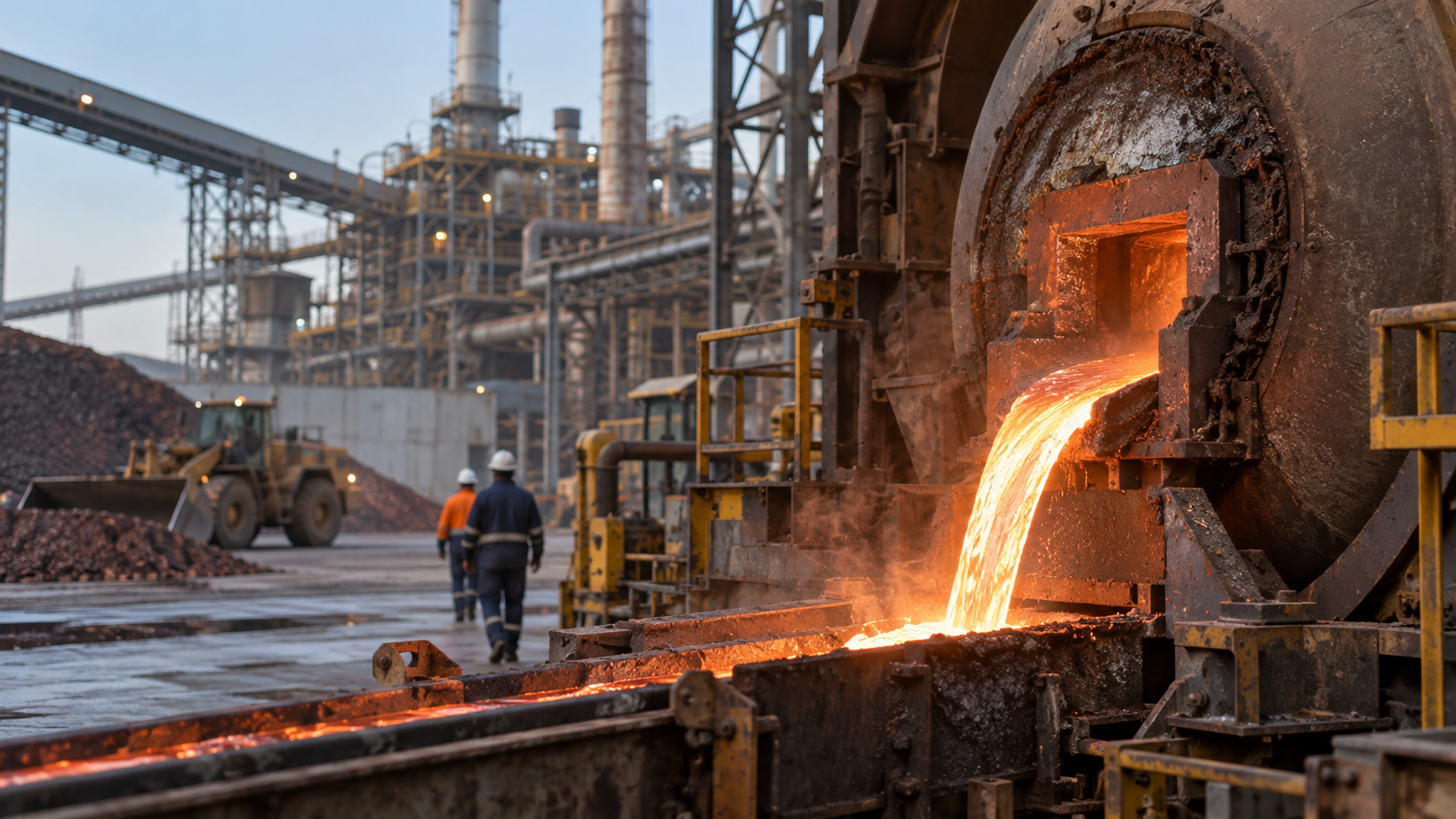
In December 2025, Chile’s Antofagasta and a Chinese smelter settled the 2026 benchmark treatment and refining charge at exactly zero: $0 per tonne, 0 cents per pound. A year earlier the same negotiation had cleared at $21.25 a tonne. On the spot market the number went further still, with Fastmarkets pegging its index at minus $66.80 a tonne on 5 December and traders quoting minus $60 through November. The treatment charge is the fee a miner historically pays a smelter to turn raw concentrate into refined metal; it is the smelter’s core revenue line. For the first time at industrial scale, that line has gone negative. Smelters are now paying miners for the privilege of processing their ore. The conventional Western story about copper is one of mine scarcity, of too few orebodies for an electrifying world. That story is now half wrong. The binding constraint has migrated downstream, and the strategic vulnerability is no longer the mine but the smelter.
The Inversion. Two forces collided to produce a negative number. Mine supply did tighten: outages at Freeport’s Grasberg in Indonesia and Ivanhoe’s Kamoa-Kakula in the Democratic Republic of Congo removed expected concentrate from a market already running thin, and global concentrate output grew roughly 1.2 percent year on year. But scarcity alone does not drive a fee below zero; it merely compresses it. What pushed the charge through the floor was the other side of the equation. Chinese smelting capacity expanded by something close to 11 percent over the same period, an order of magnitude faster than the ore available to feed it. When far too many smelters chase a slowly growing pool of concentrate, the competition to secure feedstock becomes so fierce that processors will accept not merely a small fee but a loss, paying for tonnes simply to keep their furnaces hot. The zero benchmark is the visible scar of that imbalance. Worth holding onto the trajectory: the spot charge slid to roughly minus $26.5 a tonne in March 2025, then deepened to minus $60 by November and the Fastmarkets index to minus $66.80 in December. A fee that erodes over a year is a cyclical squeeze. A fee that accelerates downward through it is a structural one, and the annual benchmark settling at zero merely ratifies on paper what the spot market had already declared.
Beijing’s Overbuild. The capacity sits overwhelmingly in one country. China now operates at least forty-five copper smelters, controls roughly 40 percent of the world’s smelting capacity, and produces close to 60 percent of global refined copper. It accounts for around twelve of the world’s twenty-nine million tonnes of annual smelting capacity, and that figure was still climbing into 2025 even as the economics turned ruinous. This was not market accident but industrial policy: a decade of provincial subsidies, cheap capital and integration into copper-product manufacturing that let smelters recover at the wire-and-tube stage what they surrendered at the furnace. The result is a midstream so oversupplied that even its builders cannot make it pay. The strategic point is uncomfortable for the West. China achieved dominance over the conversion layer of the copper chain without buying a single new orebody.
The Self-Inflicted Wound. The overcapacity is now hurting its architects, which is the surest sign of how far it has gone. In late November 2025 the China Smelters Purchase Team, the procurement bloc of the country’s largest processors, agreed to cut 2026 output by more than 10 percent; roughly two million tonnes of planned Chinese capacity has been suspended outright. The China Nonferrous Metals Industry Association, the sector’s own state-backed trade body, declared that it “firmly opposes” any free or negative processing, and its vice president Chen Xuesen warned against the “malignant competition” tearing through the membership. When Beijing’s champions publicly beg one another to stop building and stop bidding, the loss-making is structural rather than cyclical. A national smelting industry is now disciplining itself because no buyer will, and because the alternative is collective insolvency.
The Allied Casualties. If the Chinese smelter that runs at a loss can lean on vertical integration and patient state capital, the standalone Western processor cannot. The carnage among allied midstream assets is already visible. In Australia, Glencore’s Mount Isa smelter, which provides roughly half the country’s copper smelting capacity, survived 2025 only on a A$600 million rescue from the federal and Queensland governments announced on 8 October, structured as three payments of up to A$200 million and intended to keep the furnaces lit to 2028. The bailout came months after Glencore had already shut the depleted Mount Isa underground mine that the smelter once sat beside, severing the feedstock link and leaving a processing asset that the market would not fund on its own merits. In Japan, JX Advanced Metals, one of the country’s top processors with 450,000 tonnes of annual capacity, moved in September to cut output and map a reduction in capacity outright, its margins eroded by the same zero charge; roughly half its refined copper is exported to China, where ramping domestic smelters now threaten even that outlet. These are not marginal operators. They are the backbone of the non-Chinese refining base, and they are being kept alive by subsidy or shrinking by attrition.
The Weapon Mechanism. Read together, these facts describe an instrument rather than a market malfunction. A negative treatment charge is a price that only a balance-sheet built for loss can survive. The Chinese smelter, cross-subsidised and integrated, can absorb it almost indefinitely; it recovers at the rod, wire and tube stage what it surrenders at the furnace, and analysts estimate it operates at less than half the cost base of a US or allied plant. The unintegrated Spanish, Japanese or Australian smelter, dependent on the processing fee as its sole revenue, has no such recovery and no such cushion. By running the midstream below cost, China exerts downward pressure on every competitor it is not permitted to acquire. Foreign-investment screening in Canberra, Tokyo and Washington can block the purchase of an allied smelter outright; no screening regime can stop a Chinese furnace from bidding a tonne of concentrate up to a price at which the Western rival bleeds. Capacity that cannot be bought can still be attrited, and attrition leaves no acquisition for a regulator to veto. The conversion layer of the entire energy-transition supply chain is being captured by margin warfare rather than by acquisition.
The Western Blind Spot. The policy response has lagged the diagnosis badly, because the West kept fighting the last war. Capital and political attention flowed toward mining: permitting reform, new tariffs on imported metal, talk of opening domestic orebodies. The Center on Global Energy Policy at Columbia has been blunt that this misses the choke point. The United States ran sixteen primary copper smelters in 1976 and runs two today, with a third mothballed, leaving a domestic processing deficit on the order of 660,000 tonnes that no amount of new mining can close, because mined concentrate from an American pit still has to be smelted somewhere, and that somewhere is increasingly China. A mine without an allied smelter to feed is not strategic independence. It is a feedstock subsidy to Beijing’s furnaces, dressed up as resource security.
The Verdict. The negative toll is the clearest market signal yet that the West has been guarding the wrong door. Copper scarcity is real, but scarcity at the mine is precisely what makes the smelter the decisive asset, because whoever controls the furnaces controls the conversion of ore into the metal that the grid, the data centre and the electric drivetrain actually consume. China built that control at a loss it could afford and its rivals could not, and is now throttling its own output not to retreat but to stop the bleeding while the allied base hollows out around it. Defending Western copper means defending smelters, not just mines: price floors for the unintegrated processor, modernisation capital for Mount Isa and its peers, and the recognition that a smelter kept alive by subsidy is cheaper than a supply chain surrendered. The miners will get paid to deliver their ore. The only open question is to whose furnace it goes.
Read our full Report Disclaimer.
Important Notice
Bretalon Ltd is not a registered investment adviser or broker-dealer. This report is published free of charge as impersonal, general commentary in a publication of regular circulation. It is not investment, financial, legal, or tax advice, and not an offer or recommendation to buy, sell, or hold any security; no report recommends, rates, or values any specific security. Do not rely on it for investment or business decisions; always consult a qualified professional. It speaks only as of its publication date, and its views on companies, securities, and markets are analytical opinion, not fact. As of 22 October 2026, neither Bretalon Ltd nor those involved in its reports have ever been paid by any company a report discusses (unless expressly disclosed in the report). Those involved hold no direct positions in individual securities and hold any securities only through mutual funds and similar pooled or collective investment funds. Bretalon Ltd provides strategic advisory services to publicly listed and privately held companies under separate written agreements. This report was drafted with AI from public sources, its illustration is AI-generated, and it was approved for publication by a person acting for Bretalon Ltd. Provided "as is" without any duty of care to readers. Read our full Report Disclaimer.