
Nations spend extravagantly chasing advantages that can be purchased. They buy fighter jets, fabrication plants, sovereign data centres, foreign consultants and turnkey factories, on the implicit theory that capability is a commodity and that a sufficiently large cheque closes the gap. Most of these advantages depreciate the moment they are acquired. Hardware ages, patents expire, consultants leave, and the supplier who sold you the equipment is already two generations ahead. There is one asset that behaves differently. The accumulated stock of skills, judgment, tacit know-how and functioning institutions that a society carries inside the heads of its people and the routines of its organisations does not depreciate on the same schedule. It compounds. It is also, almost uniquely, the one thing that cannot be transferred by wire. Understanding why is the difference between a state that converts wealth into durable power and one that merely rents the appearance of it.
The asset that hides on no balance sheet
Conventional accounting trains decision-makers to see what is countable: machines, buildings, reserves, cash. This is precisely the wrong lens for the most important asset a country owns. The World Bank’s Changing Wealth of Nations programme, which attempts to measure comprehensive national wealth rather than annual output, has repeatedly found that human capital, the value embedded in the working population’s skills and earning capacity, constitutes roughly two-thirds of total global wealth. Produced capital (the factories, roads and equipment that dominate the popular imagination of “the economy”) accounts for only about a quarter. The factories matter, but the people who know how to run, repair, redesign and reinvent them matter more.
The same body of work contains a quieter and more pointed finding. In economies heavily dependent on resource extraction, human capital makes up a much smaller share, with natural capital doing the heavy lifting instead. A petrostate can post a high income per head while owning very little of the asset that actually sustains prosperity once the resource is gone. The income is real; the wealth is shallow. This is the statistical signature of an economy that has bought its way to a number rather than built its way to a capability, and it is the clearest available evidence that money and human capital are not interchangeable.
Why technology refuses to travel alone
The decisive concept here was named by the economists Wesley Cohen and Daniel Levinthal in a 1990 paper for Administrative Science Quarterly: absorptive capacity, the ability of an organisation to recognise the value of external knowledge, assimilate it, and apply it to commercial ends. Their central and counterintuitive claim was that the capacity to absorb outside ideas is largely a by-product of doing your own research. You cannot simply receive frontier knowledge; you can only catch what you are already trained to reach for. A firm with no internal research effort cannot even perceive what a competitor’s breakthrough is worth, let alone deploy it.
Scale this from the firm to the nation and the implication is severe. A country can import the most advanced reactor, the most modern semiconductor line, the most sophisticated air-defence system, and still extract only a fraction of its potential value, because the imported object is the visible tip of a vast submerged body of tacit knowledge: the operating intuitions, the maintenance culture, the supply relationships, the failure post-mortems, the trained workforce that knows why the manual says what it says. None of that ships in the crate. It has to already exist on the receiving end, or be painstakingly grown there. Technology without absorptive capacity becomes a museum piece under warranty, dependent on the seller for every upgrade and every repair, which is to say dependent indefinitely.
The Korean demonstration
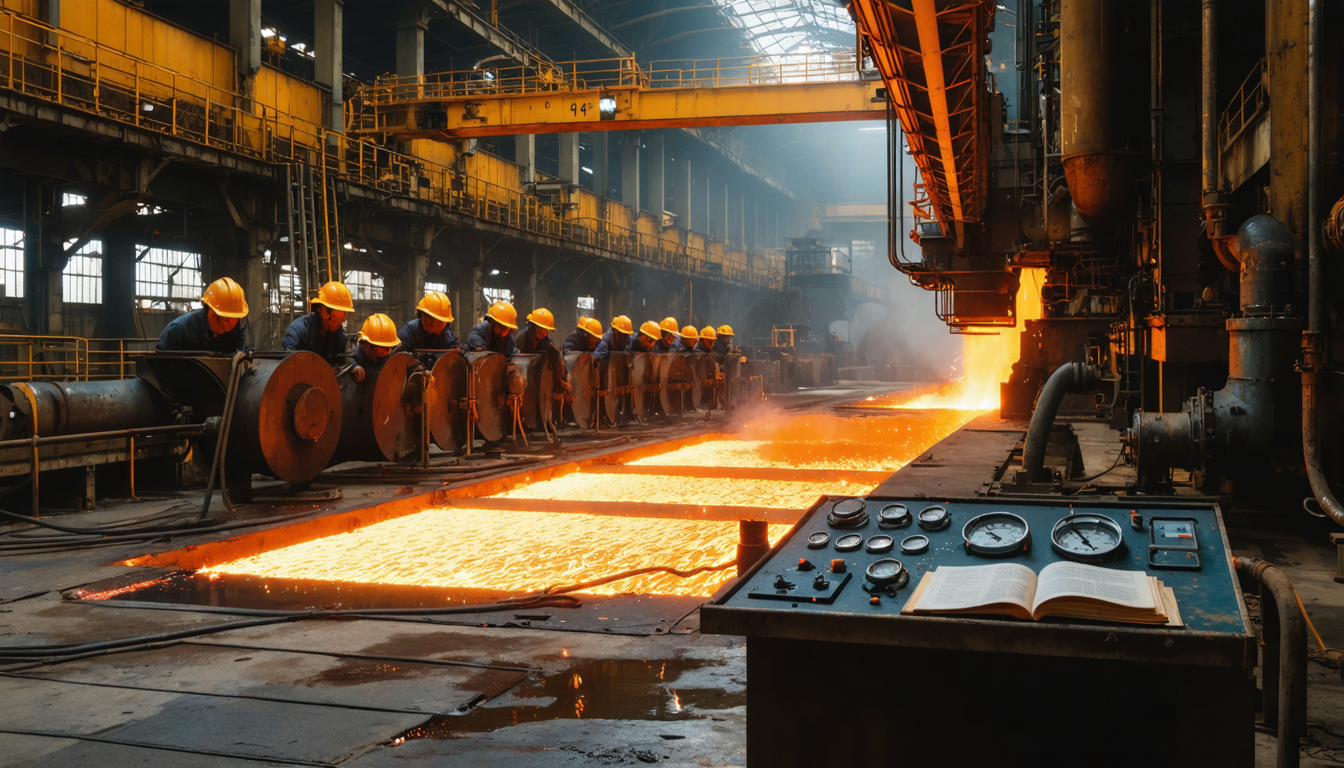
South Korea is the cleanest case study in the deliberate manufacture of absorptive capacity, and it is worth reading carefully because it is so often misread as a simple story of imported technology. When the Pohang Iron and Steel Company, now POSCO, was built, it relied heavily on Japanese finance and engineering; the two governments signed a basic financing agreement at the end of the 1960s under which Japan supplied capital and technical assistance worth roughly 124 million dollars at the time, a sum well into the hundreds of millions in today’s money. A petrostate logic would have stopped there: buy the plant, run it, sell the steel. Korea did something else. It treated the imported technology as a teacher rather than a product, systematically reverse-engineering, retraining, and reinvesting until the recipient out-engineered the source. POSCO became one of the largest and most efficient steelmakers in the world, and Korea’s broader electronics and shipbuilding sectors followed the same arc from licensee to licensor.
The proof that this was about absorptive capacity and not luck lies in what Korea did with its surplus. Rather than parking the proceeds in foreign assets, it ploughed them back into the knowledge base. South Korea now spends well over 5 percent of its gross domestic product on research and development, among the very highest research intensities in the world, alongside Israel and far above the United States, Japan and Germany, and roughly double the OECD average. That is not the spending pattern of a country buying capability. It is the spending pattern of a country compounding it.
Tacit knowledge and the institutions that hold it
Much of what makes an economy genuinely hard to replicate is knowledge that no one can fully write down. Germany’s industrial strength rests substantially on its dual vocational training system, codified in the Vocational Training Act of 1969, which combines classroom theory with structured, multi-year apprenticeships inside real firms. The small and mid-sized companies of the Mittelstand provide the bulk of these placements. What the apprentice acquires on the shop floor, the feel for tolerances, the recognition of a process drifting out of specification, the social choreography of a working team, is exactly the tacit, hard-to-articulate knowledge that absorptive-capacity theory identifies as decisive. A rival can read every German engineering standard ever published and still be unable to reproduce the workforce that makes those standards routine.
This is why institutions, not individuals, are the real unit of analysis. A single brilliant engineer can be hired away; a training system that reliably produces tens of thousands of competent ones every year cannot. The moat is not any one person’s knowledge but the social machinery that creates, transmits and renews knowledge across generations: universities, professional bodies, apprenticeship pipelines, research agencies, the dense informal networks through which workers move between firms and carry methods with them. These institutions are slow to build, expensive to maintain, and almost impossible to copy by decree, which is precisely what makes the advantage they confer so durable.
The limits of the cheque book
The contrast case is the resource economy that mistakes liquidity for capability. The Gulf states have demonstrated both the appeal and the ceiling of the purchasing strategy. They have bought world-class infrastructure, recruited global talent, and stood up sovereign wealth funds and national champions such as Saudi Aramco that form joint ventures with the most advanced foreign firms. Yet the same governments have spent the better part of two decades publishing diversification strategies precisely because they understand that hydrocarbon revenue, however vast, has not yet been converted into a self-sustaining knowledge economy. The persistent reliance on expatriate expertise, who make up the large majority of the private workforce across the region, together with the heavy weight of public-sector employment for nationals, is the tell. Capital can rent the capability; it has struggled to internalise it. The harder, slower work of building domestic absorptive capacity, the schools, the research base, the private firms that learn, is what remains unfinished.
This is not a moral judgment about any country. It is a structural observation. The cheque book buys access to the global frontier; it does not buy the capacity to stand on the frontier unaided. Those are different goods, and only the second compounds.
The strategic implication
For any state or institution thinking past the current quarter, the lesson is uncomfortable because it offers no shortcut. The advantages that can be purchased are, by definition, available to anyone with comparable money, and therefore confer no lasting edge. The one advantage that cannot be purchased, the accumulated, institutionalised, self-renewing stock of human capability, is the only one that grows rather than decays, and it grows fastest in those who already have it. Education spending, research funding and training systems read as costs on an annual budget and as compounding assets on a fifty-year one. Societies that grasp this treat their schools, laboratories and apprenticeships as the foundational infrastructure of national power, and protect them accordingly. Those that do not will keep writing larger cheques for capabilities they never quite own, and wondering why the gap refuses to close.
Read our full Report Disclaimer.
Report Disclaimer
This report is provided for informational purposes only and does not constitute financial, legal, or investment advice. The views expressed are those of Bretalon Ltd and are based on information believed to be reliable at the time of publication. Past performance is not indicative of future results. Recipients should conduct their own due diligence before making any decisions based on this material. For full terms, see our Report Disclaimer.