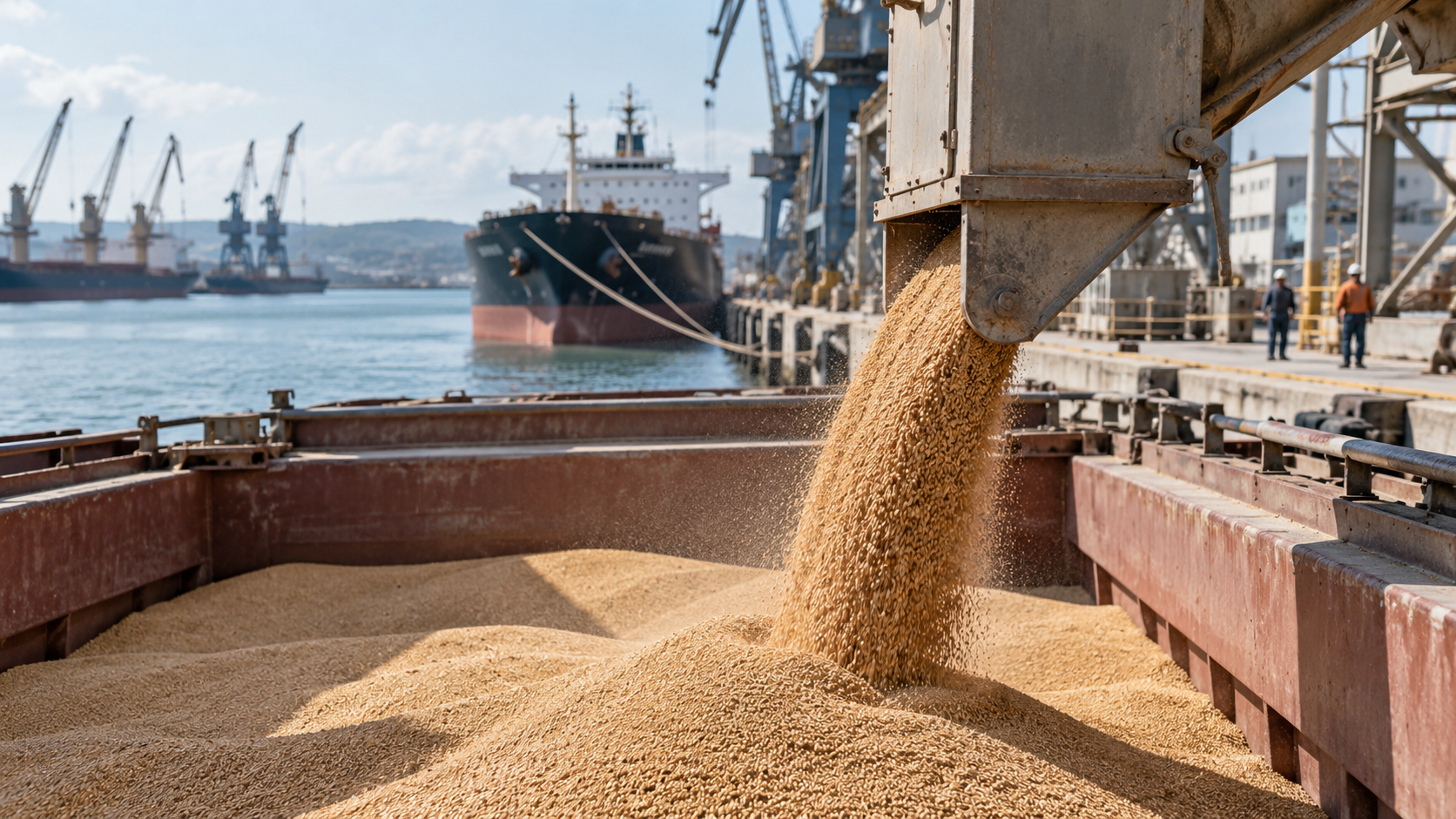
Few political slogans travel as well across ideologies as food sovereignty. Populists, autarkists, agrarian nationalists and security hawks all converge on the same intuitively satisfying proposition: a serious country should be able to feed itself. The instinct is ancient and the emotional appeal is obvious, since hunger is the oldest instrument of coercion. Yet as a guide to modern statecraft, the pursuit of national food self-sufficiency is more often a trap than a fortress. It misidentifies where the vulnerability actually lies, it consumes scarce capital and political attention on the wrong objectives, and in its most aggressive forms it has produced some of the deadliest policy failures in recorded history. The countries that are genuinely food-secure are rarely the ones that grow everything they eat. They are the ones that have engineered redundancy into the systems that stand between a seed and a loaf.
The Conflation at the Heart of the Argument
The first error is definitional. Self-sufficiency measures how much of a nation’s caloric intake is grown inside its own borders. Food security measures whether the population can reliably obtain enough food at all times, regardless of where it originates. These are not the same variable, and they frequently move in opposite directions. A state can be highly self-sufficient and chronically insecure, as subsistence economies vulnerable to a single failed harvest demonstrate every decade. It can also import the overwhelming majority of its calories and still rank among the best-fed societies on earth.
Singapore is the cleanest illustration. The city-state imports more than 90 percent of its food, sourced from well over 180 countries and territories, and yet it sits among the most food-secure populations in the world. Its strategy is not domestic production but diversification, stockpiling, local supplementation and forward partnership, treating supply concentration rather than import dependence as the actual hazard. The lesson is uncomfortable for sovereignty advocates: security came from spreading exposure across many suppliers, not from trying to eliminate exposure altogether.
What Comparative Advantage Actually Buys
The economic case against forced self-sufficiency is two centuries old and has never been refuted. Land, water, climate and labour are distributed unevenly across the planet, so the marginal cost of growing a given crop varies enormously by location. When a desert state diverts capital and aquifer water into domestic wheat at several times the world price, it is not buying security; it is buying a politically visible but economically destructive symbol while depleting the one truly irreplaceable input, groundwater.
Trade allows a country to convert what it produces cheaply into what it consumes expensively, and the global grain market exists precisely because that arbitrage is large. Wheat exports are spread across several big suppliers rather than dominated by any one. Russia is the single largest exporter, typically supplying somewhere around a fifth of internationally traded wheat, with Canada, the United States, the European Union (France above all), Ukraine, Australia and Argentina accounting for most of the remainder. Exact annual shares shift with harvests and exchange rates, but the structural point is durable: no single origin commands the market. That fragmentation is itself a security asset. A buyer with hard currency and functioning ports can rotate among origins as harvests and politics move. The danger is not that food is traded; it is when a buyer leans on too few sellers. Egypt, the world’s largest wheat importer at well over ten million tonnes a year once private trade is included, learned this when it concentrated the bulk of its purchases on a small set of Black Sea and European suppliers.
The Real Choke Points Are Upstream
Here is the analytical core that the sovereignty narrative consistently misses. Modern agricultural output is not primarily a function of acreage. It is a function of inputs, and those inputs are far more concentrated, far more tradeable and far more weaponisable than land. A country can own every hectare it farms and still be hostage to four upstream systems: fertiliser, seed, fuel and logistics.
Fertiliser is the starkest case. Synthetic nitrogen, phosphate and potash underwrite roughly half of all calories produced today, and their supply is geographically narrow. A handful of exporters dominate each nutrient. Russia and Belarus together account for close to 40 percent of globally traded potash; Morocco sits atop the world’s dominant phosphate rock reserves, holding an estimated two-thirds of the global total; and nitrogen production is hostage to natural gas, since urea and ammonia are essentially gas converted into plant food. A nation can grow its own wheat and still find that wheat impossible to fertilise if those flows are cut. Self-sufficiency in the final crop is meaningless without security in the inputs that make the crop possible.
Seed is the quieter choke point. The commercial seed market has consolidated dramatically over four decades. The four largest firms, Bayer, Corteva, BASF and Syngenta, control well over half of the global seed market, with Bayer alone near a quarter and Corteva close to a fifth, and the top ten companies command roughly 70 percent. The genetic stock that determines yield, drought tolerance and disease resistance is therefore held in a handful of corporate portfolios and patent estates. A country that buys hybrid seed each season is structurally dependent regardless of how much land it tills, because the proprietary germplasm and trait licensing sit outside its jurisdiction.
Fuel and logistics complete the picture. Diesel powers tractors, irrigation pumps, processing plants and the trucks that move grain to mills and bread to cities. The chain from field to fork runs on refined hydrocarbons and on functioning ports, rail and cold storage. A famine in the modern world is far more likely to arrive through a fuel shortage, a port closure or a fertiliser embargo than through a shortfall in domestic acreage.
When Sovereignty Turns Lethal
The trap is not merely that self-sufficiency is expensive. In its maximalist political forms it has been catastrophic. Two of the deadliest peacetime episodes of mass starvation in modern history were both products of campaigns to make agrarian economies self-feeding and self-financing through forced restructuring. Soviet collectivisation in the early 1930s, designed to extract grain surpluses from consolidated farms to fund industrialisation, produced a famine that killed several million people across the USSR, with the Ukrainian death toll alone commonly estimated in the range of three to five million. China’s Great Leap Forward, which sought self-sufficient rural communes producing food and steel simultaneously, collapsed food output and caused a famine that killed on the order of twenty million people or more between 1959 and 1962, with credible scholarly estimates ranging considerably higher.
These were extreme cases, but they expose the mechanism. When self-sufficiency becomes a regime objective rather than a market outcome, it tends to override the price signals and adaptive behaviour that keep food systems flexible. The state substitutes a political target for the distributed knowledge of millions of producers, and the system loses its ability to respond to shocks. Autarky is brittle precisely because it severs the redundancy that trade provides.
The Narrow Cases Where It Holds
None of this means self-sufficiency is never rational. There is a defensible category, and it is narrow. The first justification is a single politically indispensable staple whose disruption would be socially intolerable. Japan keeps rice at roughly 99 percent self-sufficiency through acreage management and protection, even as its overall calorie-based self-sufficiency has fallen to around 38 percent, with wheat and soybeans deep in import dependence. This is not economically optimal; it is a deliberate decision that one culturally central staple is worth insuring against any external interruption, and the cost is borne consciously.
The second justification is strategic stockpiling for genuine wartime or blockade scenarios, where the question is survival over months rather than efficiency over years. The third is the maintenance of a baseline productive capacity, a living agricultural sector that can be surged in a crisis, which hedges against the atrophy of skills and infrastructure rather than chasing full autonomy. In each case the rationale is insurance against a specific, identified shock, not a blanket aspiration to grow everything.
The Strategic Implication
The serious objective for any state is not the percentage of calories grown at home but the robustness of the entire system that delivers food to its population under stress. That means diversifying suppliers so that no single origin can coerce, securing the input chains in fertiliser, seed and fuel as deliberately as the crops themselves, holding strategic reserves sized to real disruption windows, and preserving the logistical arteries that move food at scale. A country that does these things while importing most of its calories is more secure than one that grows its own wheat on imported fertiliser, foreign seed and diesel it cannot refine. Food sovereignty, pursued as an end in itself, mistakes the visible field for the invisible system that sustains it. The states that understand this quietly buy resilience; the ones that chase self-sufficiency too often buy a flag planted over an empty silo.
Read our full Report Disclaimer.
Report Disclaimer
This report is provided for informational purposes only and does not constitute financial, legal, or investment advice. The views expressed are those of Bretalon Ltd and are based on information believed to be reliable at the time of publication. Past performance is not indicative of future results. Recipients should conduct their own due diligence before making any decisions based on this material. For full terms, see our Report Disclaimer.