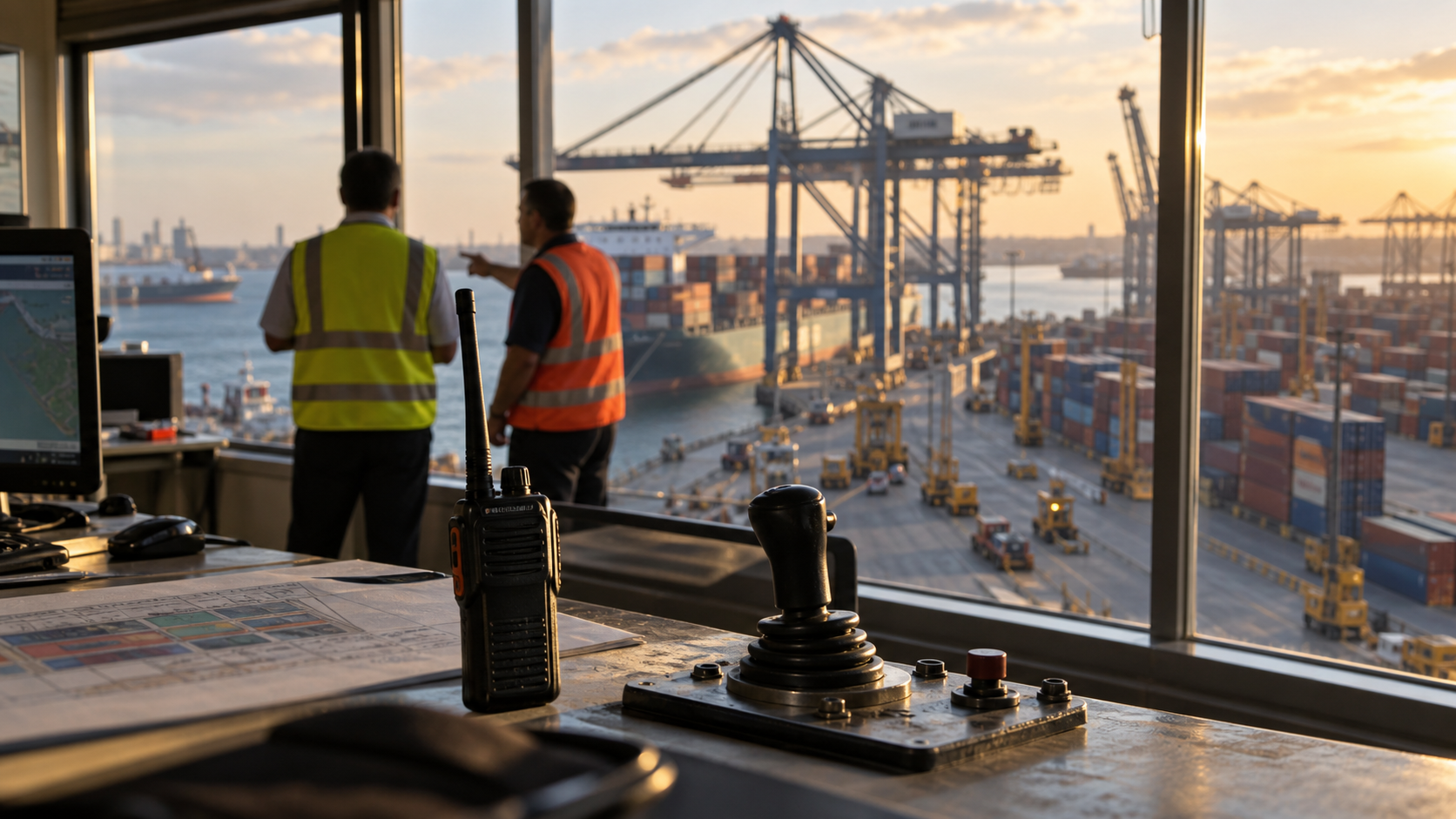
Roughly four-fifths of world merchandise trade by volume moves by sea, and almost all of it passes through a container terminal at least twice on its journey. Yet the berths, gantry cranes and stacking yards that form these chokepoints are rarely owned outright by the ships that call or the states whose flags fly above them. They are run, under contract, by a small cluster of specialist firms that have quietly assembled portfolios spanning every ocean. According to the maritime analyst Drewry, the largest global terminal operators (a group led by Singapore’s PSA International and including China Cosco Shipping, China Merchants, APM Terminals, DP World and Hutchison Ports) together account for roughly half of the world’s measured equity-adjusted container throughput. The instrument that lets so few control so much is unglamorous and almost invisible to the public: the port concession. Understanding how it works is the first step to understanding who actually holds the physical levers of globalisation.
The landlord model and the birth of the operator class
Most of the world’s large ports run on what the World Bank’s port reform toolkit calls the landlord model. The public authority retains ownership of the land, the breakwaters and the dredged channels, and acts as a neutral steward of the harbour. It does not move boxes. Instead it leases individual terminals to private operators who finance the cranes, hire the labour, run the software and take the commercial risk. The authority collects rent and a share of throughput; the operator captures the operating margin. This separation, which spread globally through the privatisations and concession reforms of the 1990s, created a new and highly mobile species of company: the global terminal operator, whose core competence is not owning waterfront but winning and running concessions on someone else’s waterfront.
The model’s logic is sound. Public authorities lack the capital and the appetite for the operational risk of buying ship-to-shore cranes that can cost well over ten million dollars apiece and depreciate against changing vessel sizes. Private operators bring that capital, plus a global playbook honed across dozens of sites. The bargain is that the state surrenders day-to-day control of a strategic asset in exchange for investment and efficiency it could not otherwise afford. That bargain is comfortable in calm waters. It becomes fraught the moment the identity of the operator starts to matter for reasons that have nothing to do with crane uptime.
Concession economics: long leases, sunk capital, captive cash flows
The concession contract is where the power actually sits. Where an operator finances and builds a new terminal under a build-operate-transfer structure, the lease typically runs around twenty-five to thirty-five years; concessions that involve little new construction tend to run shorter, often ten to fifteen years, with renewal options tied to performance criteria. The long horizon is not generosity. It is arithmetic. A greenfield deepwater terminal can absorb hundreds of millions of dollars, sometimes the better part of a billion, before it handles its first box, and that capital is almost entirely sunk: a quay wall cannot be repossessed and shipped elsewhere. Only a multi-decade revenue stream makes the numbers work.
That structure produces a particular kind of asset. Once built and ramped, a well-located terminal throws off long, predictable, broadly inflation-linked cash flows behind high barriers to competition, because the next berth may be hundreds of miles away and years from approval. Concession agreements frequently bind the operator to a minimum guaranteed throughput, shifting volume risk onto the firm best able to attract the shipping lines. The combination (scarce sites, long tenor, contracted volumes) is precisely the profile that infrastructure funds and sovereign investors prize. It is no accident that the leading operators reinvest heavily, with the largest committing on the order of a billion dollars in a single year to capacity and equipment. They are buying decades of forward cash flow at the chokepoints of trade.
The leading houses and their distinct logics
The dominant operators are not interchangeable; each carries the imprint of its owner. APM Terminals is the terminal arm of A.P. Moller-Maersk, the Danish liner group, and exists in part to guarantee its parent’s ships a berth, a structure shared by MSC’s terminal vehicle, Terminal Investment Limited. PSA International is owned by Temasek, Singapore’s state investment company, and grew out of the Port of Singapore Authority; its commercial reach is an extension of a small state’s outsized maritime strategy. DP World is controlled by the government of Dubai and has used port concessions as instruments of Emirati commercial diplomacy from Africa to the Indian subcontinent.
Hutchison Ports, long the international arm of Hong Kong’s CK Hutchison, built one of the widest geographic spreads of all, while COSCO Shipping Ports and China Merchants are arms of Chinese state-linked conglomerates whose concession footprints map closely onto Beijing’s broader trade ambitions. The point is that behind the neutral language of operating agreements sit a Danish family business, Singaporean and Emirati sovereign vehicles, a Hong Kong conglomerate and Chinese state enterprises. The concession is a commercial document; the counterparty’s ultimate owner is a geopolitical fact.
When a terminal becomes a national-security question
For decades the identity of an operator was treated as a commercial detail. That assumption has eroded. The clearest illustration is Europe’s divergent handling of Chinese capital. At the Greek port of Piraeus, COSCO acquired a controlling 51 percent of the port authority in 2016 under a privatisation deal and raised the holding to 67 percent in 2021, turning a struggling harbour into one of the Mediterranean’s busiest and giving a Chinese state firm outright control of a European gateway. At Hamburg, by contrast, Berlin in 2023 forced COSCO’s proposed 35 percent stake in a single terminal down to 24.99 percent, explicitly below the threshold that confers governance or veto rights. Same investor, same continent, two opposite verdicts on how much control is tolerable.
The unease is structural, not merely political theatre. A terminal operator sees the manifest data, controls the gate and the crane scheduling software, and decides which cargo moves and when. In a contingency, that operational visibility and control over a chokepoint is a lever. Western governments have responded by treating ports as critical infrastructure subject to investment screening, the way they already treat power grids and telecoms. The concession, once a matter for transport ministries, is now routinely vetted by national-security committees.
The Panama reordering
Few episodes have dramatised the politics of port ownership more sharply than the terminals flanking the Panama Canal. Hutchison had long operated the Balboa and Cristobal terminals under a concession that had been extended toward mid-century, an arrangement that drew sustained scrutiny in Washington over the prospect of a chokepoint near a vital waterway sitting in the hands of a Hong Kong group exposed to Chinese jurisdiction. CK Hutchison subsequently agreed to sell roughly 80 percent of its global ports portfolio, some forty-odd terminals across more than twenty countries, together with its Panama operations, to a consortium led by the American asset manager BlackRock alongside MSC’s terminal arm, in a transaction valued at about 22.8 billion dollars in enterprise value.
The deal was never a clean commercial transaction to be settled quietly by lawyers. It became entangled in pressure from both Washington and Beijing, with Chinese regulators opening an antitrust review that stalled completion, while in Panama the Supreme Court went further still, ruling the underlying Balboa and Cristobal concession unconstitutional and voiding it outright. The episode shows how such an arrangement can be reopened by sovereign action regardless of the contract’s stated end date. The lesson is sobering for anyone treating these assets as purely financial: a multi-decade lease is only as durable as the host state’s willingness to honour it, and that willingness is hostage to the relationship between great powers.
The strategic implication
The concession system was designed to solve a financing problem and ended up concentrating control of the physical internet of trade in a handful of hands. That concentration delivers real efficiency: capital flows to where it is needed, terminals are modernised, and shipping lines gain reliable berths across the globe. But the same long leases that make the economics work also make the politics inescapable, because they bind a host country to a single counterparty for a generation. As the line between commercial infrastructure and strategic asset disappears, the central question is no longer who builds the cranes but whose hand can switch them off. For investors, the durable lesson is that a port concession is never a pure cash-flow instrument; it is a multi-decade wager on geopolitics, priced as though it were a bond. The operators that endure will be those that understand they are not merely running terminals. They are holding, on lease, the chokepoints through which the world’s goods must pass, and that lease can be revised, at almost any moment, by powers that never signed it.
Report Disclaimer
This report is provided for informational purposes only and does not constitute financial, legal, or investment advice. The views expressed are those of Bretalon Ltd and are based on information believed to be reliable at the time of publication. Past performance is not indicative of future results. Recipients should conduct their own due diligence before making any decisions based on this material. For full terms, see our Report Disclaimer.