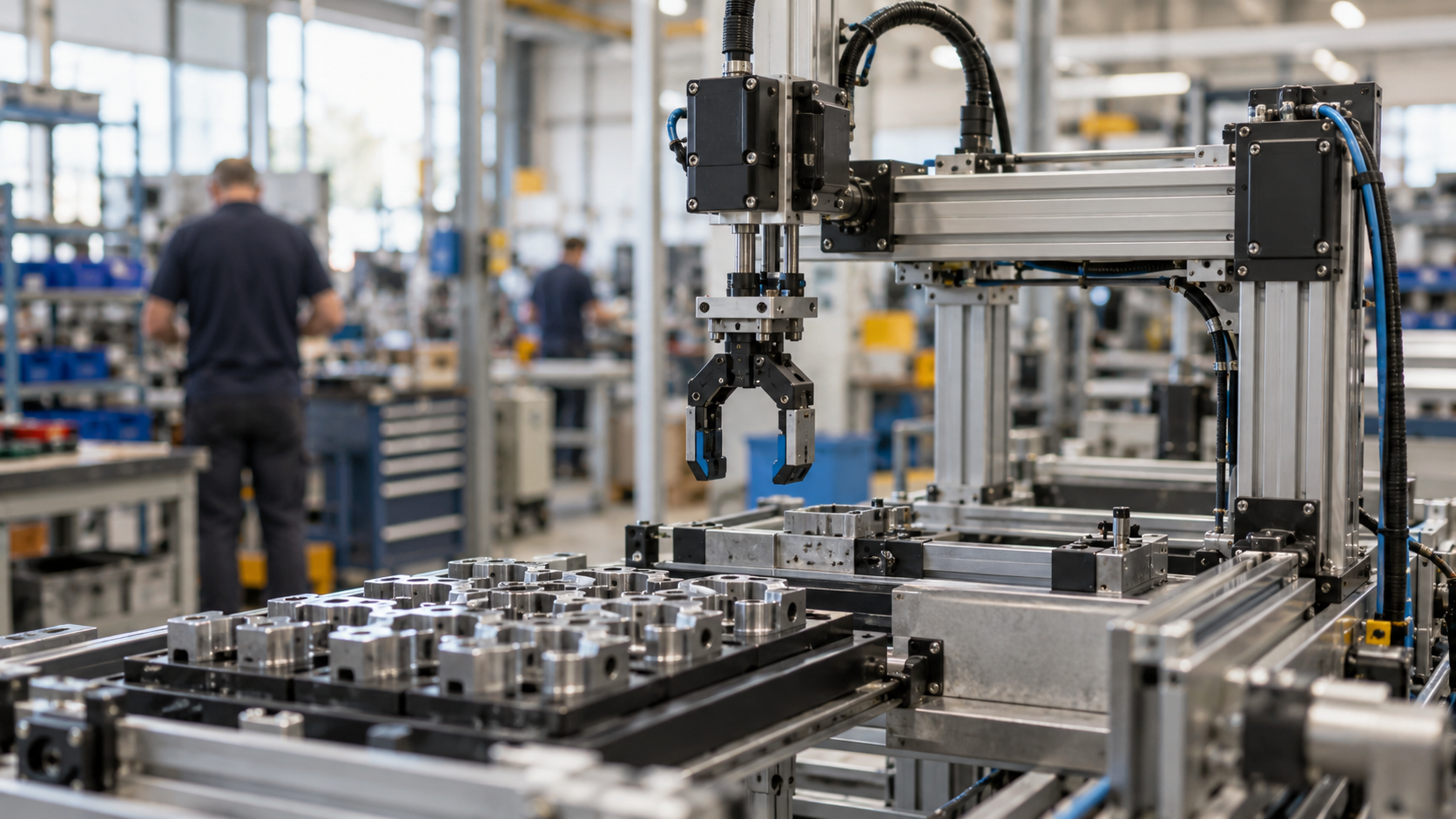
The most expensive part of factory automation has never been the robot. It has been the engineering labour required to make the robot do one specific thing in one specific building. Industry pricing guides for 2026 put a bare collaborative arm at roughly $25,000 to $60,000, while the fully deployed cell, with controller, tooling, vision, safety assessment and integration, runs from $40,000 to $150,000, and past $200,000 for welding, painting or hazardous work. The rule of thumb integrators use is blunt: budget a turnkey multiplier of 2.5x to 4x the price of the arm itself. The hardware is a minority line item. Everything else is people.
That ratio is the whole story. It explains why automation has concentrated in automotive, electronics and logistics, sectors with enough unit volume to amortise a six to twelve month custom integration project across millions of parts. It also explains the vast unautomated remainder: the mid-sized manufacturer running four hundred SKUs, the food processor whose product changes seasonally, the workshop where a ten per cent design revision would render a bespoke machine scrap. For those operations the machine was never too expensive. The engineering to specify it was.
The humanoid answer, and why it is the wrong shape. The fashionable solution to the integration bottleneck is to eliminate integration entirely by building a machine shaped like the worker it replaces. If the robot has two legs, two arms and five fingers, the theory runs, it can be dropped into a factory built for humans without changing the factory. Capital markets have found this argument persuasive. Tesla has stated a target of 50,000 Optimus units in 2026 at $20,000 to $30,000 each, with an internal cost ambition below $20,000 at scale. Unitree already sells its G1 at around $16,000 and its lighter R1 at roughly $5,900. Figure, valued in the tens of billions, has moved from a ten month pilot of its Figure 02 at BMW’s Spartanburg plant to deployment of the Figure 03 on production logistics.
The Spartanburg numbers are genuinely good, and deserve to be treated as such rather than dismissed: better than 99 per cent placement accuracy per shift, an 84 second cycle time met, more than 90,000 parts loaded across some 1,250 operational hours. But note what the task is. Part sequencing in production logistics is picking things up and putting them down in the right order. It is the most humanoid-flattering task on a car line, and it took ten months of pilot work at one of the most automation-sophisticated plants on earth to reach it. Bank of America’s 2026 analysis puts the real unit cost of a humanoid in a Western factory pilot at $90,000 to $100,000, roughly four to five times the aspirational sticker price, and reported operating economics of around $25 per robot-hour are an amortisation assumption rather than an observed steady state.
The International Federation of Robotics, which has no incentive to talk down robots, has publicly questioned whether humanoids constitute an economically viable and scalable business case for industrial applications. Two of its objections are structural rather than temporary. There is still no humanoid safety standard, and in a regulated factory an unstandardised machine near people is a liability question before it is an engineering one. And dexterous five-fingered grasping at industrial reliability, meaning the ninth decimal place rather than the demo reel, remains unsolved. A bipedal machine also spends most of its actuation budget on not falling over, which is a cost the task does not require.
Stack compression is happening, just not where the cameras are pointed. The more interesting development is that the integration cost itself is being attacked from four directions simultaneously, in the same way full stack web development collapsed from a five person team to one person with good tooling.
The first is computational design. Topology optimisation and generative design in nTopology, Altair Inspire and Fusion’s generative module already produce load-optimised geometry that no human would have drawn, and they are in production use today. The second is hardware standardisation. Aluminium extrusion, bus-connected smart servos speaking EtherCAT or exposed through ROS 2, and commodity depth cameras have turned the mechanical layer into something closer to assembly than machining. The third is additive fabrication. Carbon-fibre-reinforced polymer and laser-sintered metal mean a bespoke gripper or hopper is an overnight print at tens of dollars rather than a billet machined for thousands. The fourth is spatial foundation models. Physical Intelligence has open-sourced its π0 family; Google shipped Gemini Robotics-ER 1.6 in April 2026 with improved spatial reasoning and multi-view understanding, alongside an on-device variant that runs locally on bi-arm hardware without a network connection.
Two of those four pillars carry real weight today. Two do not. Honesty about which is which is what separates an investment thesis from a press release. Modular hardware and additive fabrication are mature, boring and deployable this quarter. The other two are further back than the marketing suggests.
Text-to-CAD, the promise that a model watches a video of a worker and emits manufacturable geometry with inverse kinematics and stress analysis attached, is not there. The current generation handles simple single-part geometry well enough for hobbyists and printing enthusiasts, and most of what is marketed as AI CAD generation in 2026 still will not produce a file an engineer would confidently send to a machine shop. The real time savings today come from the unglamorous end: part search, knowledge retrieval from an existing vault, and design validation. Similarly, zero-shot manipulation is a directional claim rather than a delivered capability. In zero-shot evaluation without fine-tuning, π0.5 achieved an average task progress rate of about 42 per cent. That is a remarkable research result and an unacceptable production number. What works commercially is few-shot: Gemini Robotics can acquire new behaviours from as few as a hundred demonstrations. A hundred demonstrations is a morning’s work for a line supervisor. It is also not zero.
The arithmetic still favours the bespoke rig. Correct for the hype in both columns and the comparison holds. A traditional integrated cell is $45,000 to $250,000 and six to twelve months. A humanoid is $90,000 to $100,000 per unit at real cost, plus months of pilot integration, and it works at roughly human speed with a large surface area of mechanical failure. A task-specific rig built from standard extrusion, three bus-connected servos, a printed gripper and a fine-tuned vision policy occupies a different order of magnitude on both cost and time, and it runs at machine speed rather than human speed because it was never asked to balance, walk or look reassuring. The humanoid’s genuine advantage is adaptability across tasks. The bespoke rig’s advantage is that it is cheap enough to be wrong about. If the product changes, you reprint the gripper and retrain the policy over a weekend rather than writing off a capital asset.
The strategic dimension is the one Western policymakers keep missing. China installed 295,000 industrial robots in 2024, some 54 per cent of the global total, and operates a stock of roughly two million units, around four and a half times Japan’s. That lead is in conventional high-volume automation, and it is not going to be reversed by matching it unit for unit. Western Europe leads on robot density at 267 units per 10,000 manufacturing employees against North America’s 204, which reflects a manufacturing base of high-mix, high-margin, lower-volume production. That base is precisely the segment the traditional integration model priced out, and precisely the segment cheap bespoke automation addresses. The competitive opening is not the million-unit line. It is the long tail of ten thousand small manufacturers who could never justify a $250,000 cell and can justify a $15,000 one.
Whoever supplies the toolchain for that tail, the design layer, the standardised actuator bus, the fine-tuning pipeline for spatial models, captures a structurally more defensible position than whoever ships the most humanoids. Toolchains compound and lock in. Hardware commoditises, and Chinese manufacturers have demonstrated repeatedly that they will set the floor price on any component that becomes standardised. Betting Western industrial policy on winning a unit-cost race against Unitree is a category error.
What to watch. Three indicators will settle this faster than any forecast. First, publication of a humanoid safety standard, which would remove the single largest regulatory obstacle and materially change the deployment curve. Second, a text-to-CAD system whose output passes a real design review and reaches a machine shop unedited, which is the gate on the whole automated mechanical engineering thesis. Third, a fine-tuning workflow that a line technician rather than a robotics PhD can run end to end. Until the third exists, the bottleneck has moved rather than disappeared, from mechanical engineers to machine learning engineers, and scarce specialist labour is still what governs the price.
The likely outcome is not one robot doing a thousand things. It is a thousand hyper-specialised rigs, each doing one thing flawlessly, generated by a software stack that treats a machine as a build target rather than a capital project. Humanoids will have a real market in the genuinely unstructured spaces where no fixed rig makes sense. That market is large. It is simply not the factory floor, and the capital currently being allocated on the assumption that it is will be redistributed accordingly.
Read our full Report Disclaimer.
Report Disclaimer
This report is provided for informational purposes only and does not constitute financial, legal, or investment advice. The views expressed are those of Bretalon Ltd and are based on information believed to be reliable at the time of publication. Past performance is not indicative of future results. Recipients should conduct their own due diligence before making any decisions based on this material. For full terms, see our Report Disclaimer.