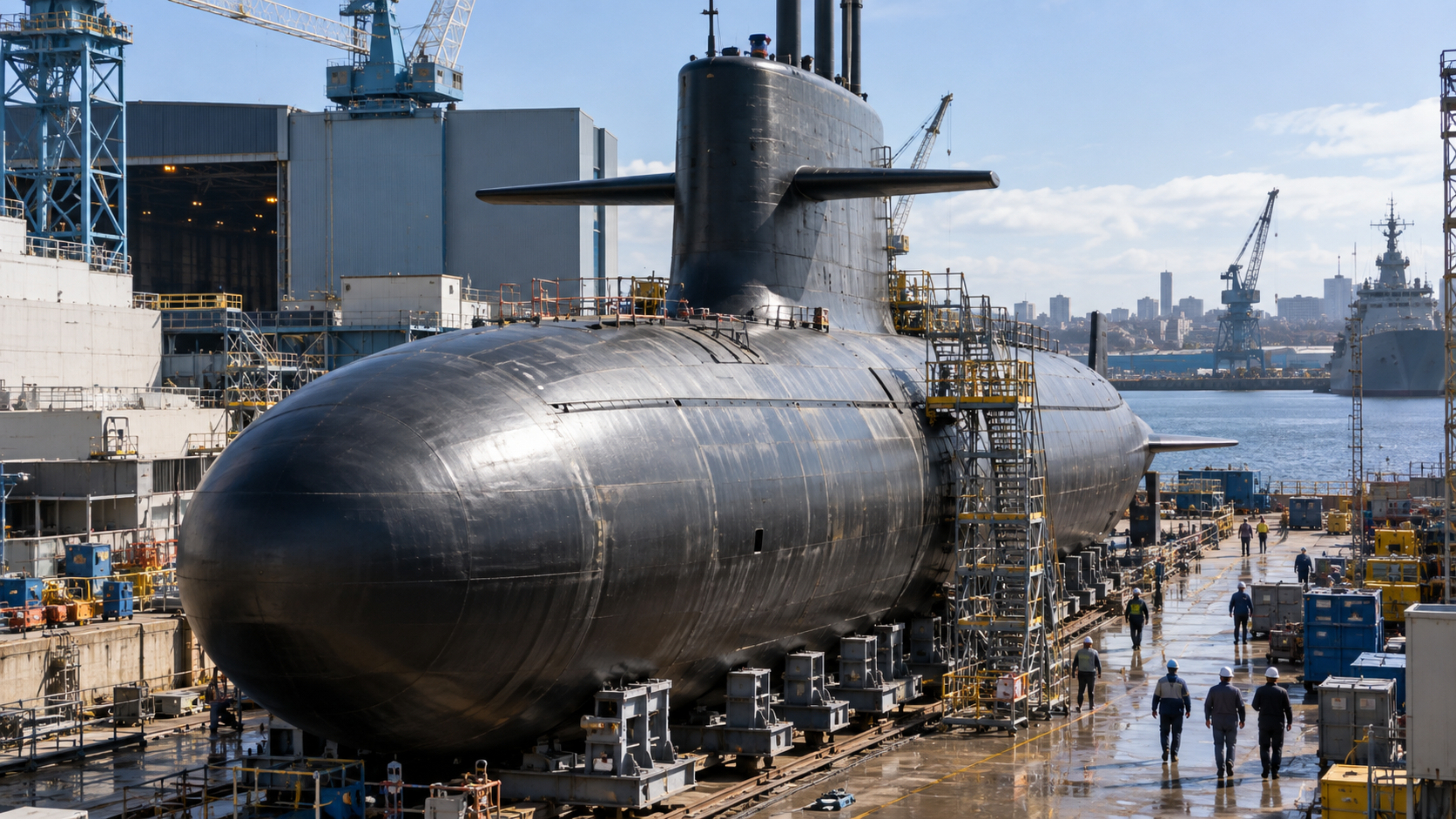
On 29 October 2025, in Gyeongju, the United States and the Republic of Korea quietly rewrote seventy years of non-proliferation doctrine. A joint fact sheet endorsed Seoul’s construction of a nuclear-powered attack submarine and affirmed Korean rights to civil uranium enrichment and spent-fuel reprocessing. The submarine, Donald Trump told reporters, would be built in Philadelphia. The fuel-cycle language, buried in the trade communique alongside a $350 billion Korean investment commitment and a tariff cut from 25 to 15 percent, was the more consequential sentence. It conceded the holy grail of half a century of ROK nuclear diplomacy. It also reframed the central security question of Northeast Asia. The argument over whether South Korea will openly build a bomb is the wrong argument. The real question, and the one Washington will have to answer by 2027, is what to do about a Korea that no longer needs to.
The Polling Floor Has Moved. The Asan Institute’s March 2026 wave of its annual survey put South Korean public support for an indigenous nuclear deterrent at 76.2 percent, the highest figure in the sixteen years Asan has run the question and a 5.3-point jump on 2025. Support for the redeployment of US tactical nuclear weapons reached 66.3 percent, the second-highest reading since 2013. These are not protest numbers driven by a single Pyongyang test. They have sat above 60 percent for three consecutive years, surviving administrations of opposite ideological colour and the convulsion of December 2024. Asan’s conditions-based work shows that a majority will pay four of five plausible costs of nuclearisation, including sanctions and reduced US troop presence, before support collapses. The only cost that breaks the consensus is the prospect of warheads stored or tested in their own neighbourhood. The political class has registered the shift. No mainstream candidate now treats nuclear discussion as taboo.
The Yoon Inheritance. The Washington Declaration of 26 April 2023 was meant to be the off-ramp. It established a Nuclear Consultative Group, promised the regular visibility of strategic assets including ballistic missile submarine port calls, and gave Seoul a consultative voice on US nuclear employment on the peninsula. It did not deliver the substance: no warheads on Korean soil, no joint custody, no NATO-style dual-key. Yoon Suk-yeol traded indigenous ambition for institutional inclusion. The bargain detonated on 3 December 2024, when Yoon declared martial law at 22:27 local time and watched the National Assembly vote 190-0 to lift it before dawn. He was impeached on 14 December by a margin of 204 to 96, removed unanimously by the Constitutional Court on 4 April 2025, and convicted of insurrection in February 2026. The episode did more than end a presidency. It destroyed the credibility of the conservative coalition that had bet the country’s deterrence on American extended assurance.
Lee’s Pivot, Quietly Executed. Lee Jae-myung won the June 2025 snap election as a centre-left progressive whose campaign rhetoric leaned toward inter-Korean engagement and a phased denuclearisation framework. In office he has done something more interesting. His government has accepted Trump’s transactional logic and used it to extract structural concessions the Yoon administration could not. The Gyeongju package was the clearest evidence: nuclear-powered submarines, civil enrichment, reprocessing rights, accelerated transfer of wartime operational control. The 2026 defence budget, set at 65.86 trillion won (roughly $44.7 billion), rises 7.5 percent year on year, with R&D up 19.4 percent to 5.84 trillion won. Lee has publicly committed to a path from 2.32 percent of GDP today toward 3.5 percent. None of this is framed as weaponisation. All of it is the infrastructure of latency.
The Pyongyang Curve. The strategic backdrop is no longer disputed. The Korea Institute for Defense Analyses now estimates between 80 and 90 assembled North Korean warheads, fissile material sufficient for up to 166 by 2030, and a declared regime target of 300. The Hwasong-19 solid-fuel ICBM was flight-tested on 31 October 2024. The Hwasong-20, unveiled in October 2025 with a reshaped nose cone suggestive of a multiple-warhead bus, has not yet flown but is the system most ROK analysts assume gives Pyongyang assured intercontinental coverage of the continental United States. The Pukguksong-5 submarine-launched variant claims a 2,000 to 3,000 kilometre range. In April 2026 Pyongyang test-fired ballistic missiles armed with cluster-munition warheads, a deliberate signalling that the conventional and nuclear thresholds are blurring on its own terms. South Korean planners no longer model a North Korea that can be denuclearised. They model one that can only be deterred.
The Latent Stack. A Japan-style latent capability does not require a test. It requires four things, and Seoul now has or is close to having each. First, the fuel cycle: the 2015 revision of the 1974 US-ROK 123 Agreement permitted research-scale pyroprocessing at the Korea Atomic Energy Research Institute and procedural enrichment under joint consent. The October 2025 fact sheet upgrades that consent posture before the agreement’s 2035 expiry, giving Seoul time and political cover to industrialise. Second, delivery: the May 2021 termination of the bilateral missile guidelines, in place since 1979, removed the 800 kilometre range and 500 kilogram warhead caps. The Hyunmoo-5, deployed from 2024, carries an eight-tonne conventional warhead at sub-800 kilometre range and is widely assessed as capable of 3,000 kilometres or more with a lighter payload. Third, platforms: the KF-21 Boramae received final combat-suitability certification on 7 May 2026, with first ROKAF deliveries scheduled in the second half of the year and 40 Block I airframes through 2028. Fourth, propulsion and naval reach: the Philadelphia-built submarine.
Beijing’s Calculus. China has signalled, through Track II channels and the state press, that it will treat even civilian Korean enrichment as a proliferation event. The 2017 THAAD precedent established the floor: an unofficial tourism and retail embargo that cost the ROK economy an estimated $7.5 billion before partial normalisation. Seoul’s planners assume that floor again, plus naval pressure in the West Sea and the Ieodo zone. The asymmetry is that the Korean public, polled repeatedly by Asan and the Chicago Council, now accepts that cost as the price of strategic autonomy. Tokyo’s reaction is the inverse problem. A Korean breakout would compress the political timeline for Japanese nuclearisation debates that have already moved from the fringe to the LDP mainstream after the 2025 Taiwan Strait war scare. Beijing knows it. The question Beijing has not answered is whether sanctions on Seoul accelerate or deter the cascade. The internal evidence suggests Politburo opinion is split.
Washington’s Three Doors. The second Trump administration has, perhaps inadvertently, narrowed its own options. The Gyeongju concessions cannot be revoked without rupturing the bilateral relationship Trump has staked $350 billion of inbound investment on. Door one is NATO-style nuclear sharing: forward-deployed US warheads under American custody with Korean dual-capable delivery aircraft. This would satisfy roughly 60 percent of the Korean public per Asan’s conditional polling and slow latency development. It would also reopen the Korean Peninsula as a nuclear theatre for the first time since George H.W. Bush’s 1991 withdrawal. Door two is acceptance of the latent posture: tacit acknowledgement that Seoul holds the screwdriver and that the alliance benefits from constructive ambiguity. Door three is the unstated one: a Korea that conducts a cold test of a nuclear device in 2027 or 2028 under a doctrine of “minimal demonstration,” accepts a year of Chinese economic punishment, and emerges as a de facto sixth Asian nuclear power. The probability weighting between these doors is the only forecasting exercise that matters for Northeast Asian markets, energy contracts, and force posture through the end of the decade.
The Verdict. Seoul will not break out openly in 2027. It will not have to. The latent stack, complete in all but the final warhead-assembly step by the end of 2028, achieves the deterrent effect at one-tenth the diplomatic cost. The defining decision is therefore not in Seoul but in Washington, where the choice between formal sharing and quiet acceptance must be made before the 2027 NCG review and the 2028 Korean presidential cycle. A Trump administration that has already conceded the fuel cycle, the propulsion reactor, and operational control transfer has little leverage left to refuse a politely worded request for B61 deployment. The likeliest 2027 outcome is a hybrid: a token US warhead presence in Korea wrapped in NCG language, paired with an unspoken understanding that Korean latency will not be challenged. That settlement will not be stable. It will, however, be the settlement.
Read our full Report Disclaimer.
Report Disclaimer
This report is provided for informational purposes only and does not constitute financial, legal, or investment advice. The views expressed are those of Bretalon Ltd and are based on information believed to be reliable at the time of publication. Past performance is not indicative of future results. Recipients should conduct their own due diligence before making any decisions based on this material. For full terms, see our Report Disclaimer.