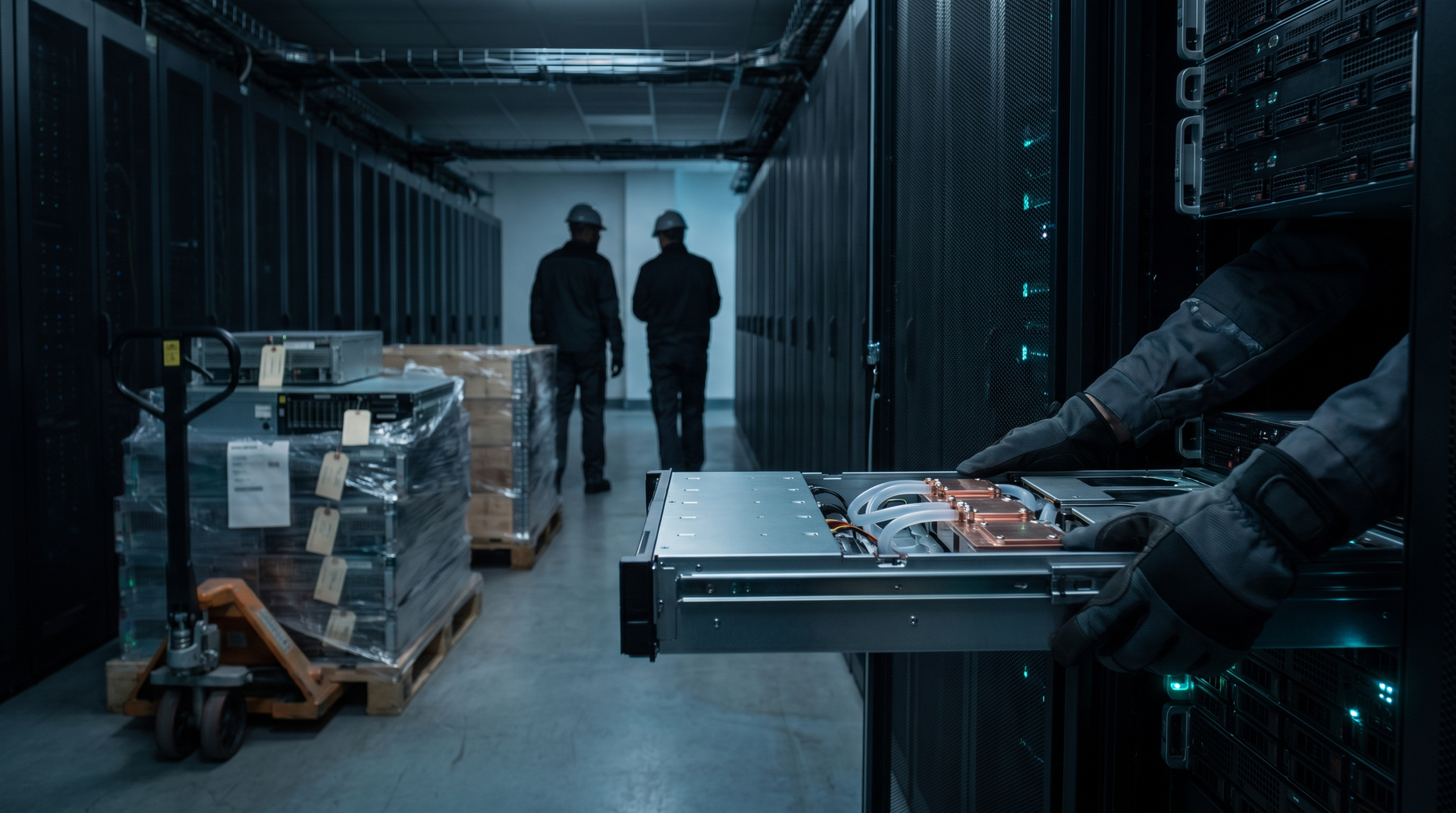
In August Nvidia began production shipments of Vera Rubin, and told investors that the new platform delivers 35 times lower token cost than Grace Blackwell Ultra, the generation it replaces. For most of Nvidia’s history a claim like that was simply good news. Faster chips pushed customers to upgrade, and the cost of obsolescence landed on buyers who could absorb it: gamers, corporate IT departments, and technology giants paying from cash flow. That is no longer the market Nvidia serves. A large and growing share of its hardware is now bought with borrowed money, and the value of that hardware, which is also the collateral behind the loans, depends on the one variable Nvidia controls absolutely: how soon it makes the last generation look expensive.
The Clock and the Collateral
Nvidia has moved its data centre roadmap to an annual rhythm: Blackwell, then Blackwell Ultra, Vera Rubin this year, Rubin Ultra slated for 2027 and Feynman for 2028. Jensen Huang made the commercial logic explicit at GTC in March 2025, when he joked that once Blackwell shipped in volume, “you couldn’t give Hoppers away.”
The Bank of England has identified why that joke now matters to financial stability. Its July Financial Stability Report cited a JPMorgan estimate that more than $2 trillion of funding may be needed for AI chips over the next five years, and warned that “chips have short and uncertain lifecycles.” Debt matched to the life of the asset, the Bank noted, “would imply shorter tenors than are typically preferred by most credit investors.” Lenders want long paper; Nvidia’s product calendar shortens the life of what secures it. The Bank conceded that the evidence is mixed: shortages argue for longer useful lives, rapid efficiency gains for shorter ones. Today the shortage is winning. Nvidia’s chief financial officer, Colette Kress, said last November that A100s shipped six years ago were still running at full utilisation. But shortage is a condition, not a business model. Nvidia expects supply to remain a bottleneck at least through its 2028 fiscal year, which ends in January 2028. When supply catches up with demand, the cadence becomes the price.
Two Costs of Capital, One Chip
The damage is not distributed evenly. The largest technology companies now borrow heavily too: Amazon, Alphabet, Meta and Oracle issued about $194 billion of bonds between January and early July, against about $108 billion in the whole of 2025, according to Reuters. But they borrow at spreads of roughly 40 to 120 basis points over Treasuries, against operating cash flows that roughly cover their spending.
The specialist GPU clouds operate on different terms. CoreWeave’s unsecured notes sold in April carry a 9.75% coupon, and Bretalon examined last week how the bond market has since repriced the company’s debt as distressed. For a hyperscaler, a new Nvidia generation is a competitive weapon: it can buy Rubin, cut the price of inference, and move older chips onto internal workloads. For a leveraged neocloud renting the previous generation, the same launch cuts the market price of what it sells while its interest bill stays fixed. The one escape, a contract that passes obsolescence risk to a creditworthy customer, is real: CoreWeave’s $8.5 billion loan facility in March, secured on a contract with an unnamed AI customer, was rated investment grade and priced at 225 basis points over SOFR. But contracts expire, and capacity that must be re-let is priced against whatever the next generation has done to the market.
The Customers Who Want to Leave
Nvidia’s revenue is concentrated in exactly the customers with the means and the motive to replace it. Last quarter, hyperscale customers produced $49 billion of Nvidia’s $89 billion in data centre revenue. Each of them is building an exit.
Amazon says its chips business has passed a $25 billion annual revenue run rate. Anthropic has agreed to take up to 5 gigawatts of Amazon capacity across Trainium generations, and OpenAI has committed to about 2 gigawatts of Trainium from 2027. Anthropic has also committed $125.2 billion to a five-year lease of Google tensor processing units. Meta announced in March four new generations of its own MTIA accelerators over roughly two years, and says it can ship a new chip every six months or less. Microsoft plans production deployments of its Maia 300 in 2027. OpenAI unveiled its first Broadcom-built inference chip in June. TrendForce estimates that systems built on custom chips will make up about 28% of AI server shipments this year, approaching 40% by 2030.
Huang’s reply, on the August earnings call, was that these are “inference-specific chips for one cloud or one service,” while Nvidia sells a platform that runs everywhere. That is true, and it identifies the problem rather than solving it. The hyperscalers do not need a universal platform. They need cheaper inference for their own services, and every Nvidia generation sold to them at speed funds the data centres in which their own silicon will eventually displace Nvidia’s.
The Franchise Network
The neoclouds have no such exit. CoreWeave, Nebius and Lambda told The Information this year that they did not expect to deploy Google’s TPUs any time soon, even as Google said it would sell them for use in customers’ own data centres. Their entire proposition is access to Nvidia’s hardware, software and networking. They are independent companies, but in economic terms they function as Nvidia’s distribution network: they find the land, the power and the capital, take the construction and financing risk, and sell Nvidia compute to customers who do not want to depend on a hyperscaler.
Nvidia’s management describes the relationship in almost exactly those terms. “We don’t own a cloud ourselves,” Kress told analysts in August. “We are a neutral partner to every sovereign and neocloud.” Nvidia, she added, “helped CoreWeave, Nebius, and Nscale build entire infrastructure businesses.” The segment that includes these customers produced $40 billion of revenue in the quarter, up 138% on the year, and Nvidia expects its neocloud partners to end 2026 with 8 gigawatts of installed capacity, up from about 3 gigawatts at the end of 2025. Unlike the hyperscalers, these customers are structurally loyal. They cannot design a replacement, and they do not want to.
The Underwriter of Last Resort
Nvidia is already paying to hold this network together, which is the clearest evidence that the risk is real. It invested $2 billion in CoreWeave in January and has agreed to buy CoreWeave’s unsold capacity through April 2032. It put $2 billion into Nebius in March, and in 2025 agreed to pay Lambda about $1.5 billion over four years to rent back its own GPUs. In August it disclosed a new structure in which it provides a take-or-pay commitment on part of a neocloud facility’s capacity, a minimum revenue guarantee that “gives lenders the confidence to underwrite the project,” in exchange for a share of revenue above the floor. It has invested nearly $50 billion in frontier laboratories, will provide credit enhancement for nearly 2 gigawatts of compute for one of them, and has signed memoranda with six investment firms, among them Apollo, Blackstone and KKR, for financing platforms meant to raise more than $500 billion of outside capital. “We know some will call this circular financing,” Kress said. “We see it differently.”
Kress’s defence was that Nvidia’s risk is limited because its platform “is fungible and durable and can be redeployed.” That is the contradiction in one sentence. Nvidia’s financing model depends on its hardware holding value. Its product model depends on persuading the market, every twelve months, that last year’s hardware is obsolete. Nvidia cannot sell 35-fold improvements and durable collateral to the same audience indefinitely. Every guarantee it writes turns its own release calendar into a liability on its balance sheet.
The Case for a Slower Clock
The obvious objection is competitive. Meta is iterating every six months, and its rivals will not pause out of courtesy. An Nvidia that withheld its improvements would hand the custom-silicon programmes the window they have been waiting for.
The objection is weaker than it appears. The custom chips compete for the hyperscalers’ internal workloads, a market Nvidia is losing at the margin regardless of how fast it moves. They barely compete for the neocloud market, which Nvidia already owns and which its cadence is damaging. The rational answer is a two-speed Nvidia: keep the architecture racing at the frontier where the hyperscalers and laboratories fight, but put the platform sold to independent clouds on a two-to-three-year commercial cycle, matched to the tenor of the debt that pays for it and backed by long software support and guaranteed residual values. Nvidia applies the principle already. Describing a SoftBank Energy campus whose initial 4.25 gigawatts will serve OpenAI, Kress said the site secures a long-lived asset “while the NVIDIA Compute within the data center can be upgraded repeatedly.” That works when the building is the collateral. For a neocloud, the chips are the collateral, and the same discipline has to reach the chip calendar.
The alternative is predictable. Gartner said last week that more than 80% of neocloud providers will stop operating independently by 2030. Consolidation means stronger balance sheets buying distressed capacity, and the strongest balance sheets belong to the hyperscalers. A neocloud credit crisis would not destroy demand for compute. It would transfer Nvidia’s most loyal distribution network, at a discount, to the companies spending most heavily to make Nvidia unnecessary. For a firm whose dominance rests on being indispensable, that is the outcome to avoid, and the release calendar is the lever that decides it.
Read our full Report Disclaimer.
Important notice
Bretalon Ltd is not authorised or regulated by the Financial Conduct Authority. This report is published free of charge as general commentary. It is not investment, financial, legal or tax advice, not an investment recommendation, and not an invitation or inducement to engage in investment activity. Do not rely on it, in whole or in part, to make investment or other decisions; take independent advice from a suitably qualified professional. It reflects information available on its publication date, and its assessments of companies, securities and markets are opinion, not fact. It was drafted with AI from researched briefs and the cited sources, its illustration is AI-generated, and it was approved for publication by a person acting for Bretalon Ltd, which takes editorial responsibility for it. Bretalon Ltd does not assume any duty of care to readers. Read the full Report Disclaimer and AI Transparency Notice.