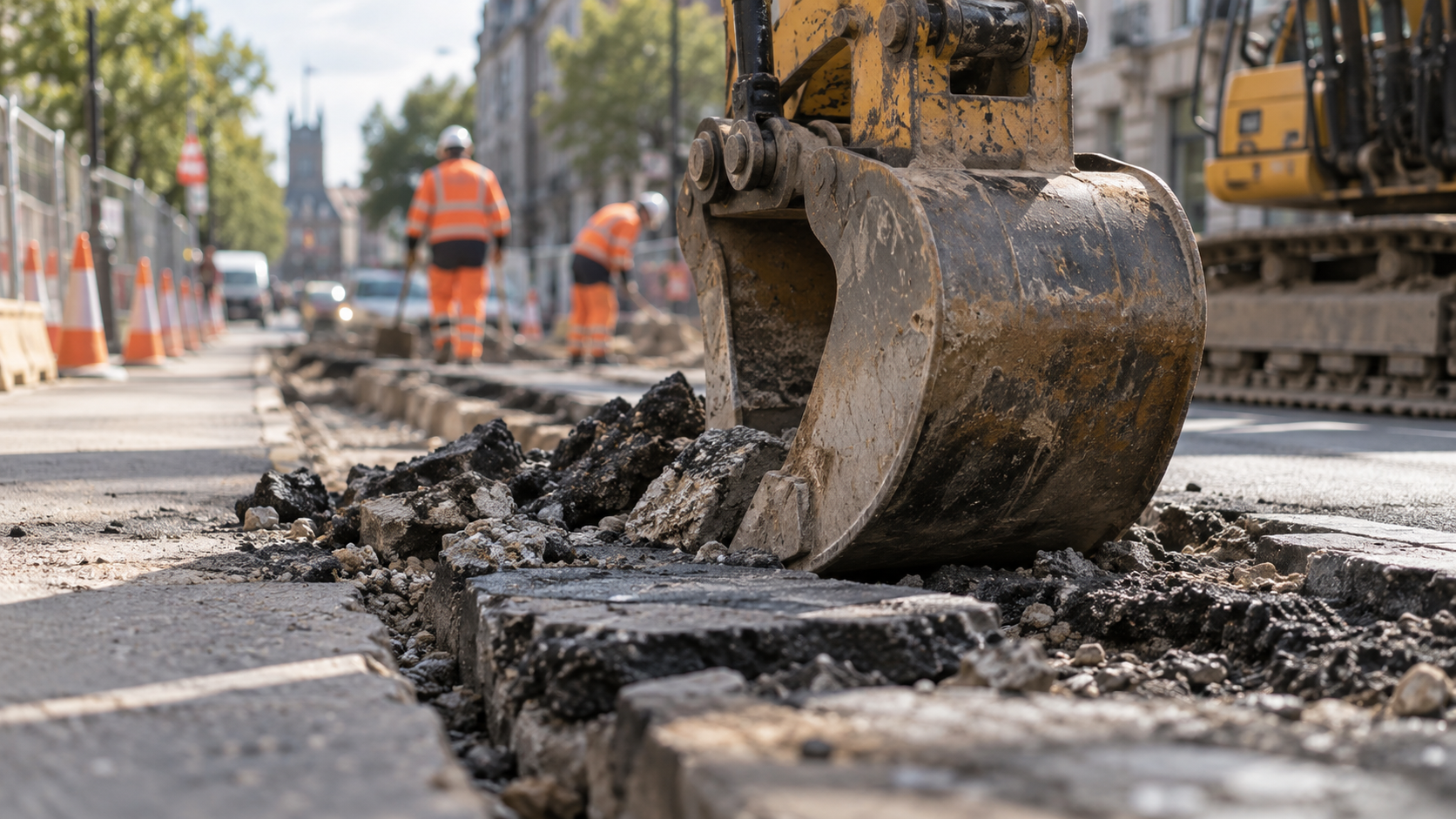
The growth debate in the developed world is fought on the wrong battlefield. Politicians, economists and the financial press treat productivity, new capacity and headline projects as the measure of national vitality, while the actual constraint sits one layer beneath the surface narrative. The rich world has accumulated a vast stock of physical capital, namely roads, pipes, bridges, grids, hospitals and schools, and is now structurally incapable of maintaining it. The American Society of Civil Engineers estimates that bringing all eighteen of its assessed infrastructure categories to a state of good repair would cost roughly $9 trillion, and that even at current funding levels the United States faces an investment shortfall on the order of $3.7 trillion across the coming decade. These are not numbers for new ambition. They are the bill for standing still. The defining economic problem of mature economies is not how to build the future; it is how to keep the past from collapsing.
The Asset Base Has Quietly Become a Liability
Every developed nation spent the postwar decades pouring concrete. The American interstate system, the British motorway and water networks, the German autobahn and rail, the Japanese expressways and seawalls were largely built in the three decades that followed 1950. Physical infrastructure has a design life, commonly fifty to seventy-five years for bridges and anywhere from fifty to a hundred for buried water mains, and the entire cohort is now aging out at roughly the same time. The asset that once compounded national output has flipped sign. It now generates a continuous, non-negotiable maintenance liability that grows whether or not anyone funds it.
The pattern is consistent across borders. In England and Wales the local road repair backlog runs to roughly $25 billion, with the industry’s annual survey estimating that a full catch-up would take more than a decade of sustained work even if conditions stopped deteriorating. Germany’s KfW Municipal Panel records a perceived investment backlog among municipalities of around $250 billion, of which roads and transport alone account for more than $60 billion. The United States Environmental Protection Agency’s most recent drinking water needs survey identifies $625 billion of work required over twenty years simply to keep taps running safely. None of this expands capacity by a single lane, gallon or kilowatt. It is the cost of preserving what citizens already believe they own.
The crucial point is that deferred maintenance is not a static figure that can be cleared once. It is a compounding liability. A pothole left unrepaired becomes a structural road failure; a small leak becomes a main burst; a roof defect becomes a closed hospital ward. The economics of repair are governed by a brutal nonlinearity. Postponing upkeep does not save money; it converts a cheap, predictable expense into an expensive, unpredictable one. Public-sector estimates in the United Kingdom have put the cost premium of deferral at well over half the original repair bill within a few years of neglect.
The Unglamorous Economics of Repair
Maintenance is the worst-structured expenditure a state can face. Its benefits are invisible, since a bridge that does not fail produces no ceremony, while its costs are immediate and recurring. New construction, by contrast, offers a discrete, photographable asset with a clear political author. The result is a systematic bias in capital allocation toward the new and against the existing, even when the return on a dollar of maintenance vastly exceeds the return on a dollar of expansion.
This bias has a financial logic that reinforces it. Capital projects can be debt-financed, ribbon-cut and attributed to a single administration. Maintenance is an operating expense, funded from constrained annual budgets that compete directly with salaries, services and pensions. When a fiscal squeeze arrives, the line that can be cut without immediate visible consequence is upkeep. The deferral is rational for any individual budget cycle and catastrophic in aggregate over decades.
The healthcare estate illustrates the trap precisely. England’s National Health Service carries a maintenance backlog above $20 billion, of which the high-risk portion, namely defects that pose a genuine danger to patients or staff, has climbed from a little over $1 billion roughly a decade ago to several times that figure today. Yet investment to reduce the backlog has consistently lagged the rate at which it grows. At recent funding levels, clearing it would take the better part of two decades, and only on the unrealistic assumption that it stopped expanding. This is the maintenance economy in microcosm: the highest-return safety spending in the system loses every budget fight to more visible priorities.
The Labour Squeeze Behind the Money
Even where the money exists, the hands do not. Maintenance is skilled-trade labour: electricians, pipefitters, welders, heavy-equipment operators, structural specialists. This workforce is aging faster than almost any other segment of the developed economy. In the United States, roughly one in five electricians is older than fifty-five, and on current trajectories about one in four skilled tradespeople is expected to retire by the end of the decade. Industry analyses point to a national shortfall measured in the hundreds of thousands of workers, with some projections of well over a million unfilled trades positions within a few years.
The replacement pipeline is thin by design. Two generations of policy and culture in the rich world steered talent toward university degrees and white-collar work, treating the trades as a residual. Apprenticeship entry now runs far below the rate of retirement; by some industry counts, only around two workers enter for every five who leave. The institutional knowledge held by departing workers, namely how a specific grid, plant or tunnel actually behaves, leaves with them. Money can be appropriated in a single budget; a master electrician takes the better part of a decade to train. Capital is liquid and fast. Skilled labour is sticky and slow.
This is why the maintenance crisis cannot be solved by spending alone, and why very large infrastructure funds, such as Germany’s roughly $580 billion special vehicle for infrastructure and climate, routinely underdeliver against their headline figures. Pour capital into a labour-constrained system and the binding constraint simply moves from the budget line to the worksite, manifesting as cost inflation, delay and competition for the same scarce crews between maintenance and the more politically attractive new build.
Why Politics Rewards the Ribbon, Not the Repair
The incentive structure of democratic politics is almost perfectly designed to underfund maintenance. Electoral cycles run shorter than asset lifetimes, so the costs of deferral fall on successors while the savings accrue to the incumbent. A new station, bridge or hospital wing is a legible achievement with a clear author and a date attached. A decade of diligent repair leaves nothing to inaugurate and no one to credit.
Accounting conventions deepen the distortion. Public-sector budgeting typically separates capital from current spending, and the political reward attaches to the capital line. Few governments maintain a balance sheet that forces them to recognise the depreciation of national infrastructure as a liability accruing in real time, so it does not appear in the numbers that discipline behaviour. A nation can let its bridges silently decay for thirty years while reporting balanced operating budgets throughout.
The failure mode is therefore not corruption or incompetence; it is a coherent response to the incentives in place. Each individual decision to cut upkeep and fund a visible project is defensible on its own terms. The aggregate is a slow, systemic transfer of risk from the present to the future, paid eventually in catastrophic failures: a collapsed bridge, a contaminated water supply, a hospital that shuts an operating theatre because the roof above it is no longer safe.
The Strategic Cost of Decay
The geopolitical implication is uncomfortable for the Western bloc. Mature economies that cannot maintain their existing capital base will find their effective output constrained regardless of how much new investment they announce. A grid that cannot absorb new load, ports and rail that throttle freight, water systems that lose close to a fifth of their throughput to leakage: each is a tax on every transaction the economy attempts, invisible in the growth statistics yet real in the friction it imposes.
There is a competitive dimension as well. States building infrastructure from a low base enjoy a structural advantage. Their assets are young, their maintenance liabilities are decades away, and their skilled-labour pipelines are still expanding. The rich world sits in the opposite phase of the cycle, carrying the full weight of a mature, aging capital stock and a contracting workforce to service it. The long contest between systems will be decided less by who can build the most than by who can keep what they have already built functioning.
The strategic conclusion is that upkeep is not a second-order housekeeping concern but a central economic question of the developed world. The nations that hold their position will be those that build the institutions to fund and staff maintenance against the grain of their own political incentives: ring-fenced repair budgets insulated from electoral raiding, national balance sheets that make depreciation visible, and a deliberate, decade-long reconstruction of the skilled trades. The maintenance economy rewards the unglamorous and punishes the spectacular. That is precisely why so few governments are built to win it.
Read our full Report Disclaimer.
Report Disclaimer
This report is provided for informational purposes only and does not constitute financial, legal, or investment advice. The views expressed are those of Bretalon Ltd and are based on information believed to be reliable at the time of publication. Past performance is not indicative of future results. Recipients should conduct their own due diligence before making any decisions based on this material. For full terms, see our Report Disclaimer.