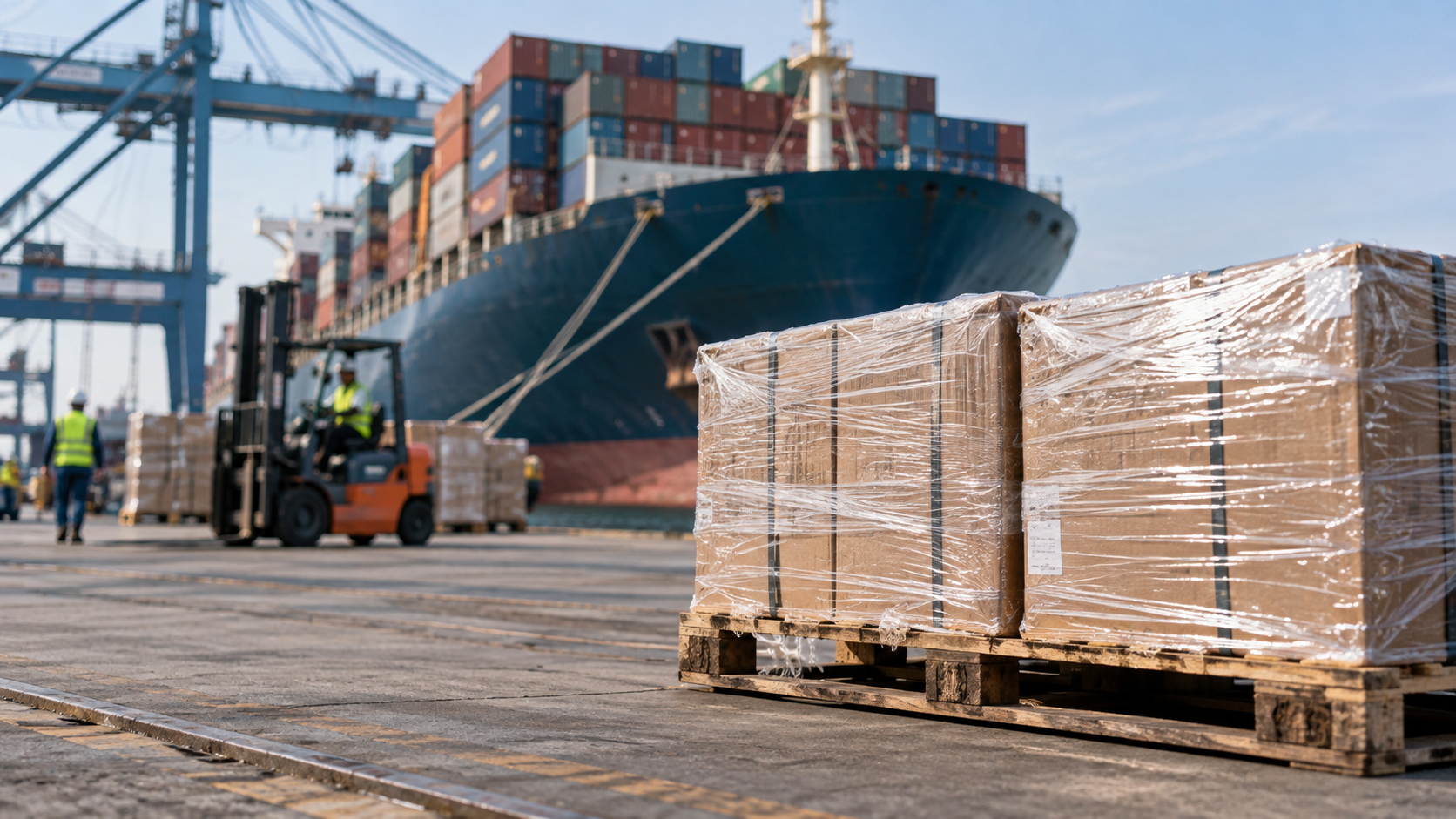
Consider the structural problem that sits beneath every cargo manifest on every container ship at sea. A textile mill in one country has agreed to ship goods to a buyer it has never met, in a jurisdiction whose courts it could never realistically reach, paid in a currency it does not control. The seller wants money before the goods leave the dock; the buyer wants the goods in hand before the money leaves the account. Neither will move first. This is not a minor friction. It is the fundamental obstacle to commerce between strangers separated by oceans, and for most of human history it was solved crudely, through family networks, ethnic trading diasporas, or simply not trading at all. Modern trade finance is the apparatus that dissolved that obstacle. It is the least visible and most consequential financial infrastructure on the planet, and by the World Trade Organization’s own estimate some 80 to 90 percent of world merchandise trade depends on it in some form.
The Trust Problem, Rendered Mechanical
The genius of trade finance is that it does not ask the two strangers to trust each other. It asks them, instead, to trust a shared intermediary, almost always a bank, whose entire business model rests on being more creditworthy than either party to the transaction. The classic instrument is the documentary letter of credit. The buyer’s bank issues a written undertaking to pay the seller a fixed sum, on the condition that the seller presents a precise set of documents proving the goods were shipped as agreed: the bill of lading, the commercial invoice, the insurance certificate, the inspection report.
The substitution is elegant. The seller no longer extends credit to an unknown foreign buyer; it relies on a bank’s promise. The buyer no longer wires money into a void; it pays only against documentary proof of performance. Banks deal in paper, not in cargo. A letter of credit transaction turns on whether the documents conform to the terms, not on whether the goods themselves are satisfactory. This is the doctrine of strict compliance, and it is what makes the system scalable: a credit officer in one financial capital can adjudicate a shipment originating thousands of miles away by examining whether a date, a description, and a signature match the agreed text.
Where parties already share a measure of confidence, lighter instruments suffice. A documentary collection routes the shipping documents through banks but without a bank guarantee of payment; the banks act as trusted couriers rather than principals. Open-account trade, in which the seller simply ships and invoices, dominates between established counterparties and accounts for the bulk of global flows, with letters of credit covering only around an eighth of world trade, on the order of two trillion dollars in annual value. The instrument chosen is, in effect, a thermometer of trust between the parties.
A Private Rulebook Older Than the Institutions That Use It
None of this would function without a common grammar. A bank in one legal system cannot afford to litigate the meaning of every clause against the contract law of another. The solution was not a treaty but a private code. The International Chamber of Commerce in Paris first published its Uniform Customs and Practice for Documentary Credits in 1933, and successive revisions have governed the field ever since. The current edition, known as UCP 600, runs to thirty-nine articles and is incorporated by reference into letters of credit across roughly 175 countries.
What is remarkable about UCP 600 is its status. It carries no force of law in any jurisdiction. It binds the parties only because they choose to write it into their contracts, and it endures because the alternative, a patchwork of incompatible national rules, would be intolerable to everyone. This is private ordering at planetary scale: a self-regulating standard, maintained by a banking commission rather than a parliament, that quietly governs the documentary terms of roughly a trillion dollars of trade each year. It is one of the clearest working examples of how the architecture of global commerce is built less on the visible scaffolding of states than on durable conventions agreed among the practitioners themselves.
From Letters of Credit to the Length of the Chain
The letter of credit is the historical core, but the modern frontier is supply-chain finance, which addresses a different problem: time. A supplier that has shipped goods may wait sixty or ninety days for payment, while its own costs come due immediately. Supply-chain finance lets that supplier be paid early, with a bank or a specialist platform advancing the invoice value at a discount, repaid later by the large buyer at the top of the chain. Because the financing is priced against the strong credit of the anchor buyer rather than the weaker supplier, capital flows down the chain to the firms least able to obtain it on their own.
This is genuinely useful and genuinely double-edged. The same technique that keeps a small manufacturer solvent can be used to disguise a buyer’s true leverage, recording what is functionally borrowing as ordinary trade payables. The episodic collapse of specialist supply-chain finance lenders has served as a recurring reminder that opacity, concentration, and aggressive accounting can turn a stabilizing instrument into a hidden fault line. The plumbing can leak in ways that are invisible until the floor gives way.
The Gap, and Who Falls Into It
For all its sophistication, the system rations its services. The Asian Development Bank’s recurring survey puts the global trade finance gap, the volume of requested financing that banks decline to provide, at roughly 2.5 trillion dollars, equivalent to about a tenth of global trade. The figure has widened materially over the longer run, from somewhere in the region of 1.5 trillion dollars a decade earlier.
The gap is not evenly distributed; it falls hardest on the firms least able to absorb it. Small and medium enterprises see roughly half their trade finance applications rejected, a rate far above the single-digit refusal rate faced by large corporates and multinationals, and women-owned firms fare worse still. The reasons are mostly structural rather than malicious. Anti-money-laundering and know-your-customer obligations make a small, unfamiliar borrower in an unfamiliar market expensive to underwrite, and the fixed compliance cost of approving a modest transaction often exceeds the revenue it generates. Faced with that arithmetic, banks retreat to the clients they already know. The result is a quiet, compounding bias in which the infrastructure of global trade is most available to those who least need help accessing it.
When the Plumbing Seizes
The clearest demonstration of how much rests on this hidden layer comes when it fails. In the financial crisis of 2008 and 2009, the freezing of interbank credit did not stay confined to mortgage securities and money markets. It propagated directly into the real economy of physical goods, because banks suddenly distrusted one another’s letters of credit. Confirmations that had been routine became unobtainable or punitively expensive, and cargo that buyers wanted and sellers were ready to ship sat idle because no one would underwrite the promise to pay. World trade contracted far more sharply than output did, a collapse out of all proportion to the underlying fall in demand.
Policymakers grasped the stakes quickly. At their London summit in 2009, the leaders of the Group of Twenty pledged at least 250 billion dollars of trade finance support, channelled through export credit agencies and the development banks, with the International Finance Corporation standing up a global trade liquidity program to backstop the flows. It was a revealing intervention. Governments that had spent the crisis rescuing banks and households now found themselves explicitly rescuing the plumbing of trust itself, because they understood that without it the goods simply stop moving, regardless of how willing buyers and sellers remain.
The Strategic Reading
Trade finance rewards attention precisely because it is engineered to escape it. When it works, it is invisible, and the visible world of ports, ships, and shelves appears to run on its own. But that visible world is a derivative of an underlying credit relationship, and whoever controls the credit relationship controls the trade. This is why sanctions that cut a country off from correspondent banking and documentary credit can strangle its commerce more effectively than any blockade of ships, and why the gradual emergence of alternative clearing and settlement arrangements is a matter of strategic consequence rather than mere financial plumbing.
The durable lesson is that physical trade is not, at bottom, a story about logistics. It is a story about the manufacture of trust between parties who have no reason to trust each other, performed by institutions and private rulebooks that almost no one outside the field can name. The goods move because the trust moves first. Understand who supplies that trust, on what terms, and to whom it is denied, and you understand a great deal about where economic power actually sits, and where, quietly, it is shifting.
Read our full Report Disclaimer.
Report Disclaimer
This report is provided for informational purposes only and does not constitute financial, legal, or investment advice. The views expressed are those of Bretalon Ltd and are based on information believed to be reliable at the time of publication. Past performance is not indicative of future results. Recipients should conduct their own due diligence before making any decisions based on this material. For full terms, see our Report Disclaimer.