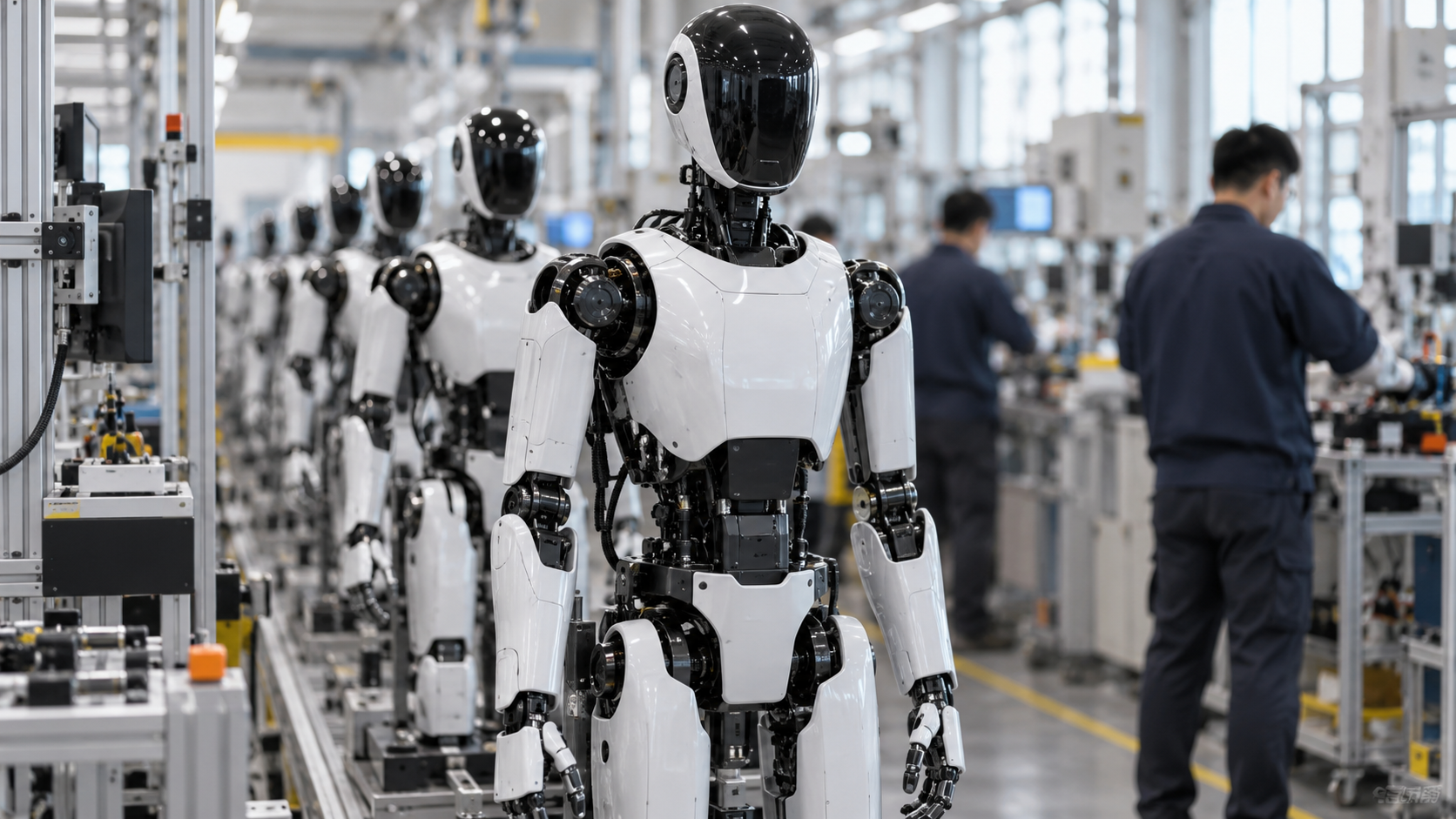
On 30 March 2026, AgiBot, the Shanghai humanoid robot manufacturer formally registered as Zhiyuan, rolled its ten thousandth unit off the line. The company had passed the five thousand milestone only three months earlier. Eight days before, on 21 March 2026, its larger rival Unitree had filed paperwork in Shanghai for a 4.2 billion yuan, roughly 608 million dollar, initial public offering on the STAR Market, disclosing 1.2 billion yuan of revenue and 105 million yuan of net income for the first nine months of 2025. Western analysts greeted both events as evidence of an industrial-policy contest with the United States, a new front in the technology cold war. That framing is wrong. China’s humanoid push is not principally a defence story or a status competition with Silicon Valley. It is a labour-substitution programme, dictated by a demographic collapse that is already in motion and that no fertility policy can now reverse.
The Arithmetic of the Vanishing Worker. China recorded 7.92 million births in 2025, less than half the 18.3 million registered in 2016 and the lowest figure since the founding of the People’s Republic in 1949. Total fertility has sat below 1.0 for two consecutive years, putting the mainland in the same band as South Korea, Taiwan, and Singapore. The working-age population peaked in 2014 at roughly 925 million; on current trajectories it will fall to about 700 million by 2050 and below 400 million by the end of the century. Deaths have outstripped births every year since 2022. The population stood at 1.404 billion at the end of 2025, three million lower than the year before, and the Apollo Group projects a working-age contingent shrinking from 900 million to 250 million across the long demographic horizon. The State Council’s own demographers expect the over-sixties cohort, already 310 million at the end of 2024 and 22 percent of the population, to pass 34 percent by 2050. China requires an estimated 2.2 million additional skilled eldercare staff today and has fewer than 500,000. The arithmetic permits no other policy lever. Immigration is politically excluded, fertility incentives have failed, and conventional automation cannot enter unstructured service environments. Humanoids are the residual variable.
Industrial Policy as Demographic Triage. Beijing’s reading of the problem is explicit. The Ministry of Industry and Information Technology and five sister ministries set a target in their 2025 Humanoid Robot Action Plan of 100,000 deployed humanoid units by 2027, with embodied intelligence named alongside biomanufacturing, quantum technology, and 6G as one of four designated future industries in the March 2025 government work report. The central state venture fund for robotics and artificial intelligence is sized at 138 billion dollars over fifteen years, with a parallel 100 billion yuan, 14 billion dollar municipal vehicle established by Beijing alone. Shanghai is targeting 50 billion yuan of embodied-intelligence output by 2027 and ten domestic robot brands at scale by 2025. Shenzhen committed a 10 billion yuan, 1.4 billion dollar AI and robotics fund in February 2025 and is steering capital toward ten companies valued above 10 billion yuan apiece. The sector raised 4.45 billion yuan, around 614 million dollars, across 27 financing rounds in January and February 2025 alone. A national eldercare-robot pilot launched in June 2025 obliges participating firms to place 200 units in 200 households for trial periods of at least six months. The policy stack is not aspirational; it is operational, sequenced, and budget-backed.
The Manufacturers Already on the Line. Unitree shipped more than 5,500 humanoids in 2025 for a 32.4 percent share of global unit volume by TrendForce’s count, with the G1 priced at 13,500 dollars, the H1 at around 90,000, and a June 2025 Series C co-led by Alibaba, Tencent, China Mobile Capital, Ant Group, and Geely Capital lifting the implied valuation toward seven billion dollars. AgiBot’s accelerator path from 5,000 to 10,000 units in ninety days is the steepest production ramp recorded in the segment. UBTECH began mass production of its Walker S2 in November 2025 against an order book exceeding 800 million yuan, with units deployed at Audi, NIO, and Zeekr factories under the company’s BrainNet swarm-control system. Xiaomi has committed to placing CyberOne descendants across its own captive manufacturing footprint within five years. Fourier Intelligence is preparing the GR-2 for mass production in 2026. TrendForce estimates Unitree and AgiBot will together capture roughly 80 percent of domestic shipments in 2026, and Chinese firms in aggregate are expected to manufacture more than 10,000 units in 2025, accounting for over half of global output.
The Western Counterweight is Thin. The American programme is sharply concentrated in three companies, with a fourth in residual deep-research mode. Figure raised more than 1 billion dollars in a Series C closed September 2025 at a 39 billion dollar post-money valuation led by Parkway Venture Capital with NVIDIA, Microsoft, Intel Capital, Brookfield, and Bezos Expeditions participating; its Figure 02 unit logged more than 1,250 runtime hours and 90,000 parts handled across an eleven-month BMW Spartanburg deployment that contributed to 30,000 X3 vehicles. Apptronik closed a 520 million dollar Series A extension in February 2026 at a 5 billion dollar valuation, lifting total Series A funding to 935 million dollars, with Mercedes-Benz and Google as strategic backers and the Apollo robot targeted at commercial-scale deployment during 2026. Tesla is committing 20 billion dollars of capital expenditure in 2026, much of it for Optimus, but Elon Musk acknowledged on the last earnings call that the platform remains in research and development; the headline target of 50,000 units in 2026 is aspirational against an installed base near zero. Boston Dynamics, under Hyundai ownership since the 2021 acquisition for roughly 1 billion dollars, has unveiled a new electric Atlas and is contracted to scale production to 30,000 units annually by 2028. Outside these four, the Western lineup is thin: bench depth, supply chain, and rare-earth integration sit decisively on the Chinese side.
The Productivity Race Decides the Contest. The conventional Western framing treats humanoids as a defence-adjacent technology, a robotics analogue to drone swarms or autonomous platforms. That framing flatters Western priorities and misreads Chinese ones. The Chinese state is not subsidising humanoids to win a tank-factory contest in 2035; it is subsidising humanoids because the working-age population is set to lose roughly 200 million people across the next two decades and the service-eldercare-light-manufacturing labour deficit cannot be closed any other way. The macroeconomic stake is direct. The IMF and World Bank both estimate that demographic drag will subtract around 0.5 percentage points from Chinese annual GDP growth across the next decade in the absence of compensating productivity. Humanoid deployment at the MIIT’s 100,000-unit 2027 mark would not close that gap; deployment at the unspoken 2030s scale, where Beijing is positioning the industrial base, plausibly would. The corresponding Western complacency, evident in Washington’s preference to think about humanoids as a national-security input rather than a productivity one, is the more dangerous error. America has not aged as quickly. American policymakers do not feel the pressure that explains Chinese urgency, and the venture-capital concentration around four firms reflects that.
The Verdict. The robot renaissance is a demographic intervention dressed in industrial-policy language, and treating it as a defence story misallocates Western attention. The productivity contest, not the silicon-and-missile one, determines whether the Chinese economy can carry a 34 percent over-sixty population without collapsing per-capita output, and it determines whether the West can hold its current lead in compound growth. On current trajectories China will deploy more humanoid workers, in more factories and households, more cheaply, and across a wider task envelope than any Western jurisdiction by 2028. Washington’s 39 billion dollar Figure valuation and Apptronik’s 5 billion dollar one are individually impressive and collectively insufficient. The geopolitical contest of the 2030s will not be lost to a Chinese tank or a Chinese chip. It will be lost, if it is lost, to a Chinese eldercare worker that does not need to be paid, fed, or replaced.
Read our full Report Disclaimer.
Important Notice
Bretalon Ltd is not a registered investment adviser or broker-dealer. This report is published free of charge as impersonal, general commentary in a publication of regular circulation. It is not investment, financial, legal, or tax advice, and not an offer or recommendation to buy, sell, or hold any security; no report recommends, rates, or values any specific security. Do not rely on it for investment or business decisions; always consult a qualified professional. It speaks only as of its publication date, and its views on companies, securities, and markets are analytical opinion, not fact. As of 22 October 2026, neither Bretalon Ltd nor those involved in its reports have ever been paid by any company a report discusses (unless expressly disclosed in the report). Those involved hold no direct positions in individual securities and hold any securities only through mutual funds and similar pooled or collective investment funds. Bretalon Ltd provides strategic advisory services to publicly listed and privately held companies under separate written agreements. This report was drafted with AI from public sources, its illustration is AI-generated, and it was approved for publication by a person acting for Bretalon Ltd. Provided "as is" without any duty of care to readers. Read our full Report Disclaimer.